But whoever causes one of these little ones who believe in me to stumble would be better off if he had been thrown into the sea with a heavy millstone hung around his neck. (Mark 9:42)
Word Focus
heavy millstone
μύλος ὀνικός / mylos onikos
<Hear It>
In this verse from the Gospel of Mark, Jesus warns his disciples against causing “one of these little ones” to stumble in their faith. Scholars have several opinions about the identity of the “little ones”. Some think it refers to children, but others think it refers to followers of Jesus. Most likely it refers to the latter and preventing them for doing good deeds in the name of Jesus. He regards this as a serious offense. So serious, that a quick death by drowning would be better than committing the offense. Jesus is using graphic language and a bit of hyperbole to underscore the seriousness of causing others to fail.
If the reference to drowning as a punishment seems arbitrary to us, it was not so to the disciples of Jesus. Drowning was a form of capital punishment used by the Romans, and a means of retribution against enemies in warfare as recorded in a number of historical accounts. What is unique to Jesus’ illustration is the addition of a millstone (μύλος / mylos <Hear It>) to hasten the drowning, which is the word focus for this post.
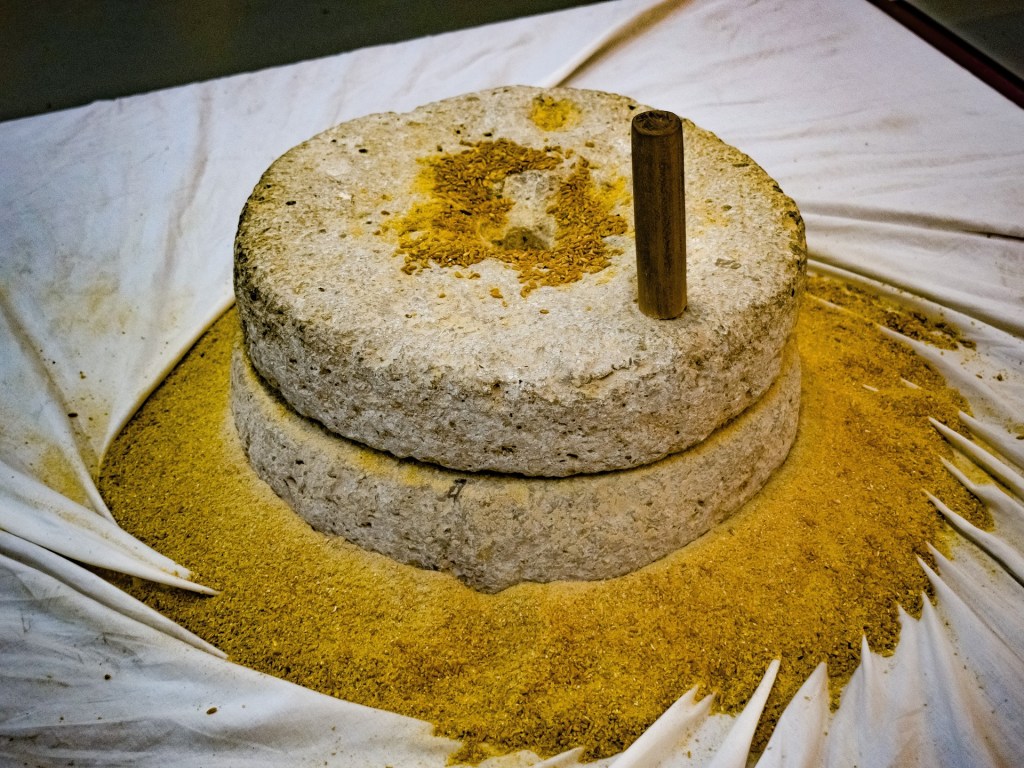
When you hear the word millstone, you might picture the millstone used by women in Biblical times that was used to make flour. As shown in the image above, there is a stationary lower millstone and an upper millstone that is rotated by a handle. The grain is poured into the hole in the center of the upper millstone and the action of turning the upper millstone grinds the grain into flour.
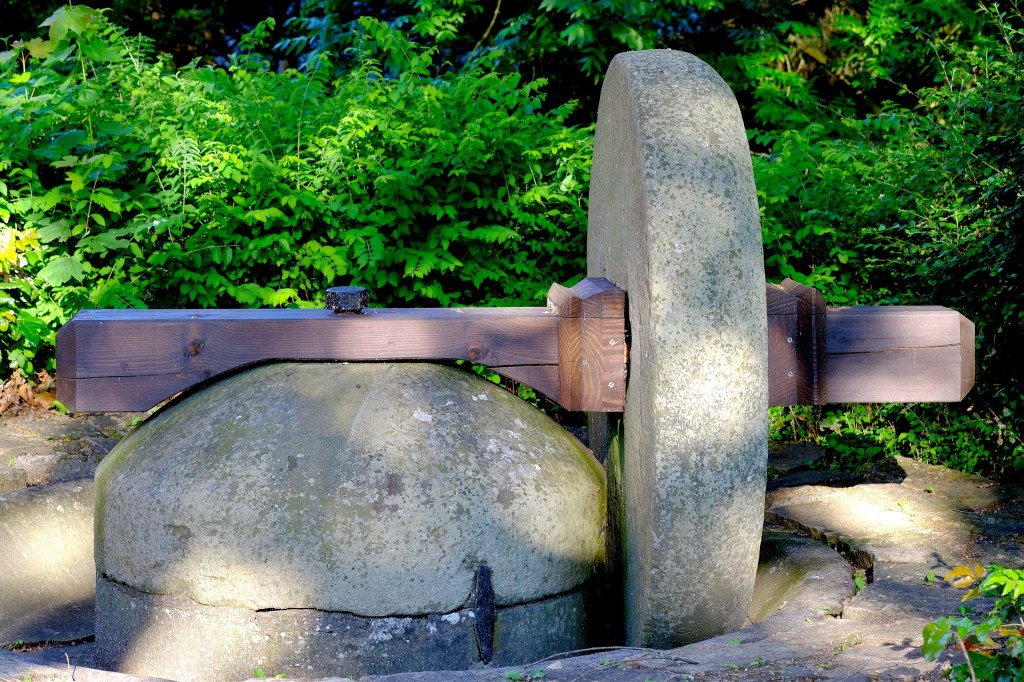
This would be a good visual for the millstone in this verse if it weren’t for the fact that there is an adjective that describes the millstone. Jesus calls it a heavy (ὀνικός / onikos <Hear It>) millstone. If you look up ὀνικός in a Greek lexicon you will find that it is an adjective that means “donkey” or “pertaining to a donkey.” In English the word “donkey” is occasionally used as an adjective in phrases such as “donkey brains,” “donkey engine,” and “donkey power.” So, in this verse Jesus describes the millstone as a “donkey millstone” – a millstone that is powered by a donkey. This would be a large or heavy millstone as shown in the image below, which is why the word is translated as “heavy,” “great,” “large,” or “huge” in English Bible translations.
Why did Jesus choose the larger millstone for his teaching? To make the image vivid and to emphasize the seriousness of causing others to fail.
When studying the Bible, remember that words must be understood in context. Always investigate words that modify or describe the word you are studying.
Word Focus Lexicon
Lexical Form: ὁ μύλος μύλου <Hear It>
Gloss: mill, millstone
Part of Speech: Second Declension Masculine Noun
New Testament Frequency: 4
Strong’s Number: G3458 (Link to Blue Letter Bible Lexicon)
Lexical Form: ὀνικός ὀνική ὀνικόν <Hear It>
Gloss: pertaining to a donkey
Part of Speech: Adjective
New Testament Frequency: 2
Strong’s Number: G3684 (Link to Blue Letter Bible Lexicon)
Unless otherwise noted, English translations of Bible verses are by the author from the Greek text and are not quotations from any copyrighted Bible version or translation.
 Koine Foundations
Leave a comment