Public domain, via Wikimedia Commons
42 They all ate and were satisfied. 43 Afterward the disciples gathered twelve baskets full of broken pieces of bread and fish. 44 The number of those that ate was 5000 men. (Mark 6:42-44).
8 Then the people ate and were satisfied, and they filled seven baskets with the broken pieces that were left over. 9 There were about 4000 people. (Mark 8:8-9)
Word Focus
basket
κόφινος / kophinos
<Hear It>
σπυρίς / spyris
<Hear It>
You are probably familiar with the accounts in the Gospels that record how Jesus broke and miraculously multiplied a few loaves of bread and several fish to feed large crowds that had gathered to hear him teach.
Chapter 6 in the Gospel of Mark reports how Jesus fed over 5000 people with five loaves of bread and two fish. At the end of this report, it says:
42 They all ate and were satisfied. 43 Afterward the disciples gathered twelve baskets (κόφινος) full of broken pieces of bread and fish. 44 The number of those that ate was 5000 men. (Mark 6:42-44).
Chapter 8 reports another incident where Jesus fed 4000 people with seven loaves of bread and a few fish. At the end of this report, it says:
8 Then the people ate and were satisfied, and they filled seven baskets (σπυρίς) with the broken pieces that were left over. 9 There were about 4000 people. (Mark 8:8-9)
Ever since I was a kid, whenever I read these accounts of Jesus feeding the crowds I always wondered, “Just how much did they pick up in leftovers? How big is a basket?”
There is no deep theology hidden in the word “basket”. Though the fact that there are baskets of leftovers from a meager initial supply of food shows that Jesus performed a miracle.
It is helpful to be able to picture an incident like this. These events happened over 2000 years ago, but when we read the accounts, we normally see the story in our minds in 21st century images. Understanding simple details, like what a basket looked like, helps us more accurately visualize the story.
Notice that two different words are used for basket: κόφινος in Mark 6:43 and σπυρίς in Mark 8:8. This means that one kind of basket was used to collect leftovers when the 5000 were fed and another kind of basket was used when the 4000 were fed. You can learn the difference by doing a little research in a good Greek lexicon and Bible dictionary. Just like today, basket sizes varied, but in general:
A κόφινος (12 filled in Mark 6:43) is a smaller wicker basket typically used by travelers to carry meals and other provisions while traveling – similar to how we use a backpack today. Jewish people commonly used this type of basket when they traveled. It held roughly 2 gallons.
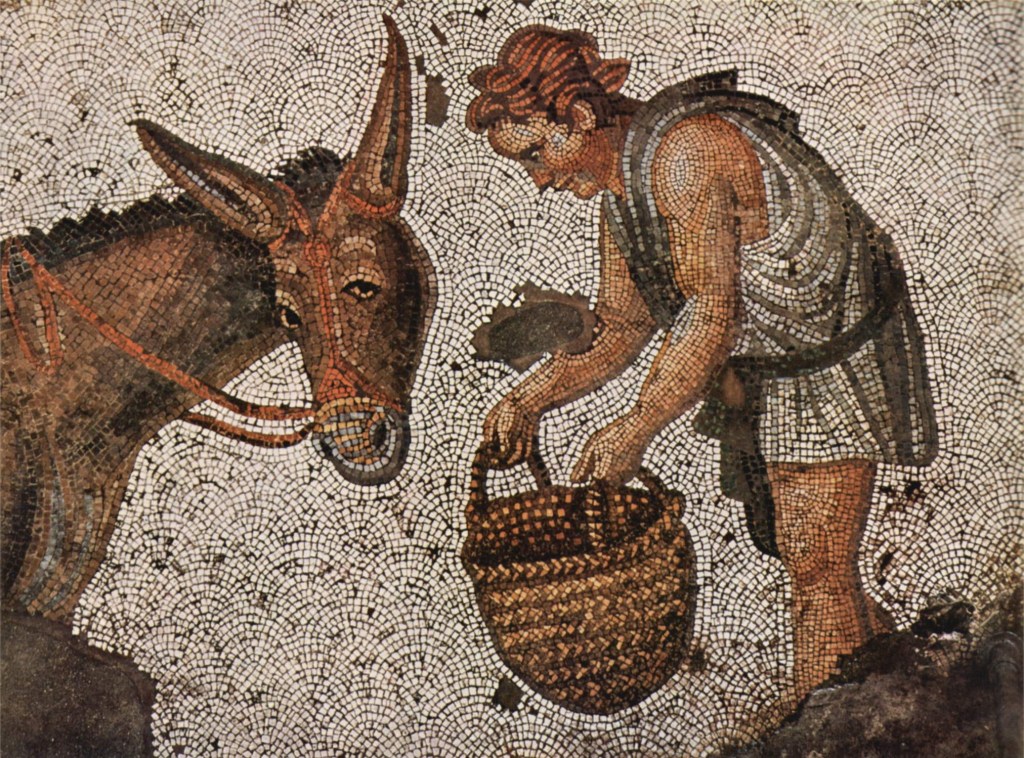
The image at the beginning of this post is of a Byzantine floor mosaic from the 5th or 6th century AD. It shows a boy feeding a donkey from a basket, which might be an example of the smaller κόφινος type basket.
A σπυρίς (7 filled in Mark 8:8) is a larger reed basket often used to store grain and other provisions. It could be large enough to hold a person, for Luke reports in Acts 9:25 that, “Paul’s disciples took him at night and let him down through an opening in the wall, lowering him in a basket (σπυρίς).” This was done to help him secretly escape a conspiracy to kill him.
Word Focus Lexicon
Lexical Form: ὁ κόφινος κόφινου <Hear It>
Gloss: basket (roughly 2 gallons)
Part of Speech: Second Declension Masculine Noun
New Testament Frequency: 6
Strong’s Number: G2894 (Link to Blue Letter Bible Lexicon)
Lexical Form: ἡ σπυρίς σπυρίδος <Hear It>
Gloss: [large] basket
Part of Speech: Third Declension Feminine Noun
New Testament Frequency: 5
Strong’s Number: G4711 (Link to Blue Letter Bible Lexicon)
Unless otherwise noted, English translations of Bible verses are by the author from the Greek text and are not quotations from any copyrighted Bible version or translation.


 Koine Foundations
Leave a comment