Photo by janeb13 on pixabay.com.
26 Now in the sixth month the angel Gabriel was sent by God to a town in Galilee named Nazareth, 27 to a virgin engaged to a man named Joseph, of the family line of David. The virgin’s name was Mary. (Luke 1:26-27)
Word Focus
angel
ἄɣɣελος / angelos
<Hear It>
Angels play an important role in the Christmas story and the birth of Jesus: the angel Gabriel visited Mary to tell her that she would give birth to a son (Luke 1:26ff); an angel appeared to Joseph to reassure him that marrying Mary was the proper thing to do and that her pregnancy was an act of the Holy Spirit (Matthew 1:18ff); an army of angels appeared to shepherds to announce the birth of Jesus the Savior (Luke 2:8ff); an angel warned Joseph to flee to Egypt with Mary and baby Jesus so that they would not be killed by Herod (Matthew 2:13ff); and an angel appeared again to Joseph to tell him to return to Israel because Herod was dead (Matthew 2:19ff).
In all the accounts listed above, the English word “angel” is a translation of the Greek word ἄɣɣελος / angelos, which means “messenger.” The Greek word can refer to a human or divine messenger. It is used about 175 times in the New Testament, but only 6* of these occurrences refer to human messengers. For example, when John the Baptist sent some of his followers to ask Jesus if he was the Messiah, they are called ἀɣɣέλων / angelōn <Hear It> (a plural form of ἄɣɣελος):
After John’s messengers (ἀɣɣέλων) left, Jesus began to speak to the crowds about John… (Luke 7:24)
Most of the uses of ἄɣɣελος in the New Testament refer to heavenly messengers, or what we typically call angels. Though the word is sometimes used in a more generic sense to mean “heavenly being” with little emphasis on the idea of being a messenger.
In the New Testament, heavenly angels are envoys of God who not only deliver messages but also perform specific missions or tasks such as rolling away the stone from Jesus’ tomb (Matthew 28:2) and freeing some disciples from prison (Acts 5:18-19, Acts 12:5-11). They carry out God’s will. Being all-powerful, God is not obligated to use angels, but He involves them in accomplishing His work, just as He does humans.
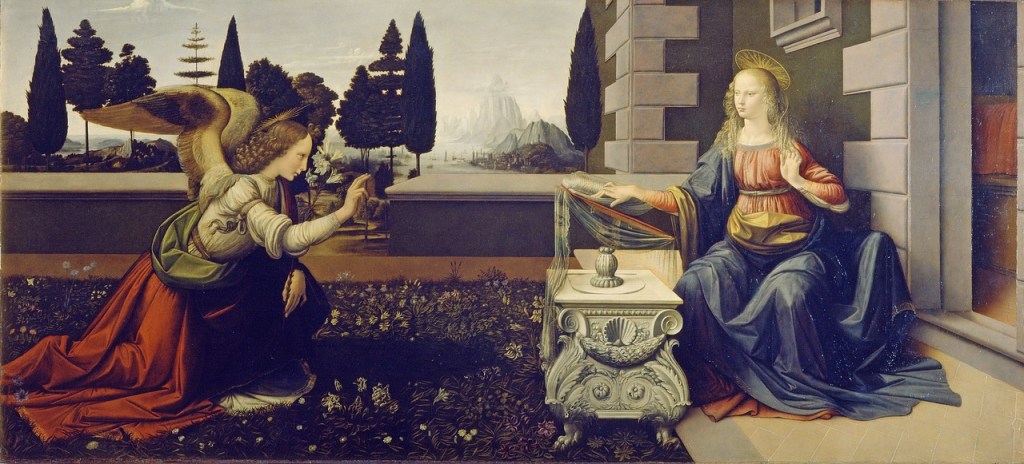
The image at the top of this post is of the painting The Annunciation by Leonardo da Vinci. It depicts the angel named Gabriel announcing to Mary that she will conceive miraculously and give birth to a son, who she is to name Jesus. The presence of angels in the birth, life and resurrection of Jesus imply his divinity, because the role of angels is to serve God.
*Note: Matthew 11:10, Mark 1:2, Luke 7:24, Luke 7:27, Luke 9:52, James 2:25. Perhaps 8 more occurrences also refer to humans. Scholars debate whether the seven “angels of the churches” mentioned in Revelation chapters 2 and 3 refer to heavenly angels or human church leaders.
Word Focus Lexicon
Lexical Form: ὁ ἄɣɣελος ἄɣɣελου <Hear It>
Gloss: messenger, angel
Part of Speech: Second Declension Masculine Noun
New Testament Frequency: 175
Strong’s Number: G32 (Link to Blue Letter Bible Lexicon)
Pronunciation Note: When there is a double Gamma (ɣɣ) in a word, such as in ἄɣɣελος, the first Gamma is pronounced like the ng in sing.
Unless otherwise noted, English translations of Bible verses are by the author from the Greek text and are not quotations from any copyrighted Bible version or translation.
 Koine Foundations
Leave a comment