19 So those who were scattered by the persecution that began because of Stephen, traveled as far as Phoenicia, Cyprus and Antioch, speaking the Word to no one other than Jews. 20 But there were some of them who came to Antioch, men from Cyprus and Cyrene, who were also speaking to the Greeks – announcing the Good News of the Lord Jesus. 21 The hand of the Lord was with them and a large number of people believed and turned to the Lord. (Acts 11:19-21)
Word Focus
Antioch
Ἀντιόχεια / Antiocheia
<Hear It>
If I asked you to name three important cities in the New Testament, your answer would probably start with Jerusalem and then include well know cities like Bethlehem, Nazareth, Rome, or Athens. Your list might include one of the cities to which a book of the New Testament was written like Corinth or Ephesus. But would you think of Antioch?
The Bible is a book of history that describes real people who lived in certain towns and countries and traveled from place to place. Countries, cities, towns, rivers, lakes and mountains are named frequently in the Bible in connection with important events. These geographic names are part of the inspired words of the Bible that help us understand what is written. However, we often read them and quickly move on to what we think is more important. We don’t stop to find out where places like Jerusalem, Bethlehem, Corinth or Antioch were located, or discover their history and relevance to what we are reading.
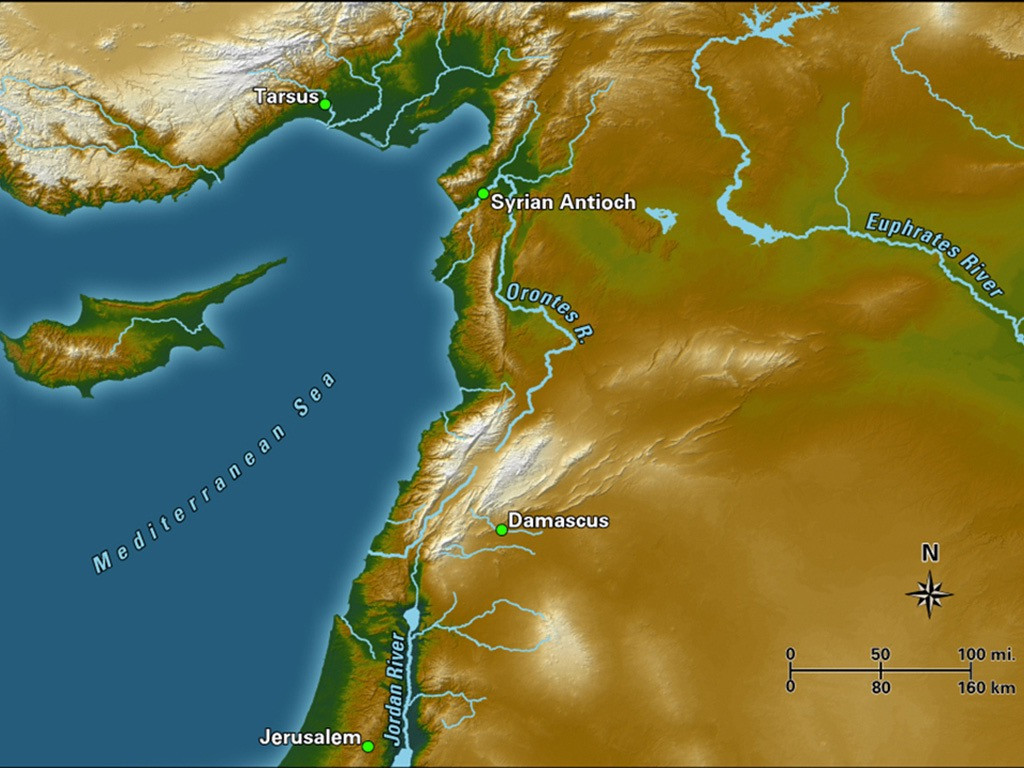
Antioch* is an example. It is mentioned 14 times in the Acts of the Apostles. It was located in Palestine about 300 miles north of Jerusalem and was the capital of the Roman province of Syria. Its ruins are located in present day Turkey near the Syrian border. Consider this:
- It was the third largest city in the Roman Empire, with a population of perhaps 500,000. Rome was the largest city and Alexandria, Egypt the second largest.
- It was located on major land and sea trade routes so that international trade from across the world passed through it. This made it a thriving economic and multicultural center.
- The Romans transformed the city by building a 80,000 capacity amphitheater used for chariot racing, a 30,000 seat horseshoe shaped stadium, a Roman style forum, public baths, aqueducts, and temples dedicated to Roman gods and goddesses. Antioch was no backwater town.
Antioch is first mentioned in the New Testament in Acts 11:19-21 (see verses at the top of this post). Severe persecution had broken out against followers of Christ in Jerusalem. It began when Stephen, a effective apologist for the Christian faith, was stoned to death (Acts 11:54ff). To avoid persecution, other followers of Christ scattered throughout the region, spreading the Good News wherever they went. However, their message was shared almost exclusively with Jewish people. But some of those who were scattered began to share the Good News with the Greeks living in Antioch. This was the lighting of a fuse that resulted in the explosion of the Christian faith to the rest of the world. Antioch became a major hub for the spread of Christianity. Consider this:
- All three of Paul’s great missionary journeys throughout the Roman Empire were launched from the church in Antioch. It was his home base. (Acts 13:1ff; Acts 15:40ff; Acts 18:23ff)
- Followers of Christ were called “Christians” for the first time in Antioch. (Acts 11:26)
- The first major doctrinal issue that the Church had to wrestle with had its roots in Antioch – how much of the Mosaic Law did Gentile Christians need to observe? The answer was decided by a council held in Jerusalem almost 2000 years ago and is still a basic doctrine of the Church today. (Acts 15:1-35)
Antioch was an important city with respect to the secular and the spiritual. Knowing something about the city helps us better understand the Bible passages where it is mentioned. So whenever you read the Bible, consult a map to identify where the geographic features are located. If there is travel, trace the movement on the map. Look up the name in a Bible dictionary to get historical and cultural information. These simple steps will enhance your reading of God’s Word.
*Note: There are two cities named Antioch mentioned in the New Testament. This post is about Syrian Antioch, also known as Antioch on the Orontes. It is mentioned 14 times in the New Testament. The other Antioch, known as Pisidian Antioch, was located in Asia Minor and evangelized by Paul on his first missionary journey. It is mentioned 4 times in the New Testament (Acts 13:14,19,21; 2 Timothy 3:11).
Word Focus Lexicon
Lexical Form: ἡ Ἀντιόχεια Ἀντιοχείας <Hear It>
Gloss: Antioch
Part of Speech: First Declension Feminine Proper Noun
New Testament Frequency: 18
Strong’s Number: G490 (Link to Blue Letter Bible Lexicon)
Pronunciation Note: When Tau (τ) follows Nu (ν), such as in Ἀντιόχεια, the Tau sounds like the d in den rather than the t in star.
Unless otherwise noted, English translations of Bible verses are by the author from the Greek text and are not quotations from any copyrighted Bible version or translation.
 Koine Foundations
Leave a comment