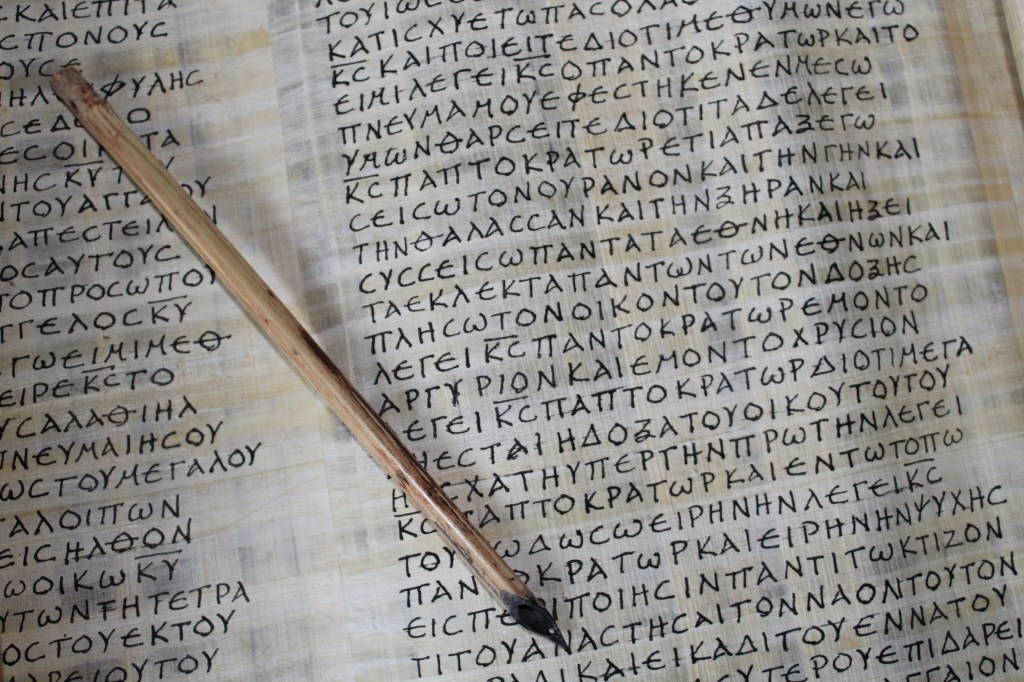
Pen, manuscript and photo by Matthew Jones.
13 I had many things to write to you, but I don’t want to continue writing to you with ink and reed pen. 14 But, I hope to see you soon and we will speak in person. (3 John 1:13-14)
Word Focus
reed pen
κάλαμος / kalamos
<Hear It>
The book of Third John is a short, personal letter written by the Apostle John to commend and encourage a prominent Christian named Gaius, who was providing generous hospitality to traveling teachers and missionaries. He was faithful in providing this service even though it certainly cost him time and money. He was also faithful in spite of opposition from another Christian leader named Diotrephes who was more interested in promoting himself than helping others. Click here to read the entire letter of Third John in the Blue Letter Bible. It takes less than two minutes.
John had many things he wanted to tell Gaius, but preferred not to write them in the letter (“with ink and reed pen”). Instead, he hoped to see Gaius soon and speak to him in person.
In 3 John 1:13 (see verse at top of post), the Greek word translated as “reed pen” is κάλαμος (kalamos ) which means “reed”. A κάλαμος is the woody stem of a tall grass, such as the water reeds that grew along the Jordan River. κάλαμος can refer to various things depending on the context in which it is used. For example:
- A actual reed of grass. See Matthew 11:7 where Jesus rhetorically asks the crowd if they expected John the Baptist to be like a reed (κάλαμος) shaken by the wind.
- A staff made from a reed. See Matthew 27:29 where the Roman soldiers mock Jesus by placing a staff (κάλαμος) in his right hand to pretend it is a royal scepter.
- A measuring rod made from a reed. See Revelation 21:15 where an angel has a golden measuring rod (κάλαμος).
- A writing instrument or pen (κάλαμος) made from a reed as in the key verses for this post and shown in the photo at the top of this post.
As demonstrated by κάλαμος, most words have a range of meanings. The particular meaning is always determined by the context in which the word is used.
Probably all the original copies of the New Testament Gospels and Epistles were written using a reed pen. It was the most common writing instrument from about the third century B.C. until the Middle Ages. Note that the quill pen made from a feather did not come into use until some time in the fourth or fifth century A.D.
Writers made their own reed pens by carving a dried reed to a sharpened point and making a slit in the point to hold ink. This is similar to our modern calligraphy pen with a metal nib. If you want to make your own reed pen, click here to view an excellent and entertaining YouTube video by an artist who explains how to make a reed pen. Cutting is required, so children must have adult supervision. If you cannot find suitable reed material growing in your neighborhood, you can probably purchase reeds or bamboo at a local craft store. You can even use a sturdy plastic soda straw. Also buy some calligraphy ink so that you can use your pen.
In the next post I will continue the word focus on writing by looking at ink.
Note: Plutarch (Greek philosopher, historian, biographer, essayist c. A.D. 46-119) in his biography on Demosthenes (Greek statesman, orator 384-322 B.C.), notes that Demosthenes had the habit of chewing on his reed pen when he was thinking and writing. Human nature hasn’t changed much in 2000 years!
Word Focus Lexicon
Lexical Form: ὁ κάλαμος καλάμου <Hear It>
Gloss: reed, staff, measuring rod, pen
Part of Speech: Second Declension Masculine Noun
New Testament Frequency: 12
Strong’s Number: G2563 (Link to Blue Letter Bible Lexicon)
Unless otherwise noted, English translations of Bible verses are by the author from the Greek text and are not quotations from any copyrighted Bible version or translation.
 Koine Foundations
Leave a comment