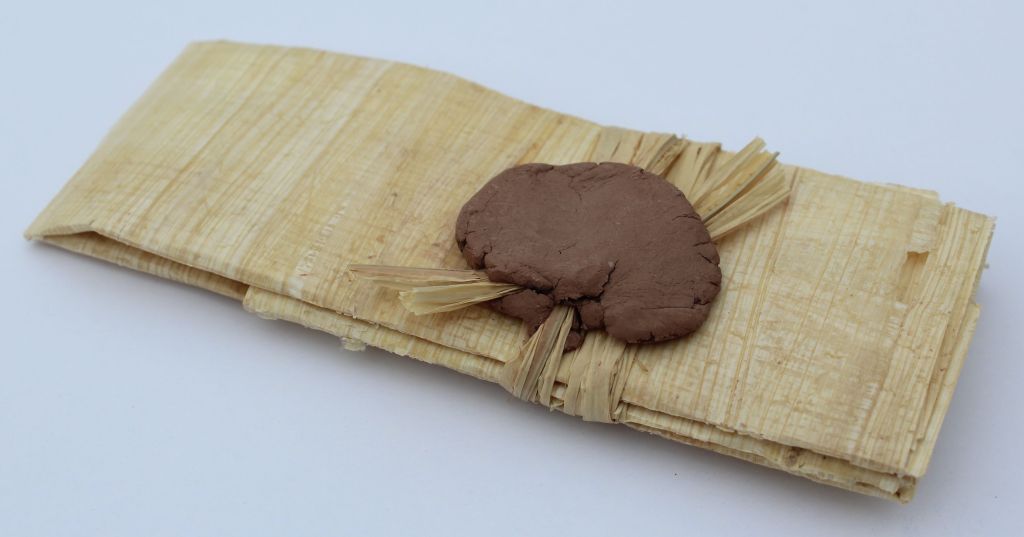
Reproduction and photo by Matthew Jones.
Then I saw a scroll in the right hand of the one seated on the throne. It had writing on the inside and on the back side and was sealed with seven seals. (Revelation 5:1)
Word Focus
seal
σφραγίς / sphragis
<Hear It>
In the Book of Revelation, the Apostle John recorded a vision about future events in the end times. What was revealed to him is described in highly symbolic language that details God’s final plan for the salvation of His people and the judgment of the wicked.
Early on in his vision (verse 5:1) he sees God seated on His throne with a scroll in His right hand. John describes two details about the scroll: 1) It had writing on both the inside and on the back side, and 2) it was sealed with seven seals.
In John’s day, scrolls were made of papyrus sheets glued edge to edge. In a previous post I explained that papyrus sheets were made by cutting the papyrus plant stems into strips and laying them side by side in two layers at right angles to one another. Because of the direction of the fibers in the papyrus, writing was usually only done on one side of the sheet where it would be parallel with the direction of the fibers. It was more difficult to write across the fibers. The written side would be the inside of the scroll when it was rolled up.
The scroll in John’s vision is somewhat unusual because it had “writing on the inside and on the back side,” which means it had writing on both sides. Paleographers call this type of scroll an opisthograph1 (opistho: “back” + graph: “writing”). Biblical scholars suggest that perhaps this symbolizes the fullness of the revelation on the scroll in John’s vision. Scholars also have various opinions about the content of the scroll, but perhaps it contained the comprehensive prophecy of the world’s destiny.
The other detail that John mentions about the scroll is that it was “sealed with seven seals.” In John’s day, a seal might consist of a clay lump pressed around the knot on the cord that was used to secure a document or letter. The photo at the top of this post shows a reproduction of a papyrus letter (epistle) that is folded, tied and sealed for privacy in this manner. Note that the cord is entwined within the letter so that it cannot be slipped off the end of the letter unless the seal is broken. This serves the same purpose as licking and sealing the flap on a modern envelope.
Seals were used for various reasons:
- As proof of identity. Seals placed on an object could be impressed with a mark or symbol identifying the owner of, witness to, or authority behind it.
- To guarantee the legal validity of documents such as deeds, wills, contracts, and bills of sale. This is comparable to the notarization process of a present day notary public who places a seal on a document for validation purposes.
- To confer accreditation or authorization by a legal or governmental authority regarding the contents of a document. For example, a ruling official might place a seal on a decree to show that its contents are authorized by the government and have the force of law.
- To guarantee privacy and security. For example, a sealed document or letter could not be tampered with or read without breaking the seal. An unbroken seal indicated the document was not opened or tampered with.
The scroll in John’s vision had seven seals. As you read further in John’s account, the events leading up to the end of the world are progressively revealed as each seal is broken. Multiple seals on a document was not unusual. For example, several witnesses to a will would all seal the original document. (The owner would probably also have an unsealed copy.) Scholars have various opinions as to why there were seven seals. Perhaps it symbolically represents that the scroll is completely tamperproof and its contents completely hidden from every human eye2. John notes that only the crucified and resurrected Jesus Christ is worthy to break the seals and open the scroll. Check a good commentary if you want to explore this more.
1Note: See Ezekiel 2:9-10 for another example of an opisthograph mentioned in the Bible. The prophet Ezekiel also sees a scroll written on both sides in his vision.
2A Commentary on the Revelation of John, George Elden Ladd, William B. Eerdmans Publishing Company, ©1972.
Word Focus Lexicon
Lexical Form: ἡ σφραγίς σφραγῖδος <Hear It>
Gloss: seal (the object used or the impression made by the object)
Part of Speech: Third Declension Feminine Noun
New Testament Frequency: 16
Strong’s Number: G4973 (Link to Blue Letter Bible Lexicon)
Pronunciation Note: When a single Gamma (γ) is followed by the vowels Epsilon (ε) or Iota (ι), or by the digraph Epsilon-Iota (ει) as in the word σφραγίς, the Gamma is pronounced like the y in yet.
Unless otherwise noted, English translations of Bible verses are by the author from the Greek text and are not quotations from any copyrighted Bible version or translation.
 Koine Foundations
Leave a comment