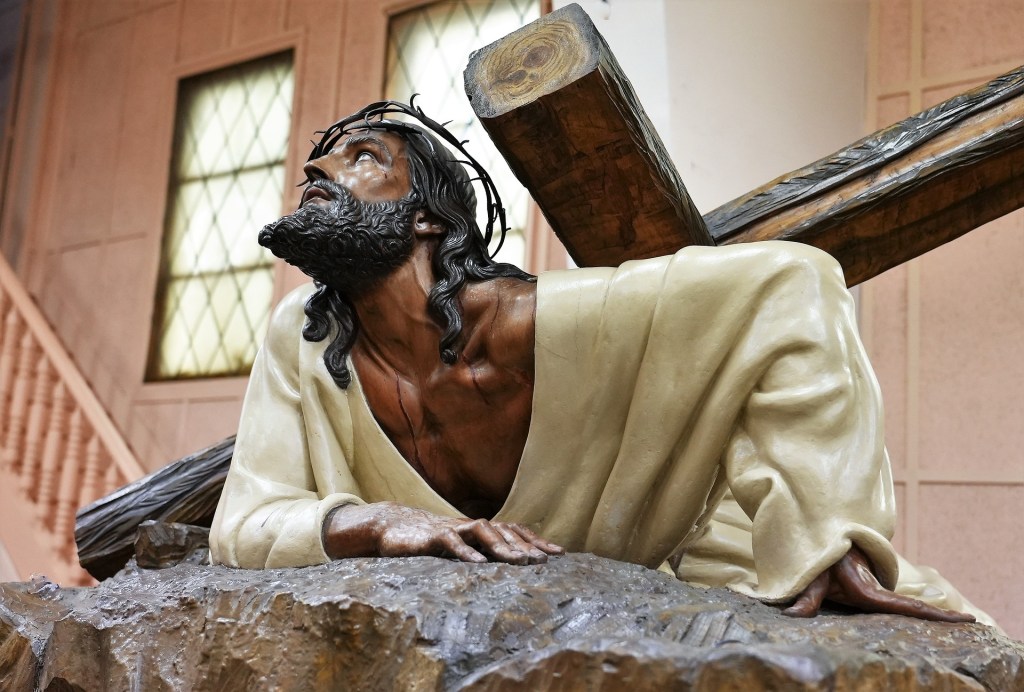
16 Then Pilate handed Him over to them to be crucified. Therefore the soldiers took charge of Jesus, 17 and carrying His own cross, He went out to what is called “the Place of the Skull” (in Aramaic it is called “Golgotha“).
18 There they crucified Him and two other men with Him – one on each side with Jesus in the middle. 19 Now Pilate also wrote a placard and placed it on the cross. It read: Jesus of Nazareth, the King of the Jews. (John 19:16-19)
Word Focus
Place of the Skull
κρανίου τόπος / kraniou topos
<Hear It>
The word focus this week continues with the theme of Easter and John 19:16-19. In verse 17 John tells us that Jesus carried His own cross. It was not unusual for the condemned man to carry the crossbeam to the place of crucifixion where the upright stake was already in place. However, somewhere along the way another person was pressed into service by the soldiers to take over the task of carrying Jesus’ cross. The Gospels of Matthew (27:32), Mark (15:21) and Luke (23:26) record that a man named Simon from the town of Cyrene was forced to carry the cross the rest of the way to the place of execution. The crossbeam was not an especially heavy burden for a healthy man to carry. So, the transfer to Simon possibly indicates the extremely weakened condition of Jesus due to the loss of blood from the brutal flogging he had received prior to being handed over for crucifixion (see Matthew 27:26; Mark 15:15; John 19:1). The sight of someone carrying the crossbeam was a common enough occurrence that Jesus used it as an illustration for discipleship (Matthew 16:24; Mark 8:34; Luke 9:23).
In verse 17 John also tells us that the place of execution was called “the Place of the Skull” (κρανίου τόπος). John also notes that the Aramaic name for this place was Golgotha (which also means “the skull”). Aramaic was the language that the Jewish people spoke in Palestine during the time that John wrote the Gospel of John. It replaced their native Hebrew language while they were in captivity in Babylon starting in the 6 century BC. The place of crucifixion is also commonly called Calvary by Christians. This name comes from the Latin word for skull – calvaria – which was used in the Latin translation of the Bible called the Vulgate. John does not tell us why the site was called “the Place of the Skull”, and there is no other historical source that explains the name. Some scholars have speculated that the place was a hill shaped like a skull, but there is no evidence for this. Some others have suggested that the skulls from crucified criminals were scattered around the site. However, it is unlikely that the Jewish people would have allowed this in or near Jerusalem, as it was offensive to them to allow unburied bodies to lie around.
Where “the Place of the Skull” was located is also not known. Many Christian hymns and sermons refer to the place as a hill. But interestingly, there is no indication that Jesus was crucified on a hill in the Bible, in any other historical source, or in ancient tradition. There certainly are hilly locations around Jerusalem, but the Gospel writers do not record that the crucifixion took place on a hill.
Also, the exact location of “the Place of the Skull” is not known. The topography of Jerusalem has changed significantly since the time of Jesus’ crucifixion due to building projects by Herod Agrippa I, the massive destruction of Jerusalem in 70 AD by the Romans, and various waves of destruction and rebuilding by Muslims and Christians over the past 2000 years. What is known is that it was located outside the city wall, probably close to a main road. Presently, there are two locations that are claimed to be the site of the crucifixion: (1) the traditional site at the Church of the Holy Sepulchre that was built in the 4th century AD. (2) Gordon’s Calvary which is north of Jerusalem outside the Damascus Gate. Perhaps if we knew the exact location we would worship it rather that Jesus Christ who died there.
The illustrations below show the location of Golgotha based on the traditional site at the Church of the Holy Sepulchre. Note: The Illustrations are ©2008 by Crossway. All rights reserved. Used by permission. They may not be reproduced, transmitted, or used in any form without permission from the copyright holder.
Jerusalem in the Time of Jesus. The traditional site of Golgotha is item 8 on the illustration. Gordon’s Calvary is not marked, but would be outside the North Gate (between items 10 and 11 on the illustration).
Golgotha and the Temple Mount. Golgotha is located at the bottom center of the illustration.
Word Focus Lexicon
Lexical Form: κρανίου τόπος <Hear It>
Gloss: Place of the Skull
Part of Speech: Place Name
New Testament Frequency: 4
Strong’s Number: G2898 and G5117 (Links to Blue Letter Bible Lexicon)
Unless otherwise noted, English translations of Bible verses are by the author from the Greek text and are not quotations from any copyrighted Bible version or translation.
 Koine Foundations
Leave a comment