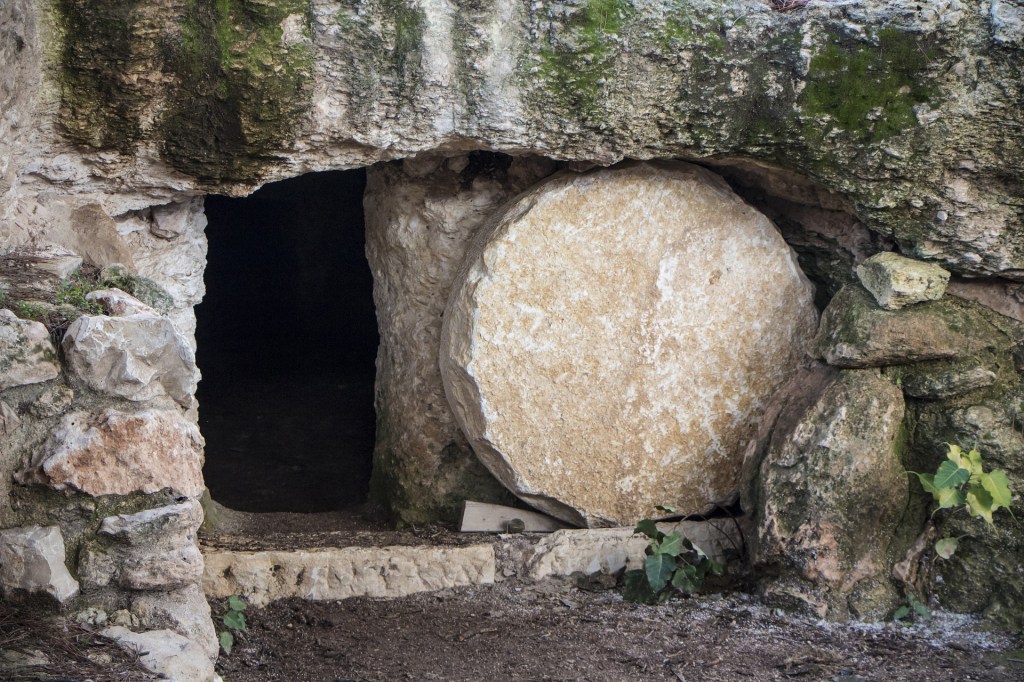
5 The angel said to the women, “Do not be afraid. For I know that you are looking for Jesus, who was crucified. 6 He is not here, for He was raised just as He said. Come, see the place where He was lying.” (Matthew 28:5-6)
Word Focus
resurrection
ἀνάστασις / anastasis
<Hear It>
The final word focus for this Easter season is the word “resurrection”. See the previous posts about Cross/Crucify, Place of the Skull, and Nail/Placard.
The last post ended with Jesus hanging on the cross. However, He died fairly quickly, before the other two men who were crucified with him. Their legs were broken by the Roman soldiers to hasten their deaths. The Jewish leaders had asked Pilate to allow this so that they would die quickly and be removed from their crosses before the Sabbath began at the end of that day. This was a bit unusual, for typically the Romans left the dead body of a criminal hanging on the cross to act as a warning and deterrent.
In the historical accounts in the Gospels we learn that none of Jesus’ men disciples were present at the crucifixion, except John. Out of fear they had scattered and abandoned Jesus. However, there were a number of women present who had faithfully followed and supported Jesus’ ministry. The Gospels list various women including Jesus’ mother Mary, Salome (possibly Mary’s sister), another woman named Mary, and Mary from the town of Magdala. Because the Gospels use different descriptions of the women, it is difficult to get an exact count. There were at least four, and as many as seven women present who are specifically mentioned. However, there were many more, for Matthew reports that these women were among the many who were watching the crucifixion from a distance (Matthew 17:55-56). These women endured the horrible scene of crucifixion. Some of them were close enough to talk with Jesus (John 19:26-17).
It was now late on a Friday afternoon when Jesus died and the Sabbath was approaching at sundown. Two men named Joseph and Nicodemus, who were members of the Jewish ruling council and secret disciples of Jesus, took the body of Jesus and prepared it for burial. Preparation involved wrapping the body in linen cloths and placing spices in the folds. They placed Jesus’ body in a tomb that was near the site of crucifixion (Matthew 15:42-47; Mark 15:42-47; Luke 23:50-56; John 19:38-42). Tombs were typically hewn out of solid rock and closed with a heavy stone. It is important to note that three of the Gospels record the detail that some of the women who were at the crucifixion, followed and saw where Jesus was buried (Matthew 27:61; Mark 15:47; Luke 23:55-56). For example, Luke 23:55-56 says:
55 Now the women who had come from Galilee with Jesus followed along. They saw the tomb and how His body was laid in it. 56 Then they turned back and prepared spices and perfumes. They rested on the Sabbath according to the commandment.
Very early on Sunday morning, after the Sabbath was over, a group of women came to the tomb with spices, perhaps to complete the burial ritual. Again, the men disciples were nowhere to be found. It was the faithful women disciples who were looking for Jesus and discovered the heavy stone rolled away from the entrance and an empty tomb. They are afraid. The empty tomb by itself could have a number of explanations. Fortunately, according to the key verse for this post, there was an angel to clearly explain the reason for the empty tomb – Jesus was raised from the dead, just as he had predicted. The women were not at the wrong tomb; Jesus’ body was not stolen or moved as some critics contend.
These verses witness to the resurrection (ἀνάστασις / anastasis) of Jesus Christ from the dead. The resurrection is central to Christianity. As Paul writes in 1 Corinthians 15:16-22, if Christ was not raised from the dead, our Christian faith is in vain, and we are still dead in our sins. But in fact, Christ has been raised from the dead, and He claimed:
I am the resurrection and the life. The one who believes in me will live, even after dying. (John 11:25)
Word Focus Lexicon
Lexical Form: ἡ ἀνάστασις ἀναστάσεως <Hear It>
Gloss: rising up, resurrection
English Derivative: Anastasia (female name)
Part of Speech: Third Declension Feminine Noun
New Testament Frequency: 42
Strong’s Number: G386 (Link to Blue Letter Bible Lexicon)
Alphabet Note: ἀνάστασις is spelled with three sigmas. The σ form appears twice inside the word. Τhe ς form appears at the end of the word. These two forms are the same letter and pronounced the same. The ς form is called a final Sigma and is used only at the end of words. Elsewhere it is written as σ.
Unless otherwise noted, English translations of Bible verses are by the author from the Greek text and are not quotations from any copyrighted Bible version or translation.
 Koine Foundations
Leave a comment