
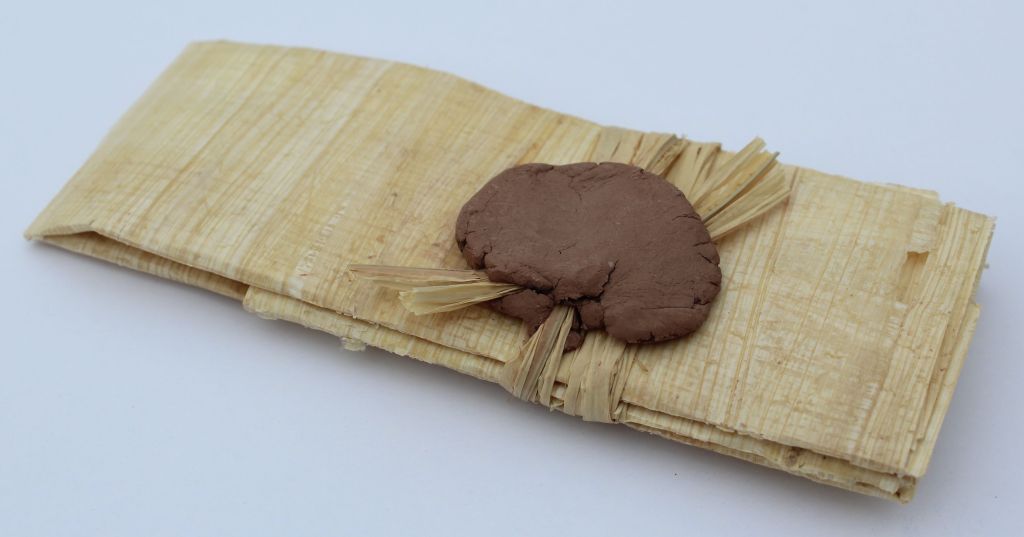
Reproduction and photo by Matthew Jones.
In Christ you also were sealed with the Holy Spirit of promise when you heard the message of truth, the gospel of your salvation, and believed.
(Ephesians 1:13)
Do not grieve the Holy Spirit of God, by whom you were sealed for the day of redemption. (Ephesians 4:30)
Word Focus
I seal
σφραγίζω
sphragizō
<Hear It>
In the era in which the New Testament was written, a seal was used for various reasons, such as:
- Proof of identity. Seals placed on an object could be impressed with a mark or symbol identifying the owner of, witness to, or authority behind it.
- To guarantee the legal validity of documents such as deeds, wills, contracts, and bills of sale. This is comparable to the notarization process of a present day notary public who places a seal on a document for validation purposes.
- To confer accreditation or authorization by a legal or governmental authority regarding the contents of a document. For example, a ruling official might place a seal on a decree to show that its contents are authorized by the government and have the force of law.
- To guarantee privacy and security. For example, a sealed document or letter could not be tampered with or read without breaking the seal. An unbroken seal indicated the document was not opened or tampered with.
On a document or letter, a seal might consist of a clay lump pressed around the knot on the cord that was used to secure it. The photo at the top of this post shows a reproduction of a papyrus letter (epistle) that is folded, tied and sealed for privacy in this manner. Note that the cord is entwined within the letter so that it cannot be slipped off the ends of the letter unless the seal is broken. This serves the same purpose as licking and sealing the flap on a modern envelope.
In Ephesians 1:13 and 4:30 at the top of this post, the Apostle Paul wrote that believers are sealed by the Holy Spirit. Verse 1:13 indicates that the sealing occurs when a new believer accepts the message of salvation.
The following things are taught about the Holy Spirit’s sealing in the New Testament:
- All believers are sealed.
- Believers are sealed when they accept the Good News, the gospel of salvation (Ephesians 1:13; Acts 2:38).
- God does the sealing (2 Corinthians 1:22).
- Sealing lasts until the day of redemption (Ephesians 4:30), which is the day when believers will be completely set free from their enslavement to sin because of the payment of Christ’s death (Revelation 5:9).
The sealing of the Holy Spirit results in a number of the positive consequences for the believer:
- Ownership – The seal is a mark that the believer belongs to God who is a loving father (1 John 3:1).
- Security – Because the believer belongs to God, salvation is secure. The believer is protected “from tampering” until redemption is complete. Nothing can separate from the love of Christ (Romans 8:35-39), because there is nothing and no one more powerful than God.
- Guarantee – It guarantees that the believer will receive all that God has promised including salvation and an eternal inheritance (Ephesians 1:13-14).
Click here to read a previous post about the word “seal”.
Word Focus Lexicon
Lexical Form: σφραγίζω <Hear It>
Gloss: I seal, I put on a seal, I certify
Part of Speech: Omega Verb
New Testament Frequency: 15
Strong’s Number: G4972 (Link to Blue Letter Bible Lexicon)
Pronunciation Note: When a single Gamma (γ) is followed by the vowels Epsilon (ε) or Iota (ι), or by the digraph Epsilon-Iota (ει) as in the word σφραγίζω, the Gamma is pronounced like the y in yet.
Unless otherwise noted, English translations of Bible verses are by the author from the Greek text and are not quotations from any copyrighted Bible version or translation.
 Koine Foundations
Leave a comment