
16 Always rejoice, 17 constantly pray, 18 in everything give thanks. For this is God’s will for you in Christ Jesus. (1 Thessalonians 5:16-18)
Word Focus
always rejoice
πάντοτε χαίρετε
pantote chairete
<Hear It>
The book of First Thessalonians in the New Testament is an epistle (i.e., letter) written by the Apostle Paul to Christian believers living in the city of Thessalonica (modern day Thessaloníki in Greece). It was the largest city in the province of Macedonia, and the capital. Paul had founded a church in the city around AD 49 during what is referred to as his Second Missionary Journey.
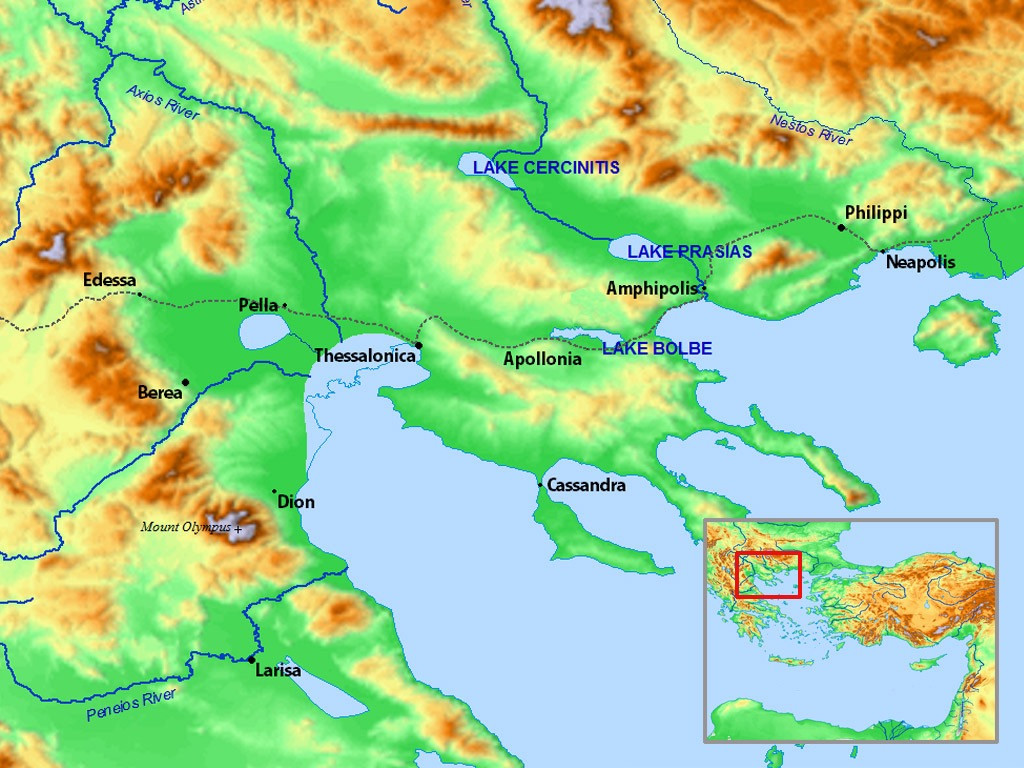
The letter was written some time in AD 50 or 51 in response to the good report Paul had received that the believers in Thessalonica were standing firm in their faith despite difficulties and persecution (see 1 Thessalonians 3:6-9). In fact, their faith had become a good example throughout Greece (1 Thessalonians 1:6-8). Unfortunately, there were a few issues that Paul had to address such as immorality (1 Thessalonians 4:1-7) and disorderly living (1 Thessalonians 5:14).
Near the end of his letter, Paul encourages the Thessalonian Christians to engage in three activities that should characterize all genuine believers:
16 Always rejoice,
17 constantly pray,
18 in everything give thanks.
These three activities will be the topics of the next three posts. This post comments on “always rejoice“.
To rejoice is to show delight or joy. According to the Merriam-Webster Dictionary, joy is “the emotion evoked by well-being, success, or good fortune or by the prospect of possessing what one desires.” This is the secular view of joy – a feeling of happiness that depends on positive circumstances.
Biblical joy is radically different. It does not depend on circumstances. It persists through the good and the bad. It is not disturbed or shattered by pain, grief, loss, misfortune, or persecution. In fact, it is present despite these things and often occurs precisely because of these things. This is because true joy does not come from positive circumstances. It comes from placing one’s trust in a loving God who does not change (Romans 15:13). For the believer, it is grounded in the knowledge that God keeps His promises, our salvation is secure in Him (Luke 10:20), and He works out all things for our good (Romans 8:28).
Because of this the believer can always have joy and should express that joy by rejoicing, as Paul urges here and in Philippians 4:4:
Rejoice in the Lord always. I will say it again – rejoice!
Joy is more than emotion or feeling. It involves action – always rejoicing. To do this is to see the hand of God in whatever is happening.
Note: Joy is a Fruit of the Spirit. Click here for a series of posts on the Fruit of the Spirit.
Links to all three posts in this series:
Always rejoice
Constantly pray
In everything give thanks
Word Focus Lexicon
Lexical Form: πάντοτε <Hear It>
Gloss: always, at all times
Part of Speech: Adverb
New Testament Frequency: 41
Strong’s Number: G3842 (Link to Blue Letter Bible Lexicon)
Lexical Form: χαίρω <Hear It>
Gloss: I rejoice, I am glad
Part of Speech: Omega Verb
New Testament Frequency: 74
Strong’s Number: G5463 (Link to Blue Letter Bible Lexicon)
Pronunciation Note: When Tau (τ) follows a Nu (ν), such as in the word πάντοτε, the Tau is pronounced like the d in den, rather than like the t in star (its primary sound). Click here for a table that shows the Koine era pronunciation of all the alphabet letters.
Bibliography
Thomas, Robert L. 1 Thessalonians, The Expositor’s Bible Commentary, Volume 11. The Zondervan Corporation. 1978.
Barclay, William. The Letters to the Philippians, Colossians and Thessalonians. The Westminster Press. 1954, 1959.
Danker, Frederick William (Editor). A Greek-English Lexicon of the New Testament and other Early Christian Literature, Third Edition (BDAG). The University of Chicago Press. 2000.
Best, Ernest. A Commentary on the First and Second Epistles to the Thessalonians, Harper’s New Testament Commentaries. Hendrickson Publishers. 1972, 1977, 1979, 1986.
Morris, Leon. The First and Second Epistles to the Thessalonians, The New International Commentary on the New Testament. William B. Eerdmans Publishing Company. 1991.
Vos, Howard F. Beginnings in the New Testament. Moody Press. 1973.
Wanamaker, Charles A. The Epistles to the Thessalonians, The New International Greek Testament Commentary. William B. Eerdmans Publishing Company. 1990.
Wiersbe, Warren. Be Ready. Victor Books. 1979.
Unless otherwise noted, English translations of Bible verses are by the author from the Greek text and are not quotations from any copyrighted Bible version or translation.
 Koine Foundations
Leave a comment