
10 I came that they may have life and have it abundantly. (John 10:10)
Word Focus
abundantly
περισσός
perissos
<Hear It>
In the Gospel of John, written by the Apostle John, he records an allegorical story given by Jesus where He describes Himself as the Good Shepherd who tends sheep (see John 10:1-21 for the full account). Jesus explains that temporary hires don’t care about the welfare of the sheep (vv. 12-13), and thieves are malicious and come to steal and kill the sheep (v. 10). In contrast, Jesus is the Good Shepherd who truly cares for the sheep, even to the extent of laying down His life for them (vv. 11, 15). The sheep represent those who follow Jesus, and He says this about them:
I came that they may have life and have it abundantly. (John 10:10)
This statement by Jesus implies that He actively promotes their wellbeing. He wants them to live life to the full. The Greek word translated “abundantly” (περισσός / perissos) means outstanding, over and above, overflowing, or extraordinary in number, size, or quality. Jesus uses this word to describe the superabundance that He wants to bring to the lives of those who believe in Him.
But what makes a life abundant? If you asked the average person on the street in an affluent culture, you would get answers like wealth, success, popularity, fame, being a social media influencer, having lots of friends, or having a good time. Some people might give a more noble answer like doing something worthwhile, raising successful children, or helping others.
In other cultures, the answers might focus on the basics of life like food, clothing, a place to live, or freedom.
There are many people in affluent cultures who have these things but are unhappy and their lives are empty. They go through multiple marriages/partners, suffer depression, turn to drugs and alcohol to ease the pain, are depressed, and sadly, some commit suicide.
Why does having these things not lead to an abundant life? They are the wrong starting place. An abundant life begins with God. Again, as Jesus said, “I came that they may have life and have it abundantly.“
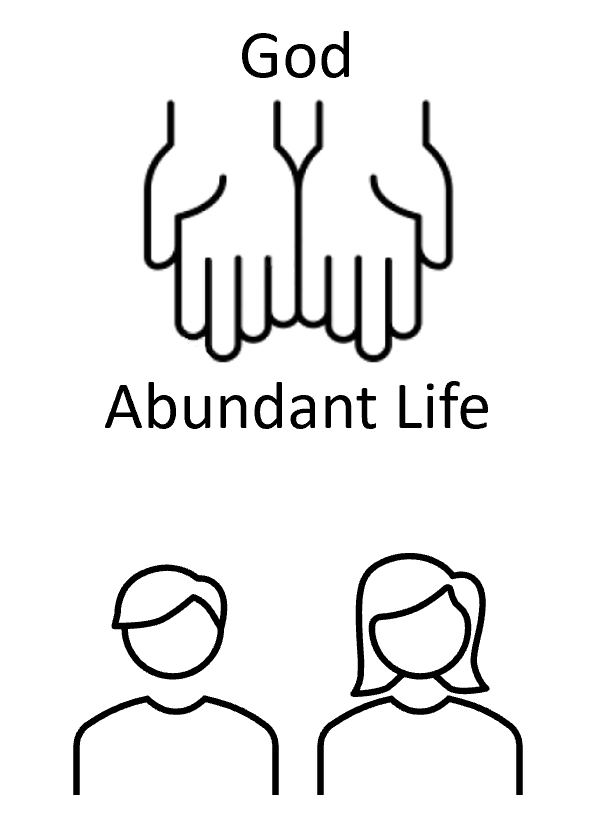
The abundant life that God offers through Jesus Christ is:
- An eternal life – it lasts forever. You probably know the verse John 3:16, where the Bible says:
For this is how much God loved the world: He gave His one and only Son, so that everyone who believes in Him will not perish, but have everlasting life. (John 3:16)
- A life of true joy. The joy that God gives is radically different from what people seek through the things listed above. God’s joy does not depend on circumstances. It persists through the good and the bad. It is not disturbed or shattered by pain, grief, loss, or misfortune. Click here to read more about this joy.
- A life free from need. God generously supplies for every need, both material and spiritual, for those who follow Him:
And my God will fully supply for every need of yours according to his riches in glory in Christ Jesus. (Philippians 4:19)
- A life of purpose. God gives His followers gifts, talents, abilities and skills to fulfill their good passions and help others. He wants to make their lives count. His followers are His works of art, created for the purpose of doing good things:
For we are God’s workmanship, created in Christ Jesus to do good works, which God prepared beforehand so that we would walk in them. (Ephesians 2:10)
This is just some of what God offers through the abundant life.
Unfortunately, there is bad news – there is a problem that prevents us from having this abundant life. I will comment on that in the next post.
Click here for a PDF document that explains the Good News and consolidates the four posts in this series: Abundant Life, Sin, The Way, Believe.
Word Focus Lexicon
Lexical Form: περισσός περισσή περισσόν <Hear It>
Gloss: in abundance; extraordinary in number, size, or quality
Part of Speech: Adjective
New Testament Frequency: 12 (including 6 comparative forms)
Strong’s Number: G4053 (Link to Blue Letter Bible Lexicon)
Bibliography
Beare, F.W. A Commentary on the Epistle to the Philippians, Harper’s New Testament Commentaries. Hendrickson Publishers. 1959.
Bromiley, Geoffrey W. (Editor). Theological Dictionary of the New Testament, Abridged in One Volume. William B. Eerdmans Publishing Company. 1985.
Bruce, F.F. The Gospel & Epistles of John. William B. Eerdmans Publishing Company. 1983.
Dallas Theological Seminary. How to Have a Happy and Meaningful life. Dallas Theological Seminary. 1971, 1978, 2005.
Danker, Frederick William (Editor). A Greek-English Lexicon of the New Testament and other Early Christian Literature, Third Edition (BDAG). The University of Chicago Press. 2000.
Gilbrant, Thoralf (Editor). The Complete Biblical Library, The New Testament Greek-English Dictionary. The Complete Biblical Library. 1991.
Kennedy, H.A.A. The Epistle to the Philippians, The Expositors Greek Testament. William B. Eerdmans Publishing Company. 1990.
Lincoln, Andrew T. Word Biblical Commentary, Volume 42, Ephesians. Nelson Reference & Electronic. 1990.
Morris, Leon. The Gospel According to John, The New International Commentary on the New Testament. William B. Eerdmans Publishing Company. 1971.
Tenney, Merrill C. The Gospel of John, The Expositor’s Bible Commentary, Volume 9. The Zondervan Corporation. 1981.
Unless otherwise noted, English translations of Bible verses are by the author from the Greek text and are not quotations from any copyrighted Bible version or translation.
 Koine Foundations
Leave a comment