
Lesson 1: This begins a series of posts that explains how to pronounce the Koine Greek alphabet and words. Koine Greek, also known as Hellenistic Greek, is the form of the Greek language spoken and written from about the fourth century BC to the fourth century AD. It is also called Biblical Greek and New Testament Greek because it is the language that was used to translate the Hebrew Old Testament into Greek and used to compose the New Testament.
The Greek language has a long history. It has been spoken for at least the last 3500 years. Its roots are among the people who migrated to the areas around the Aegean Sea. Possibly before 2000 BC, these people first settled in what is today called Greece. They later spread to the islands in the Aegean Sea, to Crete, to Cyprus (not on map), and to the seacoast of western Turkey.

Over time, all languages change in the way they are written and spoken. So, it is not surprising that Greek has changed over its 3500 year history. Scholars trace the changes in Greek by breaking its history into stages as shown in the table below.
| Stages of the Greek Language | Approximate Date Range |
|---|---|
| Mycenaean Greek | 16th to 12th C. BC |
| Greek Dark Ages | 12th to 8th C. BC |
| Ancient / Classical Greek | 8th to 4th C. BC |
| Hellenistic / Koine Greek | 4th C. BC to 4th C. AD |
| Medieval Greek / Byzantine Greek | 4th to 15th C. AD |
| Modern Greek | 15th C. AD to Present |
You may be familiar with the Ancient / Classical Greek stage. That is when Greek culture flourished and Greek philosophers like Socrates (c. 470-399 BC), Plato (c. 428 – c. 348 BC) and Aristotle (384-322 BC) lived and wrote. Their works of philosophy, science, and poetry are still read and studied today.
In my posts I comment on the Greek of the Hellenistic / Koine stage. This stage began in the fourth century BC, when King Philip of Macedon gained control over all of Greece through military conquest and diplomacy. To unify his power, he established the dialect of Greek called Attic Greek as the language of His empire.
When he was assassinated in 336 BC, his son Alexander became king at age 20. You know him as Alexander the Great. Over the next 13 years he conquered and carved out the largest empire of the ancient world that stretched 3000 miles from Greece to India.
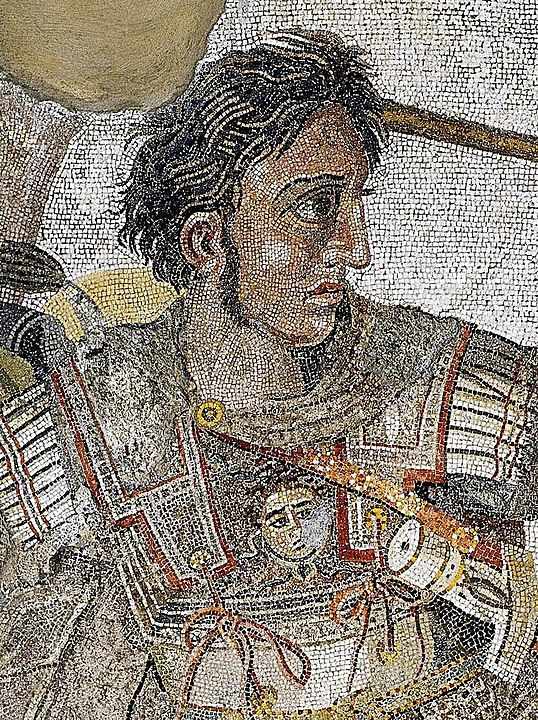
Alexander had been tutored by the Greek philosopher Aristotle, who instilled in him a love for all things Greek. Through his conquests, he spread Classical Greek culture and the Greek language. Greek became the international language of commerce and government throughout his empire.
But over time Classical Greek changed into a simpler language as it bumped up against other cultures and other languages. It became a common language used by everyday people, not just by merchants and government officials. Scholars today call this changed language Koine Greek. Koine (κοινή / koinē <Hear It>) is the Greek word that means “common“. This Koine or Common Greek language would remain the standard international language for at least four centuries, even after Latin speaking Rome conquered the Greek empire.
This common language had an uncommon impact on the religious lives of Jews and Christians during that stage. The Hebrew Bible (what Christians call the Old Testament) was translated into Greek starting around 250 BC. Many Jews no longer understood Hebrew, the original language of the Hebrew Bible. But this Greek translation, called the Septuagint, gave them access to the Scriptures. This Greek translation was also the primary version of the Old Testament used by the early Christians. For example, Old Testament quotations in the New Testament often come from the Greek Septuagint rather than from the Hebrew.
Another impact was that Koine Greek was the language of the New Testament. Even though Rome ruled the world during the time of Jesus, and Latin was the official language of the empire, the New Testament was written in Koine Greek. This made it accessible to everyone in the empire because they shared this common language.
Koine Greek was spoken in Palestine during the earthly ministry of Jesus. His primary language was Aramaic, but he also spoke Koine Greek. His brothers, James and Jude, both wrote books of the New Testament that are written in an excellent style of Koine Greek, indicating that the family was well educated in the Greek language.
As with all languages, the Greek language has changed in pronunciation over the thousands of years it has been spoken. My goal is to explain how the Greek alphabet and words were pronounced in the Hellenistic / Koine stage – the time during which the New Testament was written.
Note that there are several pronunciation systems used in Biblical (Koine) Greek education. The major ones are:
Erasmian [i-raz-mē-ən] Pronunciation – Erasmian pronunciation is the system used to teach Biblical Greek in most colleges and seminaries around the world. Its development is credited to Desiderius Erasmus in the 16th century. Erasmus was a brilliant humanist scholar during the Renaissance. Unfortunately, the pronunciation system is not how Greek sounded during the time that the New Testament was written during the first century. In fact, at no time in the history of the Greek language was Greek actually pronounced this way. The pronunciation system is used for its pedagogical benefits because each Greek letter is assigned only one unique sound making it easier to learn the language.
Modern Greek Pronunciation – Some teachers of Biblical Greek use modern Greek pronunciation. Obviously, this is not how Biblical Greek actually sounded, but it has the benefit of learning how to pronounce the modern, living language.
Reconstructed Koine Pronunciation – This is a reconstruction of what Greek might have sounded like in the Hellenistic / Koine stage based on historical research. The reconstruction focuses primarily on the pronunciation of the first three centuries AD – the period in which the New Testament and other important Christian documents were written. This system is not really any harder to learn than Erasmian Pronunciation. Plus, it gives the learner an appreciation for what the New Testament may have sounded like when it was read aloud in church gatherings, or what early believers like the Apostle Paul sounded like when they taught and preached.
This series of posts will focus on explaining how to pronounce the Koine Greek alphabet and words using a Reconstructed Koine Pronunciation.
If you are interested in knowing how scholars can reconstruct the pronunciation of Koine Greek, click on this YouTube link to view the 3 minute video, How do we know how Koine Greek was pronounced?
Word Focus Lexicon
Lexical Form: κοινός κοινἠ κοινόν<Hear It>
Gloss: common, ordinary, unclean
Part of Speech: Adjective
New Testament Frequency: 14
Strong’s Number: G2839 (Link to Blue Letter Bible Lexicon)
Unless otherwise noted, English translations of Bible verses are by the author from the Greek text and are not quotations from any copyrighted Bible version or translation.
 Koine Foundations
Leave a comment