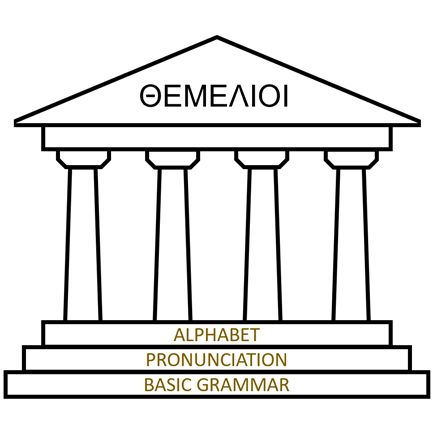

Lesson 2: This post is the second in a series that explains how to pronounce the Koine Greek alphabet and Greek words.
Word Focus
alphabet
ἀλφάβητος
alphabētos
<Hear It>
For most people, the most challenging and intimidating aspect of learning Greek is learning the Greek alphabet. If you learn the alphabet well, you will find that Greek is not a difficult language. If you don’t learn the alphabet, you will struggle with learning Greek. Your success in learning the alphabet will determine your success in being able to learn Greek grammar and effectively read, understand, and enjoy the language.
The Greek alphabet first appeared in the eighth century BC and underwent changes over the next 400 years. Several versions developed in the areas around the Aegean Sea. But in 403 BC in Athens, one version was officially adopted as the standard alphabet. Within 100 years it replaced all other versions of the alphabet in the Greek-speaking world. This official alphabet consisted of the same upper-case letters which are still used today, over 2400 years later! The lower case letters gradually developed during the Byzantine period some time after the ninth century AD.
Learning the alphabet is not hard. Some of the letters look like and represent sounds like English alphabet letters1 such as alpha (Α/α), epsilon (Ε/ε), iota (Ι/ι), kappa (Κ/κ), omicron (Ο/ο), and tau (Τ/τ). You might know some of the letters from math class, like delta (Δ) and pi (π). Once you know the sound each letter represents, you can pronounce any word in Koine Greek, even if you do not know what it means. There are a few unusual looking letters like zeta (ζ) and xi (Ξ ξ). They don’t look like anything in our English alphabet, but they represent sounds that are easy to learn.
The table below shows the Greek alphabet in order from alpha to omega.

Note that:
- There are 24 letters in the alphabet.
- There are 7 vowels (yellow highlight) and some look similar to the vowels in our English alphabet.
| Greek Vowel | α | ε | η | ι | ο | υ | ω |
| English Vowel | a | e | ē | i | o | u | ō |
- The lower-case sigma has two forms (blue highlight). The ς form is called a “final sigma” and is used only at the end of a word.
- Many of the upper-case forms look similar to their lower-case forms. The upper-case forms are used infrequently in modern printed texts, so focus on recognizing the lower-case forms.
Here is what is important to know about the Koine Greek Alphabet as you begin to learn it:
- Every letter has a name.
- The spelling of every name begins with that letter – alpha begins with an alpha, beta begins with a beta, gamma begins with a gamma, etc.
- That beginning letter has the primary sound of the letter. When you say the name correctly, you will hear the sound the letter makes in words.
- You will learn the names of the letters as they are pronounced in Koine Greek, not in modern English. For example, pi (π) is pronounced as “pie” in math, but pronounced as “pea” in Koine Greek.
Here are three options to hear the Greek alphabet recited:
- Click here to listen to a 30 second audio file of the alphabet.
- Click here to view a 1 minute video of the alphabet.
- Click here to view a 6 minute teaching video that covers the content in this post. This video is part of a homeschool course, and also covers additional content not covered in this post. Toward the end of the video there is a reference to alphabet flash cards. Click here for a pdf master to make these cards. They must be printed or copied double-sided, and then cut apart on the dotted lines
Going forward, I will cover three Greek letters in each post, and provide example words that contain only the letters you have learned to that point.
1The set of alphabet symbols used in the English alphabet is called the Latin Script or Roman Script.
Word Focus Lexicon
Lexical Form: ὁ ἀλφάβητος <Hear It>
Gloss: alphabet
Part of Speech: Noun
New Testament Frequency: 0
Strong’s Number: Not Applicable
Unless otherwise noted, English translations of Bible verses are by the author from the Greek text and are not quotations from any copyrighted Bible version or translation.
 Koine Foundations
Leave a comment