Lesson 3: This post is the third in a series that explains how to pronounce the Koine Greek alphabet and Greek words. Each post explains three Greek letters and provides example words that contain only the letters covered to that point. This post explains the letters alpha, beta, and omega, and breathing marks.*
ἄλφα / alpha

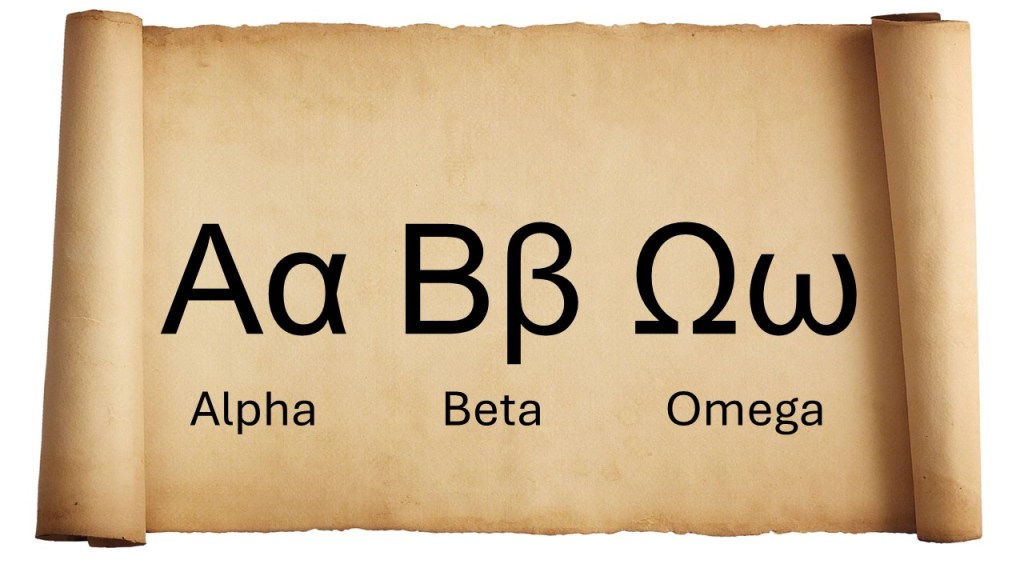
Alpha is the first letter of the Greek alphabet. It is similar in appearance to the upper-case and lower-case A/a in the English alphabet.
Alpha is a vowel and always sounds like the a in the English word spa. Greek vowel sounds are easy to learn because Greek vowels only have one sound, unlike English. For example, a in English can sound like the a in ape, the a is apple, or the a in father. Alpha always sounds like the a in spa.
βῆτα / beta

Beta is similar in appearance to the upper-case and lower-case B/b in the English alphabet.
However, beta sounds like the v in the English word vet, not like the b in bet.
ὦ μέɣα / omega

Omega is the last letter of the Greek alphabet. It is introduced now, out of order, so that more example words can be provided because the dictionary form of many Greek verbs ends in omega.
Omega is a verb and always sounds like the o in the English word go.
Do not confuse the lower-case omega with the English letter w. They have nothing in common. Note that the lower-case omega has rounded bottoms, not pointed ones like the English lower-case w.
Alpha and Omega
Two of the letters in this lesson, alpha and omega, are used as an important title for God. As recorded in the New Testament book entitled The Revelation to John (Revelation 22:13), Jesus Christ says:
I am the Alpha and the Omega,
The First and the Last,
The Beginning and the End.
In Revelation 1:8 and 21:6, God identifies Himself as the Alpha and Omega. Here in 22:13, Jesus Christ applies this title to Himself, implying that all that is found in God the Father is also found in Him, God the Son.
The title Alpha and Omega (like First and Last and Beginning and End) is an idiom that refers to the totality. It is not simply the first and the last, but also includes every aspect in between. In the context of the book of Revelation, it implies that God (Father and Son) is the absolute sovereign Lord of all that takes place in cosmic and human history – from start to finish. Nothing lies outside of God. This should be a comfort and encouragement to those who suffer for God’s cause, because He is in control of all things that affect them.
Alphabet
The English word “alphabet” comes from the first two letters of the Greek alphabet:
Alpha + Beta → alphabet.
Example Words
Practice saying the example word to learn the sounds represented by the alphabet letters.
ἀββά
father (used to address God in prayer)
[noun]
You have probably heard the anglicized pronunciation of this word as abba. But during the time of the New Testament, it was probably pronounced with a “v” sound for the betas, as in the audio above. It is used in the New Testament as a way of addressing God the Father when praying. For example:
And Jesus was saying, “Abba, Father, all things are possible for you. Please remove this cup from me. But don’t act based on what I want, but on what you want.” (Mark 14:36)
This verse records part of Jesus’ prayer in the Garden of Gethsemane on the night before He was crucified. He is experiencing great anguish and prays to be delivered from the suffering of crucifixion, while also accepting God’s will. The word “cup” is a symbolic way of referring to His suffering and death, and also to God the Father’s wrath and judgment. Jesus’ appeal assumes that all things are possible for God, but that all things must be done according to God’s will – somethings we should keep in mind when we pray.
ἀββά is a transliteration of the Aramaic word for “father” into Greek. The word exhibits a respectful intimacy on the part of Jesus.
The mark above the final alpha (ά) in ἀββά is an acute accent mark. It shows where the word is accented. Accent marks will be explained in the next post.
Breathing Marks
The mark above the first alpha (ἀ) in ἀββά is a smooth breathing mark. It does not affect the pronunciation of this word. There are two breathing marks used in printed Greek texts: the smooth breathing mark (ἀ) and the rough breathing mark (ἁ). They look like curved apostrophe marks curved left or right. They only occur at the beginning of words that begin with a vowel or the letter rho.
The Greek alphabet did not have a letter symbol equivalent to the English letter h, which is a puff of air as in our English word “help”. However, ancient Greek did have the \h\ sound at the beginning of some words beginning with a vowel. Native Greek speakers learned which words began with an \h\ sound as they heard them spoken by other native speakers, such as their parents.
Breathing marks were developed to help non-native speakers know when to add an \h\ sound at the beginning of a word. The smooth breathing mark (ἀ) indicated that there was no \h\ sound. The rough breathing mark (ἁ) indicated that there was an \h\ sound. However, by the time of Koine Greek the rough breathing or \h\ sound was no longer applied to words, except perhaps by the very well educated. A similar example in modern English is the word “herb”. Some people pronounce it with an \h\ sound and some do not.
So, in Koine Greek pronunciation, the smooth and rough breathing marks make no difference in how you pronounce a word. There is no \h\ sound at the beginning of any word with a rough breathing mark. However, the smooth and rough breathing marks are part of the proper spelling of the word in printed texts.
Review
The table below shows the Greek alphabet in order from alpha to omega. Verbs are highlighted in yellow. Lower-case sigma, highlighted in blue, has two forms.

Here are two options to hear the the entire Greek alphabet recited:
- Click here to listen to a 30 second audio file of the alphabet.
- Click here to view a 1 minute video of the alphabet.
*Symbols enclosed in left slashes such as \ä\ are Merriam-Webster Pronunciation Symbols. These are the standard pronunciation symbols used in the Merriam-Webster dictionary. They are provided as another way to know the sound of each Greek letter. Click here for a downloadable PDF document that explains the symbols and includes a one-page chart on the last page. They are also explained in any hardcopy edition of the Merriam-Webster dictionary.
Bibliography
Johnson, Alan. Revelation, The Expositor’s Bible Commentary, Volume 12. The Zondervan Corporation. 1981.
Danker, Frederick William (Editor). A Greek-English Lexicon of the New Testament and other Early Christian Literature, Third Edition (BDAG). The University of Chicago Press. 2000.
Mounce, Robert H. The Book of Revelation, The New International Commentary on the New Testament. William B. Eerdmans Publishing Company. 1977.
Unless otherwise noted, English translations of Bible verses are by the author from the Greek text and are not quotations from any copyrighted Bible version or translation.
© Copyright 2022 by Matthew Jones
koinefoundations@gmail.com
 Koine Foundations
Leave a comment