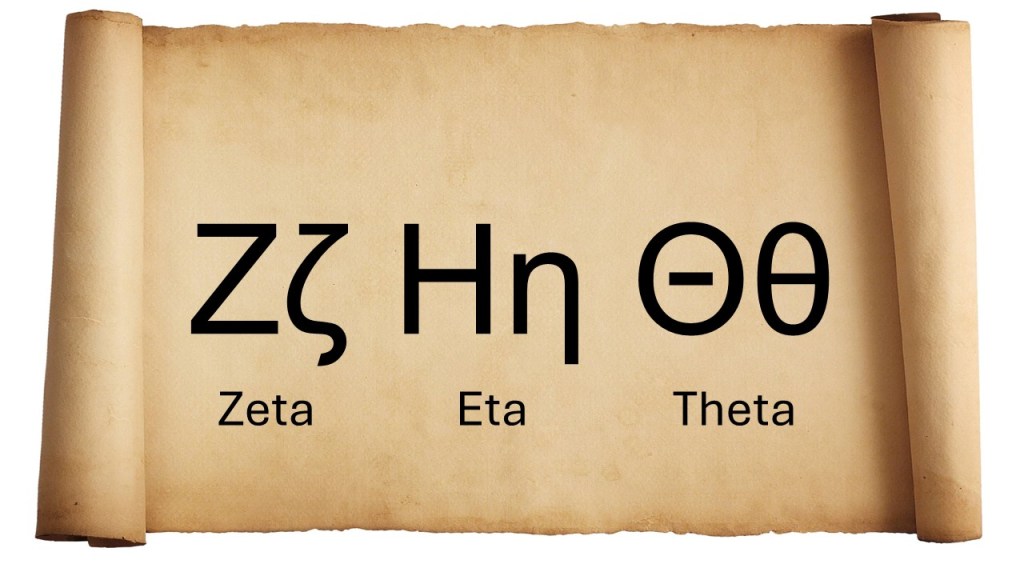
Lesson 5: This post is the fifth in a series that explains how to pronounce the Koine Greek alphabet and Greek words. Each post explains three Greek letters and provides example words that contain only the letters covered to that point. This post explains the letters zeta, eta, and theta.*
ζῆτα / zeta

Zeta is similar in appearance and identical in sound to the upper-case and lower-case Z/z in the English alphabet.
Zeta sounds like the z in the English word zest.
ἦτα / eta

The appearance of Eta can be confusing. The upper-case form looks like an English upper-case H and the lower-case form looks like an English lower-case n. However, it is neither.
Eta is a long e-class vowel and always sounds like the e in the Spanish word olé.
θῆτα / theta

Theta does not look like any letter in the English alphabet.
Theta always sounds like the th in the English word thin.
There is an alternate way of writing the lower-case form as shown above that can be written in a single stroke without lifting your pen.
Do not confuse the sound of theta with the sound of delta. Theta sounds like the th in thin. Delta sounds like the th in then. Say thin and then aloud several times to hear the difference. Notice the position of your tongue as you pronounce each word.
Example Words
Practice saying the example words to learn the sounds represented by the alphabet letters in this lesson.
ɣῆ
earth, land, soil
[noun]
Notice the circumflex accent. This is a single syllable word.
ɣῆ has a broad range of meanings including the planet earth (“heaven and earth“), a geographic area (“land of Israel”), dry land (“land and sea”) and soil (“seeds fell on the good soil“). The context determines how it should be translated.
English Derivatives: Geography, geology.
Example Verse: [Jesus speaking] “Heaven and earth will pass away, but my words will never pass away.” (Mark 13:31)
Example Verse: And Jesus was saying, “The kingdom of God is like a person who casts seed on the soil.” (Mark 4:26)
ζωή
life
[noun]
Notice the acute accent on the final syllable.
ζωή can refer to physical life or spiritual life.
English Derivatives: Zoe (feminine name), zoo, zoology, protozoa.
Example Verse: [A reference to Jesus] In Him was life and the life was the light of mankind. (John 1:4)
Example Verse: Jesus said to her, “I am the resurrection and the life. The one who believes in me will live, even if he dies.” (John 11:25)
Example Verse: [Jesus speaking] “This is eternal life: That they know You, the only true God, and the one You sent, Jesus Christ.” (John 17:3)
θεά
goddess
[noun]
Though this word is seldom used in the Bible, it is used frequently in secular Greek literature. It is used in the New Testament in Acts 19:27 in reference to the temple of the goddess Artemis in the city of Ephesus in Asia Minor (modern day Turkey). The Greeks believed that Artemis was a daughter of Zeus and the twin sister of Apollo. The Romans called her Diana.
Example Verse: …the temple of the great goddess Artemis… (Acts 19:27)
Practice & Review
ἀββά
father
ἄɣω
I lead, bring, go
ὧδε
here
ἐɣώ
I
ɣῆ
earth, land, soil
ζωή
life
θεά
goddess
The table below shows the Greek alphabet in order from alpha to omega. Verbs are highlighted in yellow. Lower-case sigma, highlighted in blue, has two forms.

Here are two options to hear the the entire Greek alphabet recited:
- Click here to listen to a 30 second audio file of the alphabet.
- Click here to view a 1 minute video of the alphabet.
*Symbols enclosed in left slashes such as \ä\ are Merriam-Webster Pronunciation Symbols. These are the standard pronunciation symbols used in the Merriam-Webster dictionary. They are provided as another way to know the sound of each Greek letter. Click here for a downloadable PDF document that explains the symbols and includes a one-page chart on the last page. They are also explained in any hardcopy edition of the Merriam-Webster dictionary.
Bibliography
Danker, Frederick William (Editor). A Greek-English Lexicon of the New Testament and other Early Christian Literature, Third Edition (BDAG). The University of Chicago Press. 2000.
Unless otherwise noted, English translations of Bible verses are by the author from the Greek text and are not quotations from any copyrighted Bible version or translation.
© Copyright 2022 by Matthew Jones
koinefoundations@gmail.com
 Koine Foundations
Leave a comment