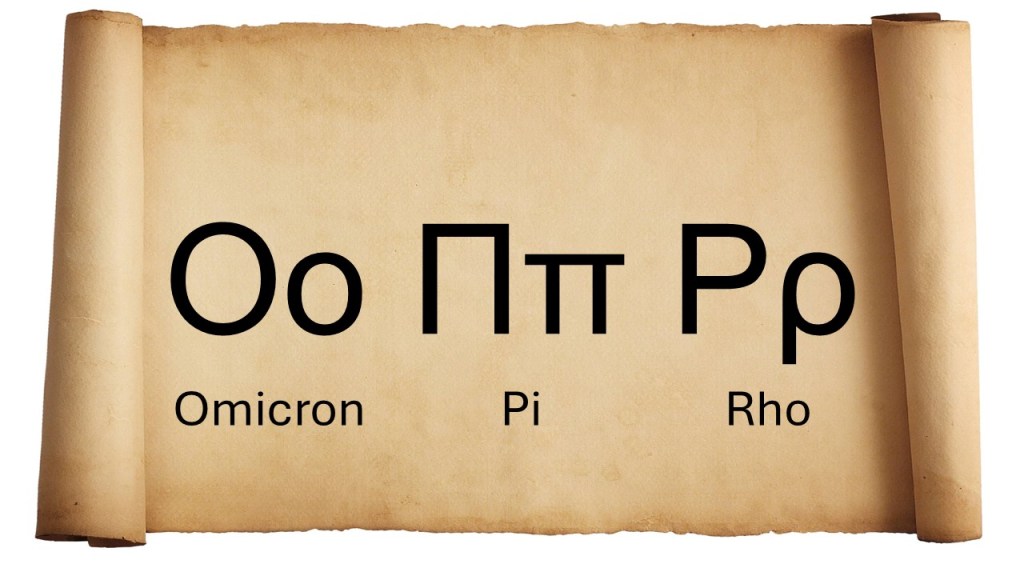
Lesson 8: This post is the eighth in a series that explains how to pronounce the Koine Greek alphabet and Greek words. Each post explains three Greek letters and provides example words that contain only the letters covered to that point. This post explains the letters omicron, pi, and rho.
ὂ μικρόν / omicron

The upper-case and lower-case omicron are identical in appearance to the upper-case and lower case O/o in the English alphabet.
Omicron always sounds like the o in the English word go. It is identical in sound to omega (Ω/ω).
The name omicron means “small o”.
πῖ / pi

Pi does not look like any letter in the English alphabet. However, you are probably familiar with the letter from math class. The letter pi is used to represent the ratio of the circumference of any circle to the diameter of that circle. Regardless of a circle’s size, this ratio is always approximately 3.14. In math, the letter is pronounced “pie”, but in Koine Greek it is pronounced “pea”.
The primary sound of pi is like the p in the English word spin, but not the p in pin – it is not aspirated. It occasionally sounds like the b in bet when it comes after the Greek letter mu (Μ/μ).
ῥῶ / rho

Rho looks like the English letter P/p, but it is actually similar in sound to the English letter R/r. So be careful not to confuse rho with the English letter P/p.
The sound of rho is trilled or rolled and always sounds like the r in the English word rest.
Note that the lower-case rho has a tail that goes below the base line.
Example Words
Practice saying the example words to learn the sounds represented by the alphabet letters in this lesson.
πέμπω
I send
[verb]
This verb includes both sounds of the letter pi. The first pi sounds like the p in spin and the second pi sounds like the b in bet because it comes after the Greek letter mu (μ).
English Derivative: Pomp.
Example Verse: [Jesus speaking] “Truly, truly, I say to you, the one who hears My message, and believes Him who sent Me, has eternal life, and does not come into judgment, but has crossed over from death to life.” (John 5:24)
ἀνήρ
man, husband
[noun]
ἀνήρ can mean “man” or “husband” depending on the context.
English Derivative: Android.
Example Verse: [Jesus speaking] “Therefore, everyone who hears these words of Mine, and does them, will be like a wise man who built his house on the rock.” (Matthew 7:24)
Example Verse: Husbands, love your wives, as Christ also loved the church and gave Himself for her. (Ephesians 5:25)
παραβολή
parable
[noun]
This word has all three of the new letters from this lesson – ο, π, and ρ.
A parable is a short descriptive story used to teach a moral or spiritual lesson. About one third of Jesus’ teachings recorded in the Gospels are in the form of parables.
English Derivative: Parable, parabolic.
Example Verse: Jesus presented another parable to them, saying, “The kingdom of heaven is like a man who sowed good seed in his field.” (Matthew 13:24)
Practice & Review
ἀββά
father
ἄɣω
I lead, bring, go
ὧδε
here
ἐɣώ
I
ɣῆ
earth, land, soil
ζωή
life
θεά
goddess
ἀδικία
unrighteousness
ἀλήθεια
truth
καί
and, even, also
εἰμί
I am
ɣεμίζω
I fill
λαμβάνω
I take, receive
ἔξω
outside
πέμπω
I send
ἀνήρ
man, husband
παραβολή
parable
The table below shows the Greek alphabet in order from alpha to omega. Verbs are highlighted in yellow. Lower-case sigma, highlighted in blue, has two forms.

Here are two options to hear the the entire Greek alphabet recited:
- Click here to listen to a 30 second audio file of the alphabet.
- Click here to view a 1 minute video of the alphabet.
*Symbols enclosed in left slashes such as \ä\ are Merriam-Webster Pronunciation Symbols. These are the standard pronunciation symbols used in the Merriam-Webster dictionary. They are provided as another way to know the sound of each Greek letter. Click here for a downloadable PDF document that explains the symbols and includes a one-page chart on the last page. They are also explained in any hardcopy edition of the Merriam-Webster dictionary.
Bibliography
Danker, Frederick William (Editor). A Greek-English Lexicon of the New Testament and other Early Christian Literature, Third Edition (BDAG). The University of Chicago Press. 2000.
Unless otherwise noted, English translations of Bible verses are by the author from the Greek text and are not quotations from any copyrighted Bible version or translation.
© Copyright 2022 by Matthew Jones
koinefoundations@gmail.com
 Koine Foundations
Leave a comment