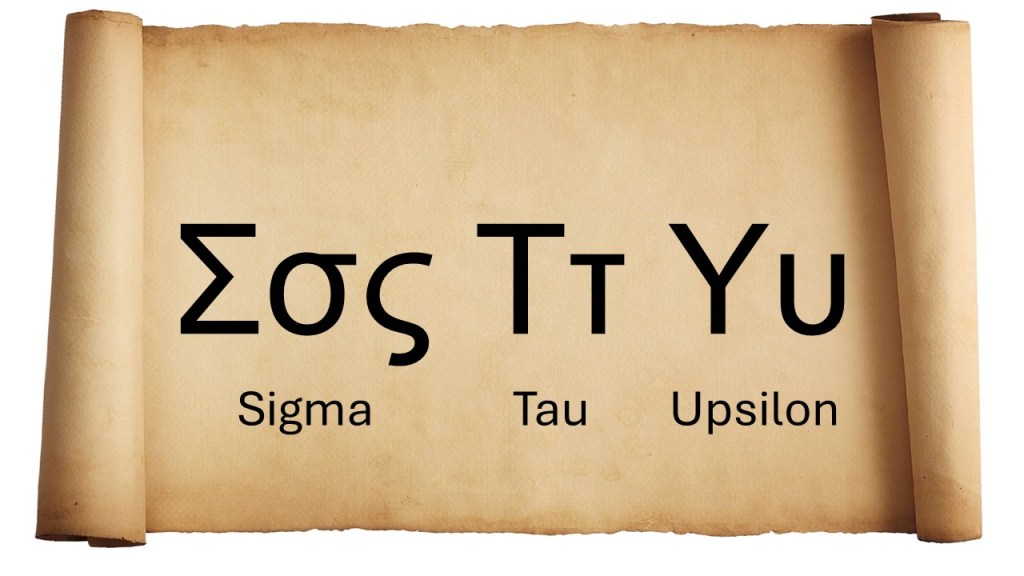
Lesson 9: This post is the ninth in a series that explains how to pronounce the Koine Greek alphabet and Greek words. Each post explains three Greek letters and provides example words that contain only the letters covered to that point. This post explains the letters sigma, tau, and upsilon.
σίɣμα / sigma

Sigma is equivalent to the S/s in the English alphabet.
The lower-case sigma has two forms. ς is called a final sigma and is used only at the end of words. Elsewhere it is written as σ. Note that the tail of the final sigma goes below the base line. Be careful not to confuse the lower-case sigma (σ) with the lower-case omicron (ο).
Sigma always sounds like the s in the English word set.
ταῦ / tau

Tau looks like and is equivalent to the T/t in the English alphabet.
The primary sound of tau is like the t in the English word star, but not the t in English word tar – it is not aspirated. It sounds like the d in the English word den when it comes after the Greek letter nu (ν). This is similar to English pronunciation of t when it comes after an n. For example, many people (mis)pronounce the word dentist as dendist – softening the t to a d.
ὖ ψιλόν / upsilon

The upper-case upsilon looks like the upper-case English Y, but that is the only resemblance. Upsilon is a vowel that is somewhat similar to the U/u in the English alphabet.
Scholars have various opinions about the sound of upsilon. The exact primary sound of the letter upsilon does not exist in English. In Koine Greek it might have been equivalent to the French vowel u as in the French word du. The u in the English word flu is a sufficient approximation of the sound when pronounced with your lips tightly rounded and your tongue touching the tops of your lower front teeth.
The primary sound of upsilon is like the u in flu. However, in the vowel combinations αυ, ευ, and ηυ it sounds like the v in the English word vet.
This was not always the case, but by the time of Koine Greek the upsilon had shifted to a consonantal \v\ sound in these three vowel combinations. So, what you need to know to pronounce these vowel combinations is that they sound like the following examples:
αυ sounds like the av in lava \äv\
ευ sounds like the ev in ever \ev\
ηυ sounds like the av in nave \āv\
In other words, these vowel combinations are pronounced using the primary sounds of α (a as in spa), ε (e as in end), or η (e as in olé) followed by a \v\ sound.
If these vowel combinations have a breathing mark and/or accent mark in a word, the mark is always written over the second vowel upsilon. The letters are treated like a unit.
Example Words
Practice saying the example words to learn the sounds represented by the alphabet letters in this lesson.
διδάσκαλος
teacher
[noun]
διδάσκαλος has both forms of the lower-case sigma – the regular sigma (σ) and the final sigma (ς).
English Derivative: Didactic.
Example Verse: [Jesus speaking] “A student is not above the teacher. But everyone, when fully trained, will be like his teacher.” (Luke 6:40)
πιστεύω
I believe
[verb]
The upsilon (υ) sounds like the v in vet.
Example Verse: [Jesus speaking] “For this is how much God loved the world: He gave His one and only Son, so that everyone who believes in Him will not perish, but have everlasting life.” (John 3:16)
σταυρός
cross
[noun]
The upsilon (υ) sounds like the v in vet. This noun also has the regular sigma (σ) at the beginning and the final sigma (ς) at the end.
Example Verse: Now Pilate also wrote an inscription of charges and put it on the cross. It said: “Jesus the Nazarene, the King of the Jews.” (John 19:19)
ɣυνή
woman, wife
[noun]
ɣυνή can mean “woman” or “wife” depending on the context.
The Gamma sounds like the gh in ghost.
English Derivatives: Gynecology, misogynist.
Example Verse: Then Jesus said to the woman, “Your faith has saved you. Go in peace.” (Luke 7:50)
Example Verse: Husbands, love your wives, as Christ also loved the church and gave Himself for her. (Ephesians 5:25)
τεσσεράκοντα
forty
[number]
τεσσεράκοντα has both sounds of the letter tau. The first tav sounds like the t in star and the second tau sounds like the d in den.
Example Verse: Jesus was in the wilderness forty days, being tempted by Satan. He was among the wild animals, and the angels were ministering to him. (Mark 1:13)
Practice & Review
ἀββά
father
ἄɣω
I lead, bring, go
ὧδε
here
ἐɣώ
I
ɣῆ
earth, land, soil
ζωή
life
θεά
goddess
ἀδικία
unrighteousness
ἀλήθεια
truth
καί
and, even, also
εἰμί
I am
ɣεμίζω
I fill
λαμβάνω
I take, receive
ἔξω
outside
πέμπω
I send
ἀνήρ
man, husband
παραβολή
parable
διδάσκαλος
teacher
πιστεύω
I believe
σταυρός
cross
ɣυνή
woman, wife
τεσσεράκοντα
forty
The table below shows the Greek alphabet in order from alpha to omega. Verbs are highlighted in yellow. Lower-case sigma, highlighted in blue, has two forms.

Here are two options to hear the the entire Greek alphabet recited:
- Click here to listen to a 30 second audio file of the alphabet.
- Click here to view a 1 minute video of the alphabet.
*Symbols enclosed in left slashes such as \ä\ are Merriam-Webster Pronunciation Symbols. These are the standard pronunciation symbols used in the Merriam-Webster dictionary. They are provided as another way to know the sound of each Greek letter. Click here for a downloadable PDF document that explains the symbols and includes a one-page chart on the last page. They are also explained in any hardcopy edition of the Merriam-Webster dictionary.
Bibliography
Danker, Frederick William (Editor). A Greek-English Lexicon of the New Testament and other Early Christian Literature, Third Edition (BDAG). The University of Chicago Press. 2000.
Unless otherwise noted, English translations of Bible verses are by the author from the Greek text and are not quotations from any copyrighted Bible version or translation.
© Copyright 2022 by Matthew Jones
koinefoundations@gmail.com
 Koine Foundations
Leave a comment