Prologue
1:1 What was from the beginning, what we have heard, what we have seen with our eyes, what we looked at intently and our hands touched, concerning the Word, the source of life –
1:2 This Life was revealed. We have seen it. And so, we testify to it and proclaim to you this Life, the Eternal Life, which was in the presence of the Father and was revealed to us.
1:3 – what we have seen and what we have heard we proclaim also to you so that you too may have fellowship with us. And indeed, this fellowship of ours is with the Father and with His Son, Jesus Christ. 1:4 We are writing these things so that our joy may be full.
Translation by the author from the SBL Greek New Testament.
Summary of Verses 1:1-4
In the Prologue, John establishes that he was a eyewitness to the revelation of the Eternal Life that was incarnated in the historical person of Jesus Christ. God’s message was revealed to mankind in such a way that it could be audibly heard, visually seen, and yes, even physically touched. It took on a personal form in Jesus Christ. This Eternal Life is now available to those who believe in Jesus Christ.
Click here for a full outline of First John.
Verse 1:3
– what we have seen and what we have heard…
See the previous post for comments about the verbs “we have seen” and “we have heard“.
The chiasmus that runs through this section comes to an end at the beginning of verse 1:3 as John repeats the verbs first used in verse 1:1 (A and B) in reverse order in verse 1:3 (B’ and A’):
A we have heard / ἀκηκόαμεν (1:1)
B we have seen / ἑωράκαμεν (1:1)
C was revealed / ἐφανερώθη (1:2)
Focus: the Eternal Life / τὴν ζωὴν τὴν αἰώνιον (1:2)
C’ was revealed / ἐφανερώθη (1:2)
B’ we have seen / ἑωράκαμεν (1:3)
A’ we have heard / ἀκηκόαμεν (1:3)
The close of the chiasmus provides a segue to the main verb of this section (“we proclaim“) and to the introduction of the important theme of fellowship that runs through the entire letter.
we proclaim also to you so that you too may have fellowship with us.
John proclaims what he has seen, heard and touched so that the readers can experience fellowship with those who were eyewitness of Jesus Christ.
“fellowship” means more than shaking hands during greeting time during Sunday services or having a potluck dinner. As Kruse comments in his commentary, it denotes a personal relationship and a partnership in the work of proclamation. [KRUSE p. 62]
And indeed, this fellowship of ours is with the Father and with His Son, Jesus Christ.
However, this fellowship is not simply with John and the other eyewitnesses, but is also with the Father (i.e., God) and with His Son, Jesus Christ. This statement strikes at the heart of what the disruptors were teaching. Based on what John writes later in verse 2:23, it appears that the disruptors were teaching some kind of Christless Christianity where it was possible to have fellowship with God without Jesus Christ. [MARSHALL p. 106] John counters:
Everyone who denies the Son does not have the Father either. The one who acknowledges the Son, also has the Father. (1John 2:23)
What John is proclaiming is that no one can have fellowship with God without fellowship with Jesus Christ, the Son of God. Whoever has fellowship with Him has fellowship with the Father through Him. He is the Word, the source of Eternal Life, that revealed the way to God. And in fact, He Himself is the way, as He claimed:
I am the way, and the truth, and the life. No one comes to the Father except through me. (John 14:6)
In the remainder of the letter, John will develop the topic of fellowship under three dependencies:
– Fellowship Depends on Walking in the Light (1:5-2:28)
– Fellowship Depends on Practicing Righteousness (2:29-4:6)
– Fellowship Depends on Expressing Mature Love (4:7-5:4)
Verse 1:4
General Comments
Verse 1:4 brings the prologue to a close.
We are writing these things so that our joy may be full.
John cannot have full joy if the church members are led astray by false teaching, resulting in his loss of fellowship with them. He has a sincere and deep love for them. So, he writes the letter to assure that they are solidly grounded in the truth – what was passed down from Jesus Christ Himself. His joy is seeing that they know the truth and live lives based on the truth.
“we” – Though John is writing the letter, he associates himself with other first-hand eye-witnesses. [KRAUSE p. 65]
“our” – Probably includes John and the readers/listeners.
Greek Note: Textural Variants
The Greek manuscripts of First John contain two minor textural variants for this verse. A textual variant is a difference between the wording of two or more manuscripts, due to errors in copying or changes made by a scribe to “correct” what he thought was an error. The New Testament was written long before the printing press and photocopiers were invented, so copies were made by hand copying. Variants were inevitable. Textural scholars review variants to determine what was originally written and how the variant came about. Scholars estimate that over 2 million copied pages exist for the New Testament, far more pages than for any other ancient writing! On average, there is only one variant for every four pages. Over 99% of these variants are unimportant and do not affect the meaning of the text because they consist of things like spelling differences and word order.
In verse 1:4, The first variant makes the following minor difference in translation:
(1) “we are writing these things” vs. (2) “we are writing these things to you“
The variant in Greek is:
(1) καὶ ταῦτα γράφομεν ἡμεῖς vs. (2) καὶ ταῦτα γράφομεν ὑμῖν
The difference is the last word of the phrase – ἡμεῖς / hēmeis (“we“) vs. ὑμῖν / humin (“to you“).
(1) ἡμεῖς is the pronoun “we” used as the subject, which is not technically needed in Greek since the subject is expressed as part of the verb ending of γράφομεν. If ἡμεῖς is original, it adds some emphasis to the subject.
(2) ὑμῖν is a pronoun used as an indirect object meaning “to you”. Obviously John is writing to them, so if this variant is original it does not add anything to the meaning of the sentence.
Textual scholars evaluate (1) to be the original and believe that (2) was a “correction” made by a scribe who thought his manuscript had an error.
The second variant makes the following minor difference in translation:
(1) “that our joy may be full” vs. (2) “that your joy may be full“.
The variant in Greek is:
(1) ἡμῶν / hēmōn (“our”) vs. (2) ὑμῶν / humōn (“your“).
The difference is one Greek letter: the initial letter ἡ- (eta) vs. the initial letter ὑ- (upsilon) in these words. This variant may be the result of an error in hearing. The pronunciation of Greek changed after the Koine period and into the Byzantine period so that ἡμῶν and ὑμῶν were pronounced exactly the same. A scribe who was copying in a Scriptorium based on the text being read (rather than copying by sight) may have chosen the wrong Greek word since they are pronounced the same.
Textual scholars evaluate (1) to be the original.
Go back to Verses 1:1-2
Go forward to Verse 1:5
Your Personal Study
Read First John 1:5 to 2:28 in your preferred translation, or click here to read from my translation of First John.
1. John likes to use contrasts in his writings. Find several contrasts in this section based on either words or ideas?
2. What does that statement “God is light” mean?
3. What are the moral implications if “God is light”?
First John Translation.
First John Translation with Outline and Notes.
Bibliography of source information used for this series of posts.
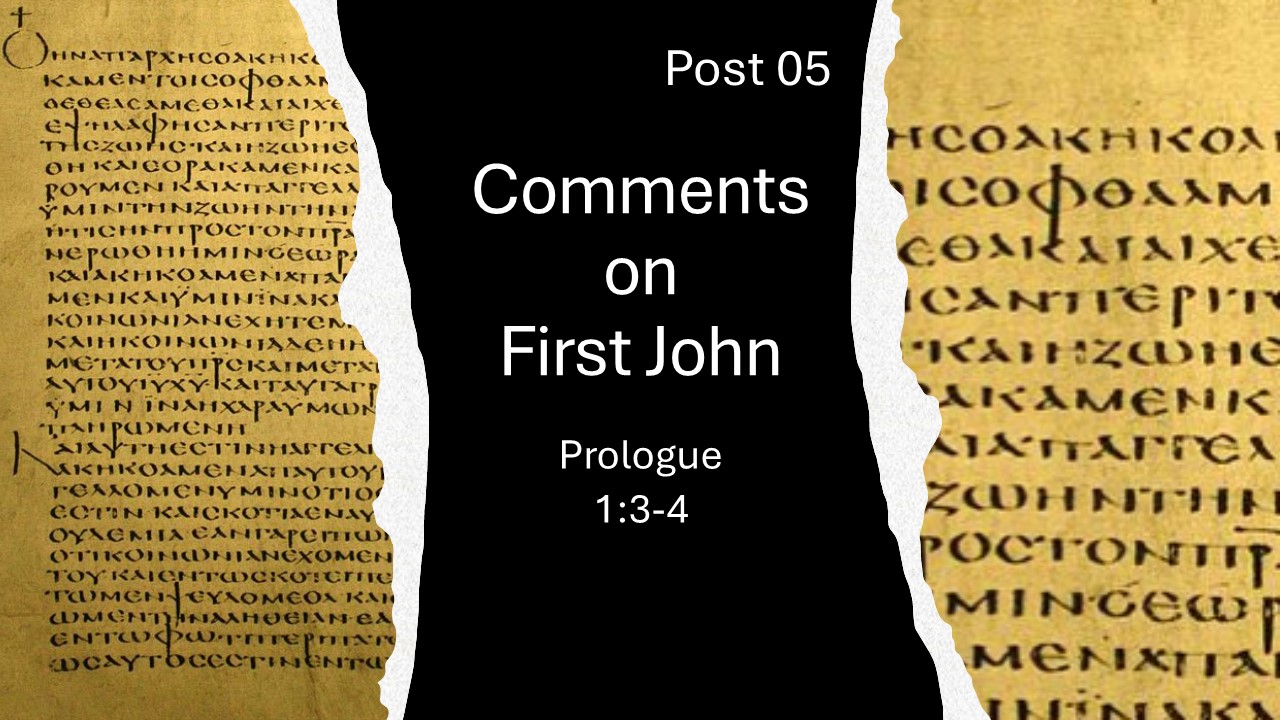
Title Slide Image Credit: First John in Codex Alexandrinus, Public domain, via Wikimedia Commons.
Unless otherwise noted, English translations of Bible verses are by the author from the Greek text and are not quotations from any copyrighted Bible version or translation.
© Copyright 2022-2024 by Matthew Jones
koinefoundations@gmail.com
 Koine Foundations
Leave a comment