
Warning: Walking in the Light is not Compatible with Love for the World!
2:15 Do not love the world or the things in the world. If anyone loves the world, love for the Father is not in him, 2:16 because all that is worldly –
The craving for what the flesh desires,
The craving for what the eyes see,
The arrogant pride over material possessions,
– is not from the Father but is from the world. 2:17 What’s more, the world is passing away, along with its cravings. But the one who does the will of God abides forever.
Translation by the author from the SBL Greek New Testament.
Summary of Verses 2:15-17
In this unit and the next (2:18-28), John ends the First Proclamation section with two warnings. The first warning in this unit is about loving worldly things. The one who loves worldly things cannot love God or love others.
Click here for a full outline of First John.
Structure of Verses 2:15-17
Verses 2:15-17 are a small unit dealing with a believer’s love for the world. It falls in the first proclamation section that develops the topic that God is Light – those who have fellowship with God walk in the light. The point of this unit is that walking in the light is not compatible with love for the world. The believer whose “love of God has reached a state of maturity” (verse 2:5) does not love the world or the things in the world.
This unit introduces the concept of overcoming the world that is developed throughout the letter, and comes to a climax in verse 5:4:
For everyone born of God overcomes the world, and this is the overcoming power that has overcome the world – our faith.
There are a several links from this unit to other parts of the letter based on the use of identical words:
- Just as in verse 2:8, “the darkness is fading away” (παράγεται / paragetai), so also in verse 2:17 “the world is passing away” (παράγεται / paragetai). This make sense because the world is the realm of darkness.
- In verse 2:16 believers are warned against “arrogant pride over material possessions” (βίου / biou), and in verse 3:17 are warned about having “a means of living” (βίου / biou) but closing their hearts to those in need.
The fact that the “the world is passing away” stated near the end of this unit provides a transition to the next unit. Not only is the world passing away (2:17), but in fact it already “is the last hour” (2:18).
Verse 2:15
Do not love the world or the things in the world.
After affirming the readers’ adherence to the truth in the previous unit (2:12-14), John begins this unit with the first command in this letter directed at his readers: “Do not love the world or the things in the world.“
Love in this section means something different from that in verse 2:10 where love was a selfless love focused on the well-being of others:
The one who loves his fellow believer abides in the light and there is nothing in him to cause others to stumble.
In this verse, love refers to the love for the pleasures and attractions of this world that are in opposition to God’s good commandments. Specifically what Johns has in mind are “the things in the world” that are characteristic of this fallen world which are defined in the next verse, 2:16.
The difference is between a love that is outward focused on others (selfless) or inward focused on self (selfish).
The “world” refers to the evil system that is under the control of the Evil One (see verse 2:14) that is in rebellion against God and His standards. The world is under God’s judgment (John 9:39) but also the object of God’s love (John 3:16). [MARSHALL p. 142]
If anyone loves the world, love for the Father is not in him,
Love for the world and love for God are not compatible.
Greek Note: love for the Father
The phrase translated “love for the Father” (ἡ ἀγάπη τοῦ πατρὸς / ē agapē tou patros) is another genitive construction that can have two different translations. A completely literal translation is, “the love of the Father”. But this can mean either “the Father’s love for us” (a subjective genitive), or “our love for the Father” (an objective genitive). Most commentators choose the latter, as I have done in my translation. The main reason for this is that it makes it parallel and in opposition to the previous phrase: one’s love for the world vs. one’s love for the Father.
Verse 2:16
because all that is worldly –
John now lists three statements that explain what the worldly things are which he introduced in verse 2:15. Ultimately, these things originate in the world and stand in opposition to God’s standards.
Note that God created material things for our pleasure and provides material things so that we can live and prosper. So John is not necessarily condemning material things as evil. Rather, as I. Howard Marshall explains in his commentary: “When I begin to desire more than other people, to covet whatever I see, to boast of what I have, and to claim that I am self-sufficient, then my desires have become perverse and sinful, and I stand condemned.” [MARSHALL p. 146] It is not the things themselves that are wrong, but the desire for the things that draws our love away from God and to things opposed to God.
The craving for what the flesh desires,
The first statement about worldly things.
This can cover a wide range of things. It is every human craving that is in opposition to God. It includes cravings for sexual gratification, drugs, alcohol, wealth, material goods, and fame.
The craving for what the eyes see,
The second statement about worldly things.
Our sinful cravings are often aroused by what we see. This refers to anything that entices the eyes and results in covetousness, greed, and sexual desire such as pornography.
The arrogant pride over material possessions,
The third statement about worldly things.
Many Bible versions translate this as “the pride of life” or “pride in possessions”. The Greek is difficult to translate into a simple English phrase. The idea is that of a person who is obsessed with accumulating “stuff” as a status symbol to impress others – having the newest and the best and boasting about it. It may also imply having a prideful attitude of security in one’s own possessions rather than dependence on God.
– is not from the Father but is from the world.
John now gives a reason why the believer should not love the world: all that is worldly is not from the Father, but from the world.
Greek Note: Chiasmic Phrase
John uses a chiasmic phrase to make his final point in this verse memorable. A chiasmic phrase is a short two-part phrase where the second part mirrors the first. Below is the Greek and a word-for-word translation, with the mirrored parts highlighted in identical colors. John loves to use various grammatical devices in his writing. The flexibility of Greek word order allows authors to easily create these types of features.
οὐκ ἔστιν ἐκ τοῦ πατρὸς ἀλλ᾽ ἐκ τοῦ κόσμου ἐστίν
not is from the Father but from the world is
Verse 2:17
What’s more, the world is passing away, along with its cravings.
Another reason why believers should not love the world is that it is passing away, along with its cravings. John made a similar point in verse 2:8 where he said that the darkness is fading away.
The fact that the “the world is passing away” provides a transition to the next unit. Not only is the world passing away, but in fact it already “is the last hour” (2:18).
Greek Note: is passing away
The verb translated “is passing away” (παράγεται / paragetai) is a Present Tense form which portrays the world’s passing as an ongoing process that has already begun. It started with the revealing of Jesus Christ (1:2). History is moving toward a goal and there is no future in loving this world. However, there is an eternal destiny for those who love God by doing His will.
But the one who does the will of God abides forever.
All that the world offers is passing away, but those who walk in the light, by doing God’s will, abide forever. This is a contrast between what is fleeting and temporary and what is lasting and eternal.
Unit Summary
- Love for the world and love for God are not compatible.
- “The world is not simply a passive entity, but a rival for the allegiance of every person.” [YARBROUGH p. 134]
- There is no future in loving the world. However, there is an eternal destiny for those who love God.
- A person’s love of the world versus his love of the Father provides a test for whether he is walking in the light.
Go back to Verses 2:12-14
Go forward to Verses 2:18-20
Your Personal Study
Read First John 2:18-20 below and answer the questions.
2:18 Children, it is the last hour, and just as you heard that Antichrist is coming, even now many have become antichrists. From this we know that it is the last hour. 2:19 They separated from us, but they were not part of us. For if they had really been part of us, they would have remained among us. But they separated, in order that they might be revealed for what they are – that none of them are part of us. 2:20 You have an anointing from the Holy One and you all understand this.
1. What is the significance of John calling the readers “children“?
2. What do you think the phrase “it is the last hour” means?
3. What is the evidence that it really is the last hour?
4. What do you think makes a person an “antichrist”?
5. Did John’s readers personally know these antichrists? How do you know?
6. Did the antichrists leave voluntarily or were they expelled?
7. What did their separation reveal about them?
8. Who do you think the title “Holy One” refers to?
9. The idea of “having an anointing from the Holy One” is a difficult concept. What do you think this means?
First John Translation.
First John Translation with Outline and Notes.
Bibliography of source information used for this series of posts.
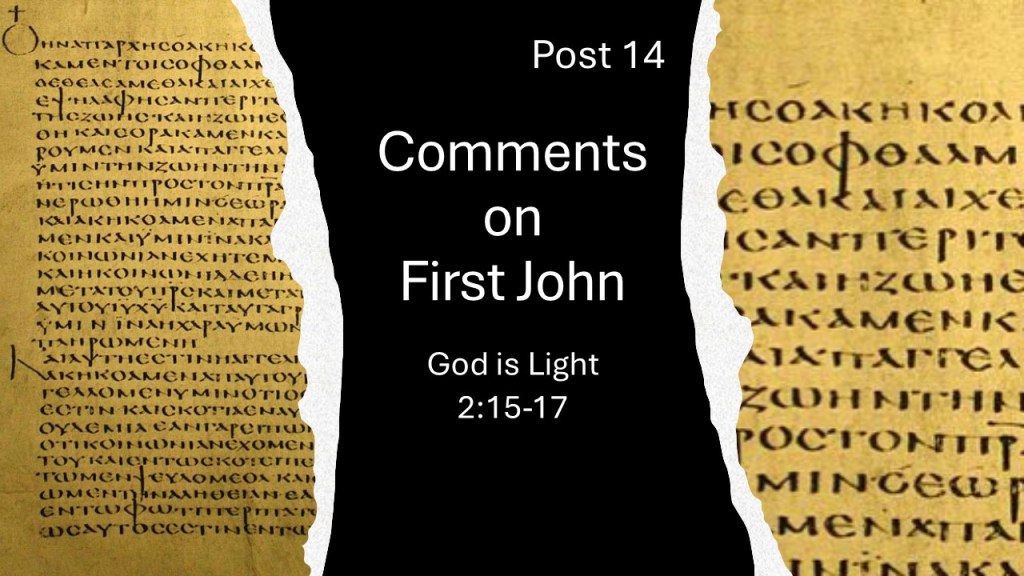
Title Slide Image Credit: First John in Codex Alexandrinus, Public domain, via Wikimedia Commons.
Unless otherwise noted, English translations of Bible verses are by the author from the Greek text and are not quotations from any copyrighted Bible version or translation.
How you can have eternal life.
© Copyright 2022-2024 by Matthew Jones
koinefoundations@gmail.com
 Koine Foundations
Leave a comment