
Righteousness is Expressed in Loving Others
3:11 For this is the message that you have heard from the beginning, that we should love one another.
3:12 We should not love like Cain. He was an offspring of the Evil One, and violently killed his brother. Why did he murder him? Because his own deeds were evil, but his brother’s were righteous. 3:13 So, fellow believers, don’t be surprised if the world hates you.
3:14 Because we love fellow believers, we know that we have passed out of death into life. The one who does not love abides in death. 3:15 Everyone who hates his fellow believer is a murderer, and you know that absolutely no murderer has eternal life abiding in him.
3:16 This is how we know what love is: ˹Christ˺ laid down His life for us. So, we also ought to lay down our lives for fellow believers. 3:17 But whoever has a means of living, and sees his fellow believer in need, and closes his heart to him, how can God’s kind of love abide in that person?
3:18 Little children, let us not love by merely talking about it, rather let us love through actions consistent with the truth.
Translation by the author from the SBL Greek New Testament.
Summary of Verses 3:11-18
In this unit, John focuses on the specific action of love. The authentication of a righteous life is love for others, and specifically love for fellow believers as demonstrated by actions consistent with the truth, and not merely through words. What love is not, is seen in the negative example of Cain (3:12-15). What love is, is seen in the positive example of Christ (3:16-18).
Click here for a full outline of First John.
Verse 3:16
This is how we know what love is: ˹Christ˺ laid down His life for us.
What love is not, was seen in the negative example of Cain in verses 3:12-15. What love is, is now seen in the positive example of Christ here in verses 3:16-18. Christ is presented as the supreme example of love that believers should imitate. He demonstrated what love is by dying for us. “Until the world saw that, it never knew what love is.” [SMITH p. 186] Love is truly understood through the historical event of Christ’s death.
See John 10:11, 10:15, and 10:17-18 where Jesus spoke about laying down His life.
Christ died “for us” means that “he acted in place of us: he died in order that we might not die”. [MARSHALL p. 193, footnote 17] It was not an act of martyrdom, but an act of atonement to pay for our sins.
As in verse 3:7, the word “Christ” here in my translation is a substitution for the far demonstrative pronoun ἐκεῖνος / ekeinos in the Greek text, which means “that one”. So a more word-for-word rendering of the phrase would be: “that one laid down His life for us“. The pronoun is translated as “he” in most English translations. In First John, John uses this pronoun six times as a personal reference to Christ (2:6; 3:3; 3:5; 3:7; 3:16; 4:17), and always in the context of Christ as an example for Christians.
In this verse, Christ is presented as the supreme example of love, and the next phrase states how those who believe in Him are to follow His example.
So, we also ought to lay down our lives for fellow believers.
Our “love must be prepared to meet the needs of others whatever the cost in self-sacrifice”. [MARSHALL p. 194]
This phrase does not necessarily mean that the believer is to physically die for others. Christ already did that to atone for sins. Rather, John has a more practical application in mind as explained in verse 3:17.
Verse 3:17
But whoever has a means of living, and sees his fellow believer in need, and closes his heart to him, how can God’s kind of love abide in that person?
Believers are indirectly admonished to lay down their lives by sharing their material possessions with fellow believers who have life-sustaining needs. As Glenn Barker notes in his commentary: “How can we know whether we would sacrifice our life for a brother? We can know by being compassionate toward him in his present need.” [BARKER p. 336] This is loving as Christ loved.
“God is the ultimate source of all provision, but most often he distributes it through people helping people. Everything we have is by the grace of God, and to withhold life resources from those in need blocks his channel of provision for them.” [JOBES pp. 158-159]
Greek Note: a means of living
The phrase “a means of living” is a translation of the Greek words τὸν βίον τοῦ κόσμου / ton bion tou kosmou. A word-for-word translation of this is “the livelihood of the world“. “World” is used here in a neutral sense. The phrase has the idea of the worldly resources, possessions, or goods needed to maintain one’s life. Note that when John speaks about who should share, he says it is those who have “a means of living” (which includes most people), rather than those who have wealth or riches (which we always think of as the other person). Most people have resources they can share with those in need.
Greek Note: God’s kind of love
The phrase “God’s kind of love” is a translation of the Greek words ἡ ἀγάπη τοῦ θεοῦ / hē agapē tou theou. A word-for-word translation of this is “the love of God“, where “God” (θεοῦ / theou) is in the genitive case. The Greek phrase and the word-for-word translation are vague and could mean either:
(a) Our love for God, understanding “God” grammatically as an objective genitive. Thus translated as: “How can love for God abide in that person?” Love for fellow believers is the visible expression of love for God (see 1 John 4:20).
(b) God’s love for us, understanding “God” grammatically as a subjective genitive. Thus translated as: “How can love from God abide in that person?” Love for fellow believers if the visible expression of God’s love poured out on us (see Romans 5:5).
(c) God’s kind of love, understanding “God” grammatically as descriptive or a genitive of quality. Thus translated as: “How can God’s kind of love abide in that person?” Love expressed to fellow believers by sharing is God’s kind of love (see Hebrews 13:16).
I chose option (c) for my translation, but all three options represent aspects of God’s love as taught in scripture. And ultimately, the point of the verse is unaffected. As I. Howard Marshall notes in his commentary: “Christian love is love which gives to those in need, and so long as we have, while our brothers have little or nothing, and we do nothing to help them, we are lacking in the love which is the essential evidence that we are truly children of God.” [MARSHALL pp. 194-195]
Verse 3:18
Little children, let us not love by merely talking about it, rather let us love through actions consistent with the truth.
See James 2.15-16 for a similar teaching about talk vs. actions in relation to helping those in need.
John ends this unit with a direct command. Loves requires actions rather than mere talk.
Actions that are “consistent with the truth” are loving deeds done according to the love revealed in and demonstrated by Jesus Christ.
Go back to Verses 3:11-15
Go forward to Verses 3:19-24
Your Personal Study
Read First John 3:19-24 below and answer the questions.
3:19 So this is how we will know that we belong to the truth and will be able to persuade our heart in ˹God’s˺ presence, 3:20 because if our heart condemns us, we know that God is greater than our heart and He knows all things.
3:21 Beloved, when our heart does not condemn us, we have confidence before God 3:22 so that whatever we request we receive from Him, because we keep His commandments and do the things that please Him. 3:23 And this is His commandment, that we believe in the name of His Son, Jesus Christ, and we love one another, just as ˹Jesus Christ˺ gave the commandment to us. 3:24 The one who keeps His commandments abides in ˹God˺ and ˹God˺ in him. And this is how we know that ˹God˺ abides in us, from the Spirit whom He gave to us.
Note: The opening phrase of verse 3:19, “so this is how we will know“, looks back to the content covered in the previous unit. The line of argument is that if we “lay down our lives for fellow believers” (verse 3:16), in a practical manner so that we “love through actions consistent with the truth” (verse 3:18), then “we will know that we belong to the truth“, and also “will be able to persuade our heart in ˹God’s˺ presence“. Stated simply, our loving actions show that we belong to the truth.
1. We often fail to love others as we should. This causes guilt and a lack of assurance that we belong to the truth. In such situations, who provides the basis for our assurance?
2. According to verse 3:22, what is a benefit of having confidence before God?
3. According to verse 3:22, what is the qualification for receiving the things we ask God for?
4. According to verse 3:23, what is the commandment we are to keep? (It has two parts.)
5. What do you think it means to believe in the name of Jesus Christ?
6. According to verse 3:24, who is a the source of confidence and assurance that God abides in us?
First John Translation.
First John Translation with Outline and Notes.
Bibliography of source information used for this series of posts.
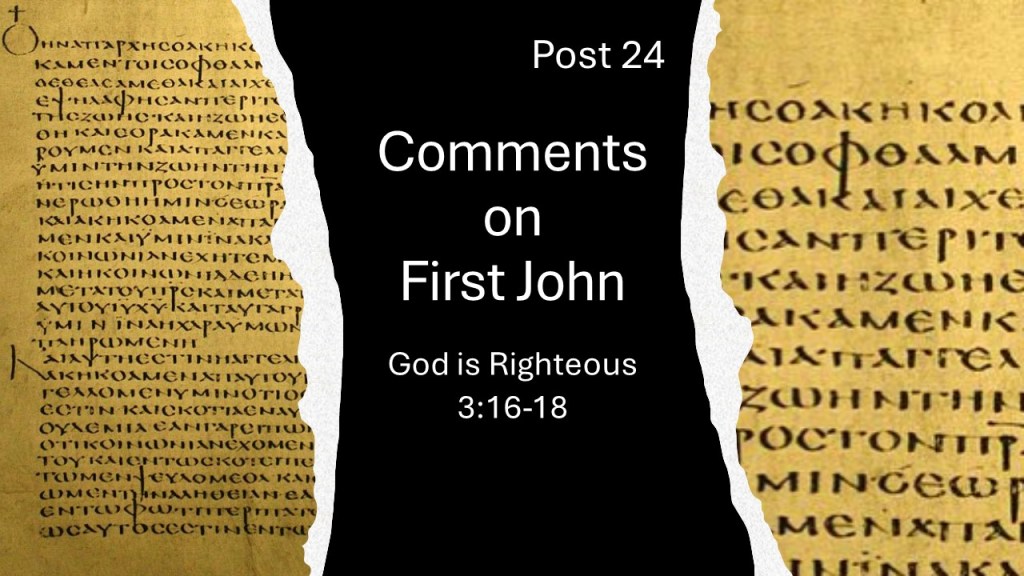
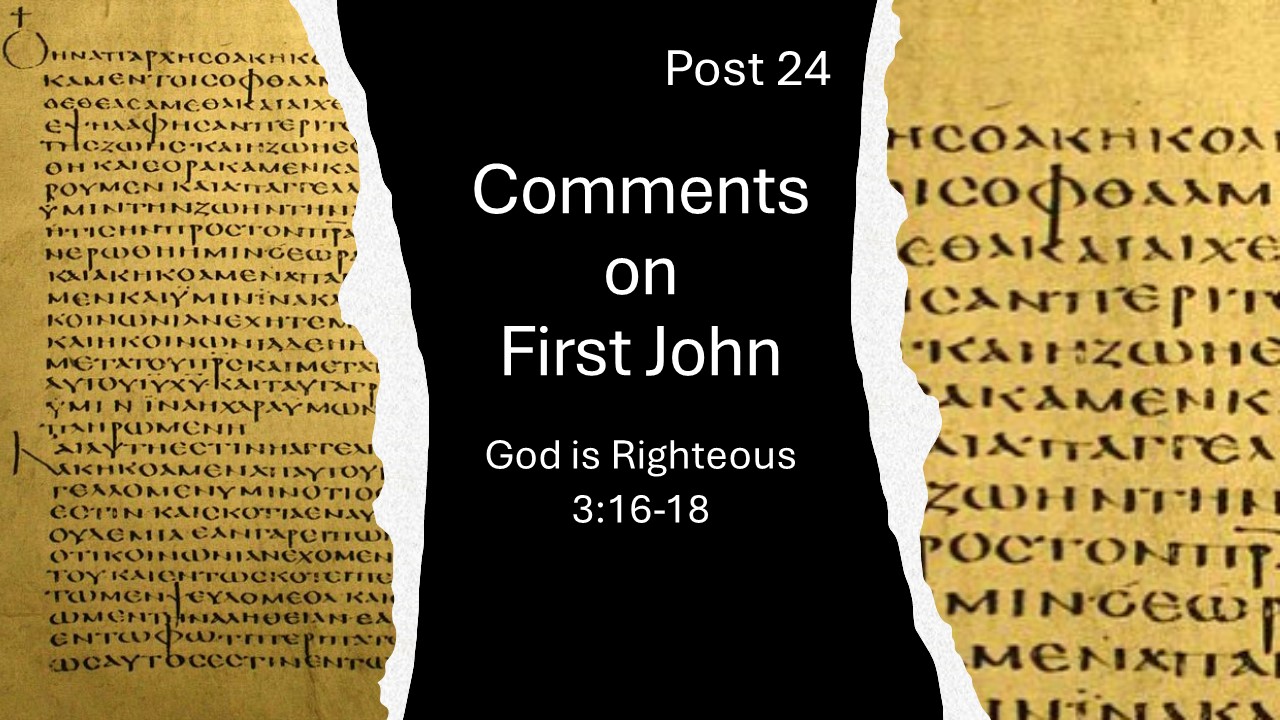
Title Slide Image Credit: First John in Codex Alexandrinus, Public domain, via Wikimedia Commons.
Unless otherwise noted, English translations of Bible verses are by the author from the Greek text and are not quotations from any copyrighted Bible version or translation.
How you can have eternal life.
© Copyright 2022-2024 by Matthew Jones
koinefoundations@gmail.com
 Koine Foundations
Leave a comment