

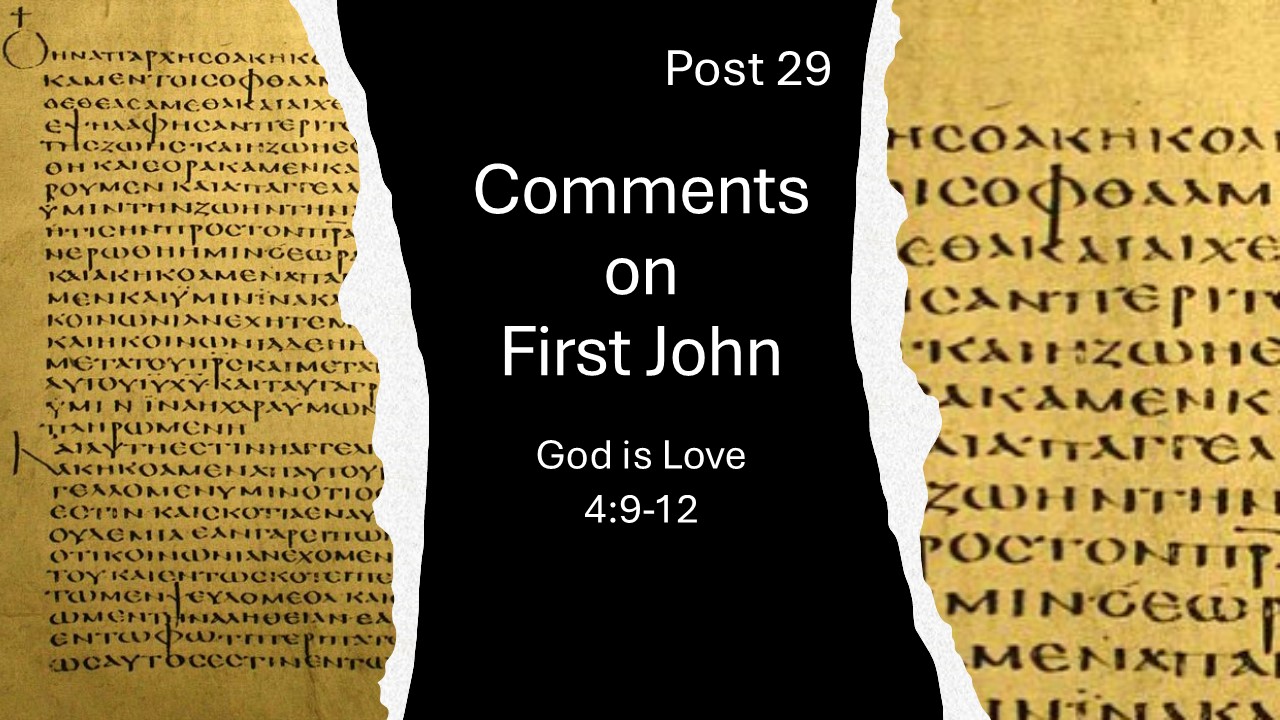
God’s Love was Revealed in Jesus Christ and is Expressed Through Us
4:9 And this is how the love of God was revealed among us: God has sent His one and only Son into the world so that we might live through Him. 4:10 This is love: Not that we have loved God, but that He loved us and sent His Son, the placater of God’s wrath for our sins.
4:11 Beloved, since God loved us like this, we also ought to love one another. 4:12 No one has ever seen God. If we love one another, God abides in us and His love has reached a state of maturity in us.
Translation by the author from the SBL Greek New Testament.
Summary of Verses 4:9-12
In this unit, John explains that the sacrificial love that originated in God (4:7-8) was revealed among us in His Son (4:9-10), and reaches a state of maturity in us when we obey God’s command to love others with the same kind of love (4:11-12).
Click here for a full outline of First John.
Verse 4:9
And this is how the love of God was revealed among us:
The statement that “God is Love” at the end of verse 4:8 is explained in verse 4:9 by what God did that expressed His loving nature.
Note: among us
“among us” is my translation of the Greek prepositional phrase ἐν ἡμῖν / en hēmin. It can be translated as “in us” / “within us” indicating that the love of God was revealed as an inward experience that is internal within each believer (a personal sense), or “among us” indicating that the love of God was revealed in the midst of the group of believers (a collective sense) – a choice between the ideas of inside vs. among.
I believe “among us” better communicates the idea expressed in this verse because the focus here is more on the collective than the personal. The body of believers is the means by which God’s love becomes known to the world as believers express love for one another [see MARSHALL p. 213, footnote 5]. His love was revealed in a way that could be seen. It was not merely inside those who believe.
God has sent His one and only Son into the world so that we might live through Him.
God revealed His love among us by sending His Son so that people can have life by believing in His Son, Jesus Christ. Life is made available to those who are dead – separated from God and from His life (see Ephesians 2:1 and 2:5). Because of God’s love they can pass “out of death into life“(1 John 3:14).
As I. Howard Marshall notes in his commentary, “The cross of Jesus is the visible appearance in this world of love that stretches back beyond our vision into the depths of eternity”. [MARSHALL p. 214]
Note that the verse says “that we might live through Him” rather than “that we might be saved through Him“. (But see verse 4:14.) Certainly, Christ did come to save, as John 3:17 and many other New testament verses attest. But John’s focus here is on the life aspect of that salvation. Eternal life is found in Jesus Christ, and only in Him. John will emphasize this point later in 1 John 5:11-12:
5:11 And this is the testimony: God gave eternal life to us and this life is in His Son. 5:12 The one who has the Son has this life. The one who does not have the Son of God does not have this life.
Greek Note: has sent
“has sent” is a translation of the Greek verb ἀπέσταλκεν / apestalken. It’s parsing is perfect active indicative. The perfect tense indicates a present state resulting from a past action. “The perfect tense is used here because the influence of the Incarnation is permanent.” [SMITH p. 191]
Verses 4:10
This is love: Not that we have loved God, but that He loved us and sent His Son,
Love is not innate in humans. The true origin of love is God and it was expressed in the historical action of God sending His Son.
God’s example of love defines what true love is: “the commitment to sacrifice one’s most beloved possession for another’s gain”. [BARKER p. 343] So love required God to send His Son as the placater of His wrath for our sins.
the placater of God’s wrath for our sins.
The Son (i.e., Jesus Christ) is described as the placater of God’s wrath that is directed toward us. God’s wrath is a response to the evil that we do – His proper reaction to our sin. Jesus Christ is able to turn away God’s wrath because of His death which was a substitutionary sacrifice that paid the penalty for our sins. His death satisfied the wrath of God.
God cannot overlook sin, but because of His deep love for us, He provided the solution to restore our fellowship with Him. In fact it was God the Father who gave His Son to be the sacrifice for our sins. He provided the means for forgiveness and paid the cost.
“The depth of God’s love is to be seen precisely in the way in which it bears the wounds inflicted on it by mankind and offers full and free pardon.” [MARSHALL p. 215]
Greek Note: placater of God’s wrath
The phrase “placater of God’s wrath” is my translation of the single Greek word ἱλασμός / hilasmos (G2434) in the original Greek text. English Bibles typically translate it as “propitiation”, “expiation”, or “atoning sacrifice” – words which are not familiar to most people.
Biblical scholars and theologians have debated the meaning of this word in this verse for hundreds of years. I will not try to explain the debate, but here is a very brief explanation of the two major views.
(1) ἱλασμός refers to propitiation which is the turning away of wrath by an acceptable offering. This is how the word was used in secular Greek in reference to making offerings to appease a god who had been offended. In the case of Christianity, the acceptable offering is the death of Christ which placates God’s wrath.
(2) ἱλασμός refers to expiation which means cancellation, dismissal, or removal. God is merciful and waives the penalty for our sins because of the death of Jesus Christ.
Verses 4:11
Beloved,
John again addresses his readers as “beloved” (ἀγαπητοί / agapētoi) which he does six times in this short letter: 2:7, 3:2, 3:21, 4:1, 4:7, and 4:11. The word is significant for the following reasons:
- In each instance, It gets the attention of the reader and signals that what follows is an important statement.
- It highlights the affection John has for the readers.
- It implies that John writes as a mentor who has a true personal interest in the spiritual development of the readers.
“beloved” should probably be understood as not just John’s love for the readers, but also God’s love for the readers – they are beloved by John and God.
since God loved us like this, we also ought to love one another.
The implication of God’s example of love for us is that we have a moral obligation “to love one another“. We are to love as we have been loved. Note that the obligation here appears to focus on loving others rather than loving God in return. But if you have understood the message of First John, then you understand that loving others is loving God.
Verses 4:12
No one has ever seen God.
John makes a nearly identical statement in John 1:18.
At first read, this statement may seem out of place within the context. But it directly connects with love. These two comments are helpful (emphasis mine):
“John’s burden in the epistle, I argue, is that God is light (1:1-2:6), but that light in its ineffable glory is invisible (4:12), and the essential form it assumes in the created world is love. God’s light takes visible shape when God’s people reflect his love.” [YARBROUGH p. 231]
“The invisibility of God is a major premise of the Johannine books (cf. John 1:18), but God is revealed in human expression, first and most supremely in Jesus (1:18; 5:37; 6:46), and second in the quality of Christians’ relationships with others. [JOBES p. 194]
The assumed thought is like this: Just as you can’t see light but you can see its effects, you can’t see God (who is light) but you can see His love revealed in Christ and believers. If believers obey the command to love others, people will see the invisible God through them.
If we love one another, God abides in us and His love has reached a state of maturity in us.
When believers love one another:
- They have assurance that the unseen God abides in them.
- Their love reaches a state of maturity, i.e., they express the same kind of love as God in “its fullest possible earthly expression”. [YARBROUGH p. 245]
This is the second of four times that John refers to love reaching a state of maturity. See 2:5; 4:12; 4:17; 4:18.
Go back to verses 4:7-8
Go forward to verses 4:13-18
Your Personal Study
Read First John 4:13-18 below and answer the questions.
4:13 This is how we know that we abide in Him and He abides in us, by virtue of His Spirit whom He has given to us.
4:14 We have seen and we testify that the Father sent the Son as the world’s Savior. 4:15 Whoever acknowledges that Jesus is the Son of God, God abides in him and he in God. 4:16 And we have come to know and to believe the love that God has in us. God is love, and the one who abides in that love abides in God, and God abides in him.
4:17 In this way love has reached a state of maturity with us, so that we may have confidence on the day of judgment, because just as ˹Jesus˺ is, so also are we in this world. 4:18 There is no fear in this love, rather mature love casts out fear, because fear comes from an expectation of punishment. The one who fears punishment has not reached a state of maturity in love.
1. Who provides assurance to the believer that he abides in God and God abides in him?
2. What is the ultimate demonstration of God’s love?
3. Why did the father send the Son? Who is the Son?
4. What do you think it means to “acknowledge that Jesus is the Son of God“?
5. Abiding in God is really about abiding in His ________. So, faith in Jesus Christ is faith in God’s ________, and our fellowship with God is a fellowship of ________.
6. Understanding and showing God’s love results in ____________________ (v. 4:17) on the day of judgment and removes ________ (v. 4:18).
7. What do you think “the day of judgment” refers to?
8. What do you think this difficult phrase means: “just as Jesus is, so also are we in this world“?
First John Translation.
First John Translation with Outline and Notes.
Bibliography of source information used for this series of posts.
Title Slide Image Credit: First John in Codex Alexandrinus, Public domain, via Wikimedia Commons.
Unless otherwise noted, English translations of Bible verses are by the author from the Greek text and are not quotations from any copyrighted Bible version or translation.
How you can have eternal life.
© Copyright 2022-2024 by Matthew Jones
koinefoundations@gmail.com
 Koine Foundations
Leave a comment