For whatever was previously written was written to teach us, so that we may have hope through endurance and through encouragement from the Scriptures. (Romans 15:4)
As explained in the previous post, revelation is defined simply as God making Himself known to mankind. God created us to know Him, but we could not know God if He did not tell us about Himself.
Theologians and Bible scholars say that there are two avenues of revelation – two ways in which God has revealed Himself. They call these two avenues general revelation and special revelation. I commented on general revelation in the previous post. In this post I will comment on special revelation.
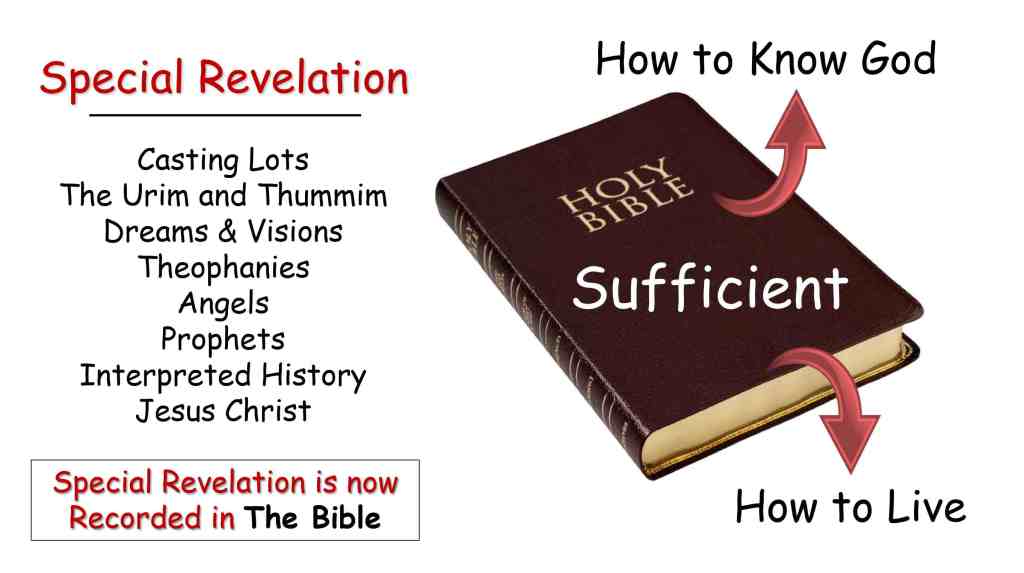
Special revelation is direct communication from God. It has been carried out through a number of agencies throughout history as explained below.
Agencies of Special Revelation
(The agencies listed below are based on a list in Basic Theology by Charles C. Ryrie, pages 71-73.)
Casting Lots – Lots were small objects, perhaps stones, that were cast on the ground or drawn from a container to make a decision, with the belief that God controlled the outcome to reveal His will. What they looked like or how they were interpreted is not known. An Old Testament example of the use of lots is recorded in Joshua 18:8-10. It describes lots being used to apportion land among the various tribes of the Israelites. In a New Testament example, lots were used by the remaining eleven disciples to determine the replacement for Judas, who had betrayed Jesus. (The full account is in Acts 1:12-26. Lots are mentioned in verse 26.)
Click here for a two minute video about lots by GotQuestions.org.
The Urim and Thummim – The Urim and Thummim were objects similar to lots that were used specifically by the Jewish chief priest to determine God’s will in certain situations (see Exodus 28:30; Numbers 27:21). The name implies that there were two objects, possibly precious stones. How they were used is not known.
Dreams and Visions – There are a number of accounts in the Bible of God using dreams and visions to communicate directly to people – to “believers” and to “non-believers”.
Examples of Believers:
Jacob: Genesis 31:11
The Prophet Isaiah: Isaiah 1:1
The Prophet Ezekiel: Ezekiel 1:1
The Prophet Daniel: Daniel 7:1, 8:1
Joseph, the Father of Jesus: Matthew 2:12, 2:13, 2:19, 2:22
The Apostle Paul: Acts 16:9-10
Examples of Non-Believers:
King Abimelech: Genesis 20:3
Laban the Aramean: Genesis 31:24
Egyptian Prisoners: Genesis 40:5
Egyptian Pharaoh: Genesis 41:1
Babylonian King Nebuchadnezzar: Daniel 2:1; Daniel 4:4-5
Theophanies – A Theophany is the manifestation or actual physical appearance of God that is tangible to the human senses. An example of a manifestation is God appearing to Moses through the burning bush (Exodus 3:2ff). But the Bible also records instances where God appeared in an observable form (Exodus 24:9-10), that is sometimes called an appearance of “the Angel of the Lord” (Genesis 16:7-13).
Angels – God sometimes uses angels as messengers (Daniel 9:20-21; Luke 1:8-19; Luke 2:10-11; Luke 1:26-28).
Prophets – In the Old Testament, God sometimes revealed his messages through people called prophets who spoke on His behalf (Haggai 1:3; Zechariah 1:1).
Interpreted History – God’s acts of deliverance and judgment through historical events also serve as a means of special revelation, when they are interpreted and explained by divinely inspired agents such as prophets or the biblical authors. (Genesis 1:1; Isaiah 37:33-38; Daniel 5:24-31).
Jesus Christ – The ultimate revelation of God is through Jesus Christ, who revealed God through His life, death, and teachings. In a number of places, the New Testament writers tell us that Jesus Christ revealed God to us.
No one has ever seen God. But the unique One*, who is himself God, is near to the Father’s heart. He has revealed God to us. (John 1:18 NLT) (*a reference to Jesus Christ)
The Son radiates God’s own glory and expresses the very character of God. (Hebrews 1:3a NLT)
In His book Basic Theology, Charles Ryrie notes that Jesus Christ revealed “the nature of God (John 14:9), the power of God (John 3:2), the wisdom of God (John 7:46), the glory of God (John 1:14), the life of God (1 John 1:1-3), and the love of God (Romans 5:8)”.
The Bible – Some of what was revealed through these agencies of special revelation is now recorded in the Bible, along with other inspired revelation made to the biblical writers. So, the Bible is the final written record of God’s special revelation, including what was revealed through Jesus Christ.

God’s special revelation was recorded in what we now call the Bible, so that it would be preserved and communicated accurately – not lost, changed, or corrupted.
Special revelation was necessary to reveal the way to salvation because general revelation is inadequate for that – the way to salvation cannot be discovered through God’s creation around us, through God’s care for us, or through our conscience (see the previous post that explains these in more detail). Ultimately, special revelation focuses on Jesus Christ. He fully revealed God to sinful humanity and through His redemptive activity made it possible for each of us to have fellowship with God and eternal life – to know God.
I noted above that the Bible is God’s inspired revelation. In the next post I will comment on inspiration which describes the method God used to record His special revelation in the Bible.
Word Focus Lexicon
Lexical Form: γραφή γραφῆς, ἡ
Transliteration: graphē
Gloss: writing, document, Scripture
Part of Speech: Feminine Noun
New Testament Frequency: 50
Strong’s Number: G1124 (Link to Blue Letter Bible Lexicon)
The word γραφή /graphē refers the something that is written such as a list, letter, or document. But in the New Testament, it is only used to refer to Scripture, either to an individual citation or to the Scriptures as a whole.
Bibliography
Danker, Frederick William. The Concise Greek-English Lexicon of the New Testament. The University of Chicago Press, 2009.
Enns, Paul. The Moody Handbook of Theology. Moody Press, 1989.
Gilbrant, Thoralf, International Editor. The New Testament Greek-English Dictionary. The Complete Biblical Library, 1990.
Liddell, Henry George and Scott, Robert. A Greek-English Lexicon. Oxford University Press. 1940. With a Supplement, 1996.
Ryrie, Charles C. Basic Theology. Moody Publishers, 1986, 1999.
Thiessen, Henry Clarence. Introductory Lectures in Systematic Theology. William B. Eerdmans Publishing Company, 1949.
Unless otherwise noted, English translations of Bible verses are by the author from the Greek text and are not quotations from any copyrighted Bible version or translation.
Scripture quotations marked (NLT) are taken from the Holy Bible, New Living Translation, copyright © 1996, 2004, 2007. Used by permission of Tyndale House Publishers Inc., Carol Stream, Illinois 60188. All rights reserved.
 Koine Foundations
Leave a comment