Every scripture is God-breathed and beneficial for teaching, for exposing wrongdoing, for correcting, for training in righteousness, so that the person of God may be fully competent, being equipped to accomplish every good work. (2 Timothy 3:16-17)
Definition
Inspiration is the method that God used to record His revelation in written form in the Bible. Inspiration guarantees that the Bible has a unified message, in spite of the fact that it was written by over 40 different authors over 1500 years. And inspiration results in a completely truthful Bible.
Inspiration is how God used imperfect men to record His perfect message. God guided the process of recording his message in the Bible through inspiration.
The verse at the top of this post is a key verse about inspiration from the New Testament. Where my translation says “God-breathed”, some other English Bible versions use the words “inspired by God”. These glosses are attempts to translate the single underlying Greek word θεόπνευστος / theopneustos, which is built on the words θεός / theos (meaning “God”) and πνέω / pneō (meaning “to breathe”).
Inspiration means that the Scriptures are “breathed out by God”. They are a product of God flowing from God. Of course, human authors had a part in the process. They actually penned many of the words. But ultimately, the Bible originated as an action of God.
Inspiration is Full
Note also that the extent of this inspiration is every scripture. This implies that the entire Bible is inspired – all parts of all 66 books – not just some parts of it, or just certain books. So, for example, the genealogies of Jesus in Matthew and Luke are just as inspired as the theology that Paul writes in Romans.
This belief that the entirety of the Bible is divinely inspired by God is called full or plenary inspiration, and implies that every part is authoritative, trustworthy, and free from error. Inspiration applies to all the words and every part of the Bible.
However, there are some Christians who have the belief that the only inspired parts of the Bible are those having to do with spiritual topics like salvation. Their concern is that applying inspiration to the parts dealing with history or the physical world (i.e., things touching on science) causes problems. So, they might say that the Bible contains the Word of God, but not that the Bible is the Word of God.
But this view has serious problems. How would one decide which parts of the Bible are inspired and trustworthy and which parts are not? Why would science, which is constantly changing as new discoveries are made, be qualified to determine what is unchanging truth? Furthermore, if the areas where the Bible touches on science are not true and trustworthy, why would anyone trust those areas that deal with salvation? How can God speak with authority on salvation, but be ignorant about science and the physical world, which the Bible claims He created?
As the verse says, every scripture is inspired by God. Thus, the entire Bible is inspired and beneficial to show us how to know God and how to live, no matter what topic it speaks about.
A Textbook Definition of Inspiration
Here is a textbook definition of inspiration:
God’s superintendence of the human authors of the Bible so that they composed and recorded without error, His message to mankind in the words of their original writings. [Charles C. Ryrie, Basic Theology, page 81.]
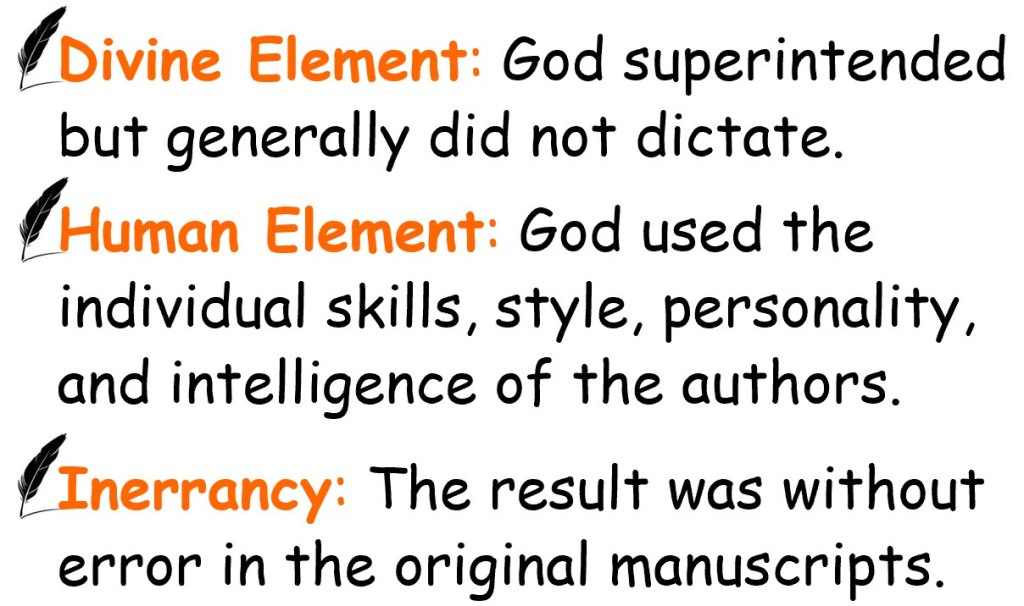
Note three things in this definition:
First, the divine element. God superintended or directed, but generally did not dictate the words. There are some exceptions. For example, the Ten Commandments and parts of the Law in the Old Testament are examples of dictation where God told the author Moses exactly what to write. But generally, God directed the writers without excluding their intelligence, their individuality, their style of writing, and their feelings. The writers were usually not passive in this process. But God superintended or directed the process so as to guard the writers to give us a completely truthful Bible.
Second, the human element: The human authors were not merely passive instruments. They were active writers not dictation machines. God allowed them varying degrees of self-expression. They expressed their own personalities, used their own vocabulary, wrote from eyewitness experience (e.g., 1 John 1:1-2), and discovered information through research (e.g., Luke 1:1-4).
For example, Luke, who was a doctor, uses medical terms in the Gospel of Luke that he wrote. And John, whose native language was apparently not Greek, uses a simpler form of Greek throughout his books. But he gets God’s message across. The difference in language can be illustrated this way: One preacher might say, “You must be born again”. Another might say, “Y’all gotta get saved”. One is considered good grammar; one not so good. But these both express the same truth, but in the style and grammar of the individual. This sort of thing occurs throughout the Bible. The vocabulary and style is that of the human author, but the message is God’s.
Third, the result was without error in the original manuscripts. The authors were active in writing, and the superintendence of God guaranteed that what they wrote was without error. The authors did not corrupt God’s message in the process of writing it in their own words and styles.
But inspiration only applies to the original words penned by the original authors. Copies and translations are not inspired, but are the Word of God to the extent that they faithfully represent what was originally written.
The Bible is the Word of God because it is the message that God wanted communicated. The famous theologian B. B. Warfield said, “The Bible is the Word of God in such a way that when the Bible speaks, God speaks.”
Because God is true (John 3:33), and the Bible was God-breathed, the Bible is true. Because God tells only the truth, His words are without error. I will comment on the topic of inerrancy in the next post.
Notes on Image
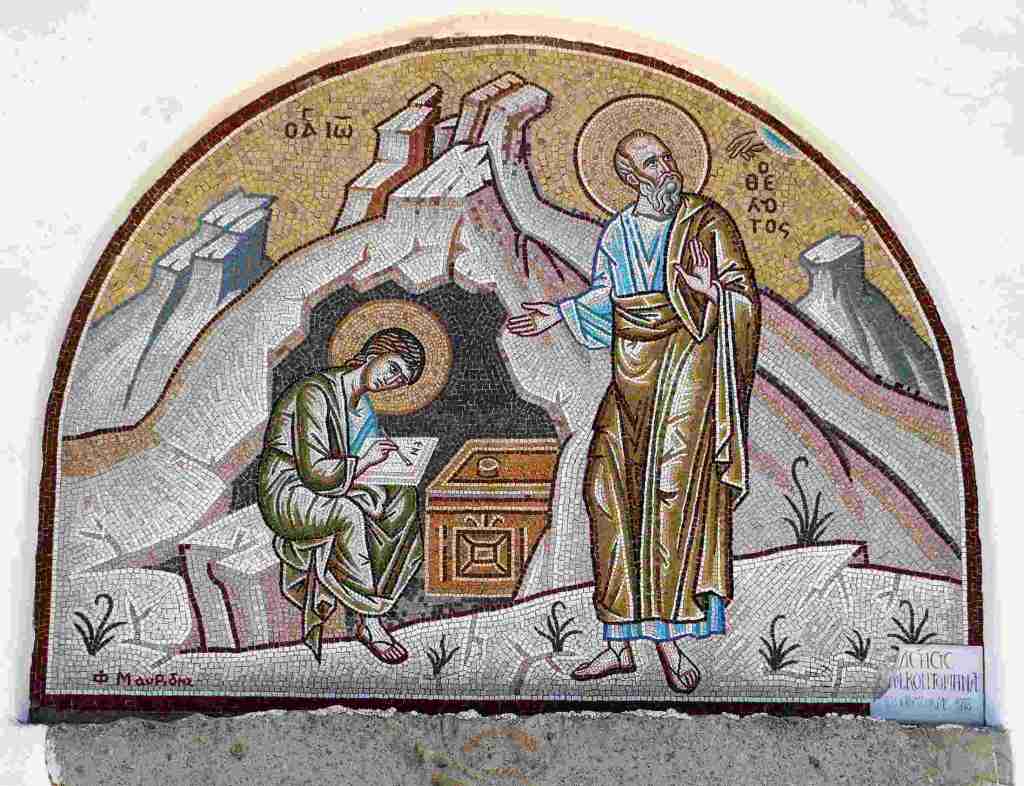
The image at the top of this post is of the Mosaic of Saint John the Theologian located at the Monastery of St. John on the island of Patmos. It is a 20th century recreation of an 11th century Byzantine illustration, which illustrates St. John dictating the words of the Book of Revelation to a secretary.
If you look carefully at the mosaic you will see the hand of God to the right of St. John’s head (John is the figure that is standing). This represents the inspiration of God. John is then directing his secretary to write down his words.
It was a common practice in the Roman and Greek worlds to use the services of a secretary called an amanuensis when writing a letter. An amanuensis was a person who wrote what another person dictated. The amanuensis would be good at taking notes. In our culture we might refer to this person as a writing secretary.
It appears that the Apostle Paul regularly used an amanuensis to write his epistles. It is implied in 1 Corinthians 16:21, Galatians 6:11, Colossians 4:18, and 2 Thessalonians 3:17 where Paul interrupted to write a final greeting with his own hand. In Romans 16:22, the amanuensis identified himself and added his own personal greeting:
I, Tertius, who wrote this letter, greet you in the Lord. (Romans 16:22)
It also appears that Peter used an amanuensis to help him write his letter known today as First Peter:
Through Silvanus, whom I regard as a faithful brother, I have written to you briefly, to exhort you and to bear witness that this is the true grace of God. Stand firm in it. (1 Peter 5:12)
The Greek letters at the top of the mosaic read, “Saint John” (left side) the theologian (right side)”.
Word Focus Lexicon
Lexical Form: θεόπνευστος -ον
Transliteration: theopneustos
Gloss: God breathed, inspired by God, breathed out by God
Part of Speech: Adjective
New Testament Frequency: 1
Strong’s Number: G2315 (Link to Blue Letter Bible Lexicon)
In the verse at the top of this post, the words “God-breathed” are a translation of the single Greek word θεόπνευστος / theopneustos. English versions translate it variously as “inspired by God”, “God-breathed”, or “breathed out by God”. The Greek word occurs only one time in the New Testament but is found several times in ancient secular Greek literature.
θεόπνευστος is an adjective that describes Scripture as originating from God and thus having divine authority. Because God Himself speaks through the Scriptures, they are beneficial for the things listed in the verse and to ultimately fully equip the believer for every good work. See also Ephesians 2:8-10 regarding these good works.
Bibliography
Danker, Frederick William. The Concise Greek-English Lexicon of the New Testament. The University of Chicago Press, 2009.
Enns, Paul. The Moody Handbook of Theology. Moody Press, 1989.
Gilbrant, Thoralf, International Editor. The New Testament Greek-English Dictionary. The Complete Biblical Library, 1990.
Liddell, Henry George and Scott, Robert. A Greek-English Lexicon. Oxford University Press. 1940. With a Supplement, 1996.
Ryrie, Charles C. Basic Theology. Moody Publishers, 1986, 1999.
Thiessen, Henry Clarence. Introductory Lectures in Systematic Theology. William B. Eerdmans Publishing Company, 1949.
Unless otherwise noted, English translations of Bible verses are by the author from the Greek text and are not quotations from any copyrighted Bible version or translation.
 Koine Foundations
Leave a comment