
For prophecy was never borne to us by means of human will. Rather, men being borne along by the Holy Spirit spoke from God. (2 Peter 1:21)
Definition
As applied to the Bible, inerrancy means that the Bible is without error in all it teaches, or alternatively, the Bible tells the truth about whatever it asserts.
Key Aspects
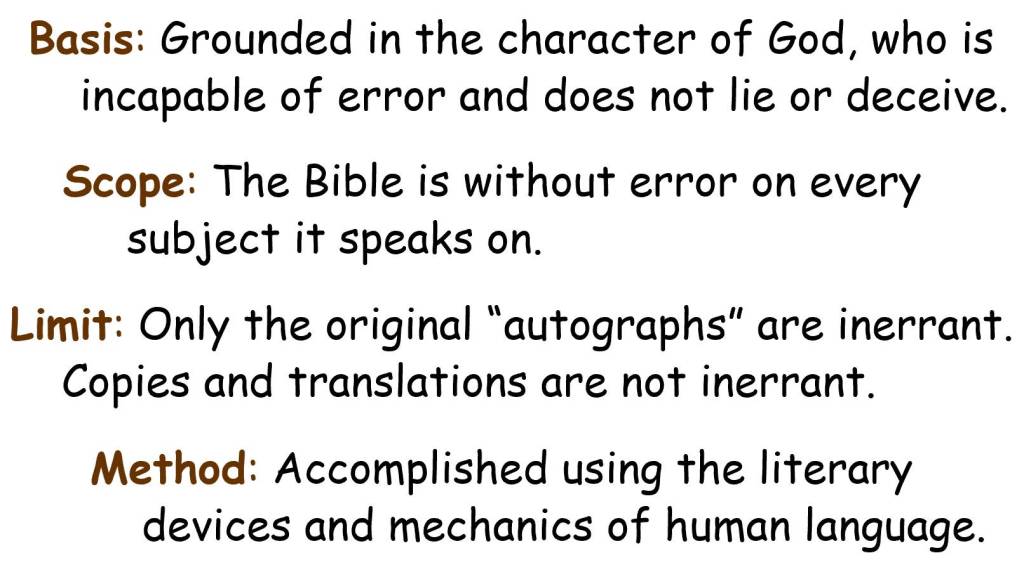
Basis: Inerrancy is grounded in the character of God, who is incapable of error and does not lie or deceive. Therefore, since the Bible is God’s word given by inspiration, it is also without error and tells the truth.
Scope: Inerrancy extends to all areas of knowledge. That is, whatever the Bible touches on regarding doctrine, history, science, geography, etc. is free from error. The Bible tells the truth on all these matters when it talks about them.
Obviously the Bible is not a math book, science book, history book, or medical manual. It wasn’t meant to be. It doesn’t address these subjects in a comprehensive way. But if it does speak about these subjects, or any other subject, it is without error – it tells the truth.
Most important, the Bible is sufficient, that is, it does provide all the information needed to know God and to know how to live.
Limit: Inerrancy is limited to the original documents, which are called the autographs. Only the original documents written by the original authors of the Bible are inerrant. Copies and translations made from them are not inerrant, no matter how accurate they may be because copyists and translators make mistakes. I will comment on this in more detail in a later post.
Method: The Bible tells the truth using all of the literary devices and mechanics of normal human language. So, in addition to regular speech, it tells the truth by using things like language of appearance, figures of speech, hyperbole, approximations, free quotations, paraphrasing, summarizing, and different accounts of the same event that don’t contradict. In other words, the Bible tells the truth by speaking to us in the same way we as humans make truthful statements to one another.
When the Bible uses the devices and mechanics listed above it is not an issue for inerrancy because scientific precision is not required to make true statements. In fact, in our normal conversations, truth is seldom communicated with statements that exhibit scientific precision. Truth can be powerfully communicated through various figures of speech.
However, Biblical inerrancy is often attacked on this basis. So, in the next two posts I will provide a few examples that illustrate how the idea of inerrancy is not invalidated by the use of various literary devices.
To end this post, let’s look at a key verse in the New Testament to summarize inspiration and inerrancy. In 2 Peter 1:21, Peter says this about how the Word of God was given to us:
For prophecy was never borne to us by means of human will. Rather, men being borne along by the Holy Spirit spoke from God. (2 Peter 1:21)
The Greek word translated as “borne along” (φέρω / pherō) could be used by a Greek speaker to describe how a sailing ship is driven along by the wind. In fact, the word is used this way in Acts 27:14-15 to describe how the ship that Paul was on was driven along by the wind during a storm:
But soon a tempestuous wind, called the northeaster, struck down from the land. And when the ship was caught and could not face the wind, we gave way to it and were driven along. (Acts 27:14-15 ESV)
The image in this verse of a ship being driven along by the wind provides a good illustration of inspiration and inerrancy.
Picture inspiration as sailing ships being driven to their destination by the power of the wind. The ships may be different kinds with different purposes – cargo ships, passenger ships, warships. But they all are powered and driven along to their destinations by the wind, not by the will or power of the ship.
In the same way the various writers of Scripture are like these ships. They had different purposes and messages, different literary skills, different ways of expressing themselves, but they were all driven along by the Holy Spirit to their destination of recording God’s words, while using their own unique styles. And in the process, God’s words were not corrupted and were recorded without error. What the writers produced was the destination God was driving them along to. The words as originally penned by the authors expressed exactly what God wanted to communicate without error.
The Bible is entirely reliable and true, and so sufficient for knowing God and knowing how to live.
Word Focus Lexicon
Lexical Form: φέρω
Transliteration: pherō
Gloss: bear, carry, bring, endure, produce
Part of Speech: Verb
New Testament Frequency: 66
Strong’s Number: G5342 (Link to Blue Letter Bible Lexicon)
In the verse at the top of this post, the words “borne” [Aorist Passive Indicative] and “being borne along” [Perfect Passive Participle] are a translation of the same Greek verb φέρω / pherō. It is also the same word in Acts 27:15 translated as “driven along” [Imperfect Passive Indicative].
φέρω / pherō is a common verb that has range of meanings such as bear a load (“carry”), bear trials (“endure”), and bear fruit (“produce”).
Bibliography
Beetham, Christopher A., Editor. The Concise New International Dictionary of New Testament Theology and Exegesis. Zondervan Academic, 2021.
Danker, Frederick William. The Concise Greek-English Lexicon of the New Testament. The University of Chicago Press, 2009.
Enns, Paul. The Moody Handbook of Theology. Moody Press, 1989.
Gilbrant, Thoralf, International Editor. The New Testament Greek-English Dictionary. The Complete Biblical Library, 1990.
Liddell, Henry George and Scott, Robert. A Greek-English Lexicon. Oxford University Press. 1940. With a Supplement, 1996.
Ryrie, Charles C. Basic Theology. Moody Publishers, 1986, 1999.
Thiessen, Henry Clarence. Introductory Lectures in Systematic Theology. William B. Eerdmans Publishing Company, 1949.
Unless otherwise noted, English translations of Bible verses are by the author from the Greek text and are not quotations from any copyrighted Bible version or translation.
Scripture quotations marked ESV are from the Holy Bible, English Standard Version, copyright © 2001, 2007, 2011, 2016, 2025 by Crossway Bibles, a division of Good News Publishers. Used by permission. All rights reserved.
 Koine Foundations
Leave a comment