

Jesus answered and said to them, “The healthy don’t need a doctor, but the sick do. I have not come to call the righteous, but sinners to repentance.” (Luke 5:31-32)
Introduction
Inerrancy is the belief that the Bible is without error in all it teaches. To state it another way, the Bible tells the truth about whatever it asserts.
[See the previous post on Inerrancy for a fuller explanation.]
In this post, I give more examples to illustrate how the Bible tells the truth (is inerrant) when using the devices and mechanics of normal human language. Inerrancy is not threatened or diminished by the use of such devices.
[See the previous post Inerrant Language (1) for more examples.]
Free Quotations
A free quotation is paraphrasing or summarizing what someone says. For example, I might say that President Lincoln during his Gettysburg address said that the Civil War was a test of whether the United States, a nation founded on the ideas of liberty and equality, could survive.
Did Lincoln say those exact words? No. This is not a direct quote, but rather an accurate free quotation of what he meant. And I have not committed an error by freely paraphrasing and summarizing Lincoln in this way. We do this sort of thing all the time in everyday conversations.
The Bible writers used free quotations, paraphrasing and summarizing to make true statements.
Because the ancient world did not have recording devices, readers didn’t expect written dialogue to be a verbatim transcript, but rather an accurate representation of what was said. In fact, quotation marks did not exist in Greek writing, or most other ancient writing for that matter.
They were not invented until the 16th century for English writing, which changed the way we think about quotations. For us, quotation marks flag the beginning and end of speech in which no words can be omitted, added, or modified without some indication like an ellipsis (…) or square brackets. For ancient writers these restrictions did not exist. That doesn’t mean that they never quoted verbatim. However, for ancient writers truthful and responsible quotation did not need to follow our modern rule of marked boundaries. For the ancient writer, truthful quotation granted certain freedoms in quotation not available to us today. [Quoted and condensed from Williams.]
Regarding the words of Jesus in the Gospels:
- The writers make no claim to be quoting Jesus verbatim. Paraphrasing was normal in that culture, even as it is today.
- It is also important to note that Jesus sometimes spoke in Aramaic when he taught Jewish crowds, but the Gospels are written in Greek. This means that the writers had to translate some of Jesus’ words into Greek. The writers’ translations varied depending on their fluency and vocabulary in Greek. So, what Jesus is recorded as saying, might be different from one Gospel to another. This is not an error in the Bible as long as the translated free quotations accurately reflect what Jesus said.
- The writers do not record everything that Jesus said. Jesus said much more than what is reported. The writers chose what they wanted to highlight based on their narrative purposes. These differences actually help us better understand the distinct purpose of each writer in reporting Jesus’ words.
- Sometimes the differences in what is reported about what Jesus said may be due to the fact that Jesus taught the same truths many times, tailored to the audience.
Below is an example of a free quotation from the Gospels where Matthew, Mark, and Luke record Jesus’ response to a question from the Pharisees to His disciples: “Why does Jesus eat with tax collectors and sinners?” I have highlighted the significant differences in what they reported.
Those who are well have no need of a physician, but those who are sick.
Go and learn what this means: “I desire mercy, and not sacrifice.“
For I came not to call the righteous, but sinners. (Matthew 9:12-13 ESV)
Those who are well have no need of a physician, but those who are sick.
I came not to call the righteous, but sinners. (Mark 2:17 ESV)
Those who are well have no need of a physician, but those who are sick.
I have not come to call the righteous but sinners to repentance. (Luke 5:31-32 ESV)
Notice that Matthew includes an entire extra sentence that is directed at the Pharisees, who looked down on “sinners”, challenging them to rediscover compassion for the outcasts that was at the heart of the Old Testament message. [Carson]
Luke includes the words “to repentance” because he “is very interested in the theme of repentance and develops it much more fully than either Matthew or Mark”. [Morris]
These differences are due to the use of free quotation, not errors in quoting.
Throughout the Gospels, you will find accurate statements of what Jesus and others said, but not necessarily exact quotations. Accurate statements, not exact quotations. It is not necessary to quote verbatim in order to accurately and truthfully represent what someone said.
Here is a recent news report that illustrates the point. During his election campaign, President Trump announced a program to compensate victims of migrant crime. Here are the reports by various mainstream news organizations, comparing the last line of their reports. No one would consider this reporting “fake news”.
Today, I’m announcing that for the first time, under my administration, we will be seizing the assets of the criminal gangs and drug cartels, and we will use those assets to create a compensation fund to provide restitution for the victims of migrant crime.
Verbatim Quote per Fox News, 10/29/24
Those assets would then be used to create a compensation fund to pay restitution to victims of crimes committed by migrants.
Newsweek, 10/29/24
The funds would create a compensation fund for victims of crimes committed by those in the US illegally.
New York Post, 10/29/24
[His administration would] use them to create a “compensation fund.” He explained those impacted by crime committed by migrants may be eligible for payments.
ABC News, 10/29/24
These varying degrees of free quotations accurately report what Trump announced, even though there is interpretation by the reporters in some places.
Likewise, the Bible can make true statements that are inerrant using free quotations, paraphrasing and summarizing. Throughout the Bible, you will find accurate statements but not necessarily exact quotations.
Different Accounts of the Same Event
The Bible writers record different accounts of the same event to make true statements.
Different writers in the Bible may describe the same event by giving different details, just as witnesses in a court give different details in their testimony. There is no error in this as long as the testimony does not contradict.
Every time we describe an event, we must decide which details to include and which to omit. This applied to the Biblical authors also. You particularly see this in the Gospels because they often record the same events.
For example, Matthew reports that two blind men were healed by Jesus at the city of Jericho. Mark only mentions one of them and tells us his name – Bartimaeus. Luke also mentions only one of them but doesn’t tell us his name. Same event – different details.
Details are included or omitted based on the author’s purpose, but the accounts are both accurate and truthful. There is no error, as long as the details given do not contradict. In the case of the blind men at Jericho, neither Mark nor Luke say that there was only one blind man. They simply focus on the principal character and ignore the other blind man for the purpose of keeping the report briefer.
In our everyday conversations we omit and include details based on many factors. For example:
Question from a friend: “Which football game did you watch this weekend?”
My wife’s response: “We watched the Chiefs game.”
My response: “We watched Kansas City play Detroit.”
We watched the same game but give different details. One team mentioned versus two. Mention of team mascot versus home city. My wife mentions only the Chiefs because they are her favorite team and the principal character in her answer.
The Bible can make true statements that are inerrant using different accounts of the same event as long as the accounts don’t contradict in their details.
Nonstandard Grammar
The Bible writers sometimes use nonstandard grammar when they make true statements. This includes what we might call grammar errors.
Suppose my wife sent me an email asking about our daughter: “Is she home?”. My response is: “She ain’t here write now”.
My bad grammar and misspelling do not affect the truthfulness of what I typed. Similarly, inerrancy does not require correct grammar or spelling because they are simply conventions that vary by language, culture, time, and even by person.
There are statements in the Bible in the original languages that are ungrammatical (according to the “proper” grammar at that time as we understand it), or contain irregular spellings. However, these statements are still inerrant because they are completely true like my email.
An odd example of this is in John chapter 9 where Jesus heals a man who was born blind. In recounting the story, John uses the word translated as “opened” 6 times, but spells it three different ways.
aneōxen / ἀνέῳξεν (verse14)
ēneōxen / ἠνέῳξεν (verses 17, 32)
ēnoixen / ἤνοιξεν (verses 21, 26, 30)
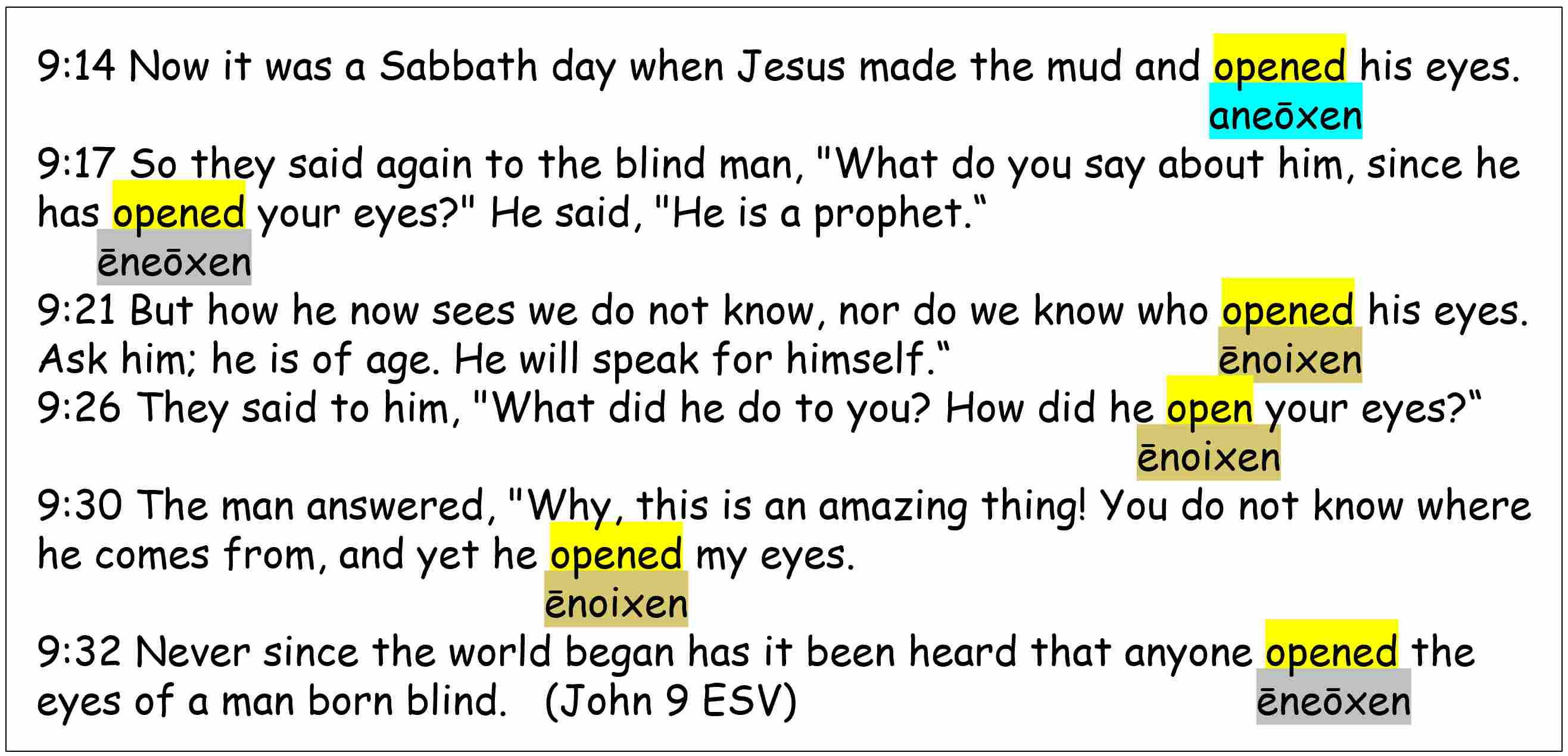
These differences in spelling do not affect the truth of what John wrote.
The Bible can make true statements even if they contain nonstandard grammar or spelling.
The Bible tells the truth (is inerrant) when using the devices and mechanics of normal human language. Inerrancy is not threatened or diminished by the use of such devices.
Word Focus Lexicon
Lexical Form: μετάνοια -ας, ἡ
Transliteration: metanoia
Gloss: repentance, a change of mind
Part of Speech: Feminine Noun
New Testament Frequency: 22
Strong’s Number: G3341 (Link to Blue Letter Bible Lexicon)
Danker defines μετάνοια / metanoia as ‘a serious change of mind and heart about a previous point of view or course of behavior’. This is the sense in which it is used in the New Testament. In secular Greek it could also mean ‘to reconsider something’ or ‘to regret’.
God makes repentance possible in Jesus as Luke 5:32 above indicates. Gilbrant’s New Testament Greek-English Dictionary notes that “faith in Jesus is the basis for repentance (Mark 1:15). Faith is the positive expression of repentance: we turn to God through Jesus, God’s representative. Repentance not only means a radical break with one’s former life, but first and foremost it is a positive, confident commitment to God’s offer of salvation. To repent is to become a child of God (Matthew 18:1-3).
Bibliography
Beetham, Christopher A., Editor. The Concise New International Dictionary of New Testament Theology and Exegesis. Zondervan Academic, 2021.
Carson, D. A. Matthew, The Expositor’s Bible Commentary, Volume 8. (Grand Rapids: The Zondervan Corporation, 1984.) Page 225.
Danker, Frederick William. The Concise Greek-English Lexicon of the New Testament. (Chicago and London: The University of Chicago Press, 2009.) S.v. μετάνοια, page 290.
Enns, Paul. The Moody Handbook of Theology. Moody Press, 1989.
Gilbrant, Thoralf, International Editor. The New Testament Greek-English Dictionary. (Springfield: The Complete Biblical Library, 1990.) Page 174.
Liddell, Henry George and Scott, Robert. A Greek-English Lexicon. Oxford University Press. 1940. With a Supplement, 1996.
Morris, Leon. The Gospel According to St. Luke, Tyndale New Testament Commentaries. (Grand Rapids: William B. Eerdmans Publishing Company, 1974 by Inter-Varsity Press.) Page120.
Ryrie, Charles C. Basic Theology. Moody Publishers, 1986, 1999.
Thiessen, Henry Clarence. Introductory Lectures in Systematic Theology. William B. Eerdmans Publishing Company, 1949.
Williams, Peter J. Can We Trust the Gospels? (Wheaton: Crossway, 2018 by Peter John Williams.) Pages 98 and 99.
Unless otherwise noted as below, English translations of Bible verses are by the author from the Greek text and are not quotations from any copyrighted Bible version or translation.
Scripture quotations marked (ESV) are from the Holy Bible, English Standard Version, copyright © 2001, 2007, 2011, 2016, 2025 by Crossway Bibles, a division of Good News Publishers. Used by permission. All rights reserved.
 Koine Foundations
Leave a comment