
Set Christ apart as Lord in your hearts, always prepared to give a defense to everyone asking you to explain the hope in you, but do so with humility and respect. (1 Peter 3:15)
Definition of Canon
In this post I continue my series on Exploring the New Testament with an introduction to the canon of the New Testament.
If you look at the table of contents in the front of your Bible, it will list 27 books for the New Testament as shown in the first column of the table below – Matthew through Revelation. These are the 27 books all Christians believe to be the inspired collection of New Testament books – whether you are Protestant, Roman Catholic, or Greek Orthodox.

This collection of 27 books is referred to as the New Testament Canon. The word ‘canon’ originally meant a measuring stick or ruler, but later became used to describe an authoritative list or collection of scriptural books. So, the New Testament Canon refers to the collection of books accepted as divinely inspired and thus the authoritative standard for the Christian’s belief and conduct [see The Bible is Sufficient]. The New Testament canon is the collection of inspired books God gave His church. It is the measuring stick by which we should measure our lives.
The New Testament Canon contains 27 books, which were written by 8 or 9 Christian authors after the resurrection of Jesus Christ. They were written over a period of about 50 years from about 45 to 95 AD.
Let’s drill down on the authorship and dates of the books.
Authorship
The 27 books were written by 8 or 9 authors as listed above. Why 8 or 9? Because the author of Hebrews does not identify himself. So, he may be one of the other writers listed, making the count 8, or a totally different writer, making the count 9. The authorship of Hebrews has been debated since early Christianity. The traditional view is that it was written by the Apostle Paul. But other theories include just about every famous person in the New Testament such as Barnabas, Luke, Timothy, Apollos, and even the married couple Aquila and Priscilla.
One reason it is attributed to Paul is that the theology in Hebrews is similar to Paul’s theology. However, the grammar and literary style of the Greek are not his. The excellent Greek of Hebrews is similar to that of Luke. This has led some to suggest that the book of Hebrews is Paul’s ideas written down by Luke, or that Paul originally wrote it in the Hebrew language and Luke later translated it into Greek. But the bottom line is that the author of Hebrews is not known, but wrote with apostolic authority.
Regarding the identity of the other authors, those listed in the table above are well established since early Christian times. Modern scholars who are critical of the Bible try to argue against these authors, but there is good historical evidence for the authors as listed.
I would also note that the names listed, without exception, are always associated with these books in early manuscripts when the title of the book is included. For example, the Gospel of Matthew is always identified in the title as written by Matthew, or a letter like First John is always attributed to John in the title. There was no confusion caused by these books being attributed to other authors.
The eight known authors are as follows:
Matthew, Peter, and John who were disciples of Jesus and apostles wrote 8 books:
- Matthew – Gospel of Matthew
- Peter – 1 Peter, 2 Peter
- John – Gospel of John, 1 John, 2 John, 3 John, Revelation
Paul, an apostle, wrote 13 or 14 books, depending on whether he wrote Hebrews:
- Romans
- 1 Corinthians, 2 Corinthians
- Galatians
- Ephesians
- Philippians
- Colossians
- 1 Thessalonians, 2 Thessalonians
- 1 Timothy, 2 Timothy
- Titus
- Philemon
- Hebrews [?]
Mark, a disciple of Peter wrote one book which passes on Peter’s teaching:
- Gospel of Mark
Luke, a ministry companion of Paul wrote two books:
- Gospel of Luke
- Acts
Two of Jesus’ brothers, James and Jude, wrote two books in the New Testament. What is fascinating about this is that the books are written in very good Greek, not what you would expect from Galilean tradesmen who spoke Aramaic. This implies that there was very good homeschooling going on in Jesus’ home!
- James
- Jude
It is often said that all of the authors were Jewish, except for Luke, who was a Gentile. I would note that there is very little evidence that Luke was a Gentile.1 Some scholars believe he was actually a Jew known as a Hellenized Jew, which was a Jew who spoke Greek and adopted certain aspects of Greek culture. If Luke was a Jew, then the entire New Testament was written by Jewish Christians, which would fit with what Paul wrote in Romans 3:2…
The Jews were entrusted with the oracles of God. (Romans 3:2 ESV)
…meaning all the Scriptures were revealed through the Jewish people.
Dating
Unfortunately, none of the authors dated what they wrote, so when the books were written is a matter determined by looking at internal evidence in each book and external historical evidence. The table above shows approximate dates of authorship for each of the books based on my research in many sources. The notes in your study Bible might show slightly different dates. For most books, it is impossible to nail down an exact date.
The most important thing to note is that all the books were written over a period of only 50 years from roughly 45 to 95 AD – in the first century AD. So, if Jesus was crucified in 30 or 33 AD in the first century, the first book was written 10 to 15 years after that – either James or Galatians was the first book written. Revelation was the last book written near the end of the first century.
The dates also imply that they were all written by eyewitnesses or by people who lived during the events recorded. They are not second or third generation reporting by people far removed from the events recorded.
As with the authorship, modern scholars who are critical of the Bible are also skeptical of these early assigned dates. They claim that the books went through many revisions, over many generations, before reaching their final form hundreds of years later. And the final canon was created by the pagan Roman emperor Constantine and forced on Christians at the Council of Nicaea in 325 AD.
This sort of view was made popular by Dan Brown in his book The Da Vinci Code, that was made into a movie in 2006. 80 million copies of the book were sold and it is the #11 all time best selling book. Unfortunately, nothing about this claim is true. The book itself is a work of fiction, but people believe the so-called facts about the New Testament presented in the book.

It is important that Christians know the facts about their faith and the Bible so they can answer the claims of skeptics. As the Apostle Peter writes in his book of First Peter:
Set Christ apart as Lord in your hearts, always prepared to give a defense to everyone asking you to explain the hope in you, but do so with humility and respect. (1 Peter 3:15)
There is very good evidence for the early dating of the books of the New Testament as shown in the table above.2 We can’t look at all the evidence in this short post, so let me present two types of general evidence that demonstrate that the books in our New Testament go back to the first century. The evidence is (1) early copies of the New Testament and (2) early quotations of the New Testament.
Evidence from Early Copies
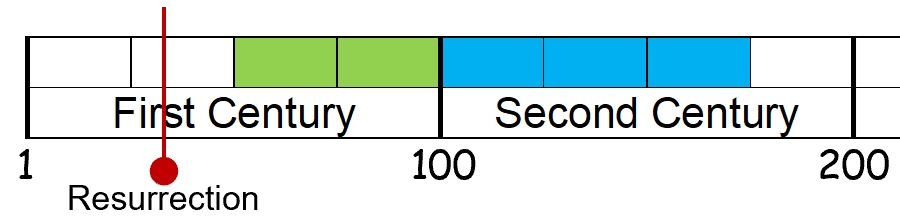
The first type of evidence for first century authorship dates is the discovery of copies of New Testament books produced in the early to middle of the second century. If you have a copy of something, the original must have been written before the copy.
The dates on my chart claim that the New Testament was written from the middle to the end of the first century [green range]. Well, there are fragments of manuscript copies of New Testament books dated from the beginning of the second century [blue range]. This demonstrates that a number of New Testament books were already being copied and in wide circulation by the middle of the second century – such as the Gospels and Paul’s letters. There are a number of these manuscript fragments, but the images below are just two examples for the Gospels.
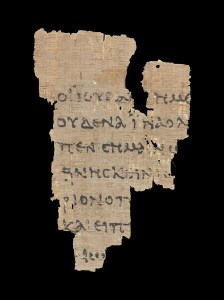
Papyrus 52 is a fragment of the earliest known copy of the Gospel of John found so far. It is about the size of a credit card. This is all that remains of the manuscript. It contains parts of John chapter 18 [vs. 31-33; 37-38]. Scholars always give a date range for manuscripts since they can’t pin it down to an exact date. But the range is 125 to 175, though some scholars date it earlier to perhaps 100 or even 80 AD. The point is, it’s an early copy, produced sometime in the earlier part of the second century.

Papyrus 104 is a fragment of the earliest known copy of the Gospel of Matthew found so far. It is also a small fragment. It contains parts of Matthew chapter 2 [vs. 34-37]. Scholars date it between 100 to 200 AD.
Significantly, both of these are from what is called a codex. Codex means a bound book. These are not just copies scribbled out on a piece of paper by some random person, but copies made by scribes and bound in book form. So, these books are being treated as important pieces of literature, perhaps suggesting the passage of time since they were originally written. This implies that they were originally composed much earlier in the first century.
Both of these fragments were discovered in archaeology digs in Egypt. John was originally written in Asia Minor and Matthew in Syria. It would have taken a few years for bound copies to be produced and find their way from Asia Minor and Syria down to Egypt.
This type of evidence does not give exact dates for when each New Testament book was written, but does reasonably place the original writing of the New Testament books, like John and Matthew, back into the first century. Clearly, the New Testament books were not written much later as some critics try to argue.
Evidence from Early Quotations

Another type of evidence that confirms early dates of composition for the New Testament is quotations of the New Testament in letters written by church leaders who wrote in the late first century and early second century [orange range].
You can only quote from something that was written before you quoted it. Well, there are letters, historical documents, by church leaders in the late first century and early second century that quote extensively from New Testament books, or refer to New Testament books. The nice thing about this is that these letters can be dated with certainty. We have letters to various churches from Clement written in 96 AD, Ignatius written in 107 AD, and Polycarp3 written between 110 to 120 AD, that quote the New Testament as scripture. These three men quote from many books, and between them, they have quotations from about 22 of the New Testament books. Clement alone, the earliest, quotes from 13 books.
The fact that they are quoting from New Testament books in the late first century and very early second century suggests that most of the New Testament books were already widely circulating in the late first century, and so must have been written prior to that in the first century. So again, the original dates of composition on the table above are reasonable.
Order of the New Testament Books
Have you ever wondered why the books of the New Testament are in the order as listed in the table above from Matthew to Revelation?
They do actually show up in slightly different orders throughout history. But the order in our current Bibles was first seen in a list written by a man named Athanasius who was the Bishop of Alexandria. In an Easter Letter written by him in 367 AD, he listed the 27 New Testament books Christians believed were God-inspired scripture that should be read in church services. He listed the books in the same order we use today indicating that this order was established early on. The New Testament books are arranged in groups:
- The Gospels and the related book of Acts that continues Luke’s gospel account come first.
- Next, all the Epistles (i.e., letters) are grouped together.
- Then, Revelation, a unique prophetic writing, comes at the end.
All the books from Romans to Jude are called ‘Epistles’. That is the Greek word that means a letter. The Epistles are all letters sent to a church or to an individual person.
There is also a bit of organization to Paul’s Epistles. They are grouped with the letters to churches first (Romans to 2 Thessalonians), and then the letters to individuals next (Timothy to Philemon). Within those two groups they are arranged from longest to shortest by length.
The remaining Epistles (James, 1 Peter, 2 Peter, 1 John, 2 John, 3 John, Jude) might also be arranged based on the prominence of the authors. In Galatians 2:9, Paul writes about the early years of his ministry and notes:
And when James and Cephas [i.e., Peter] and John, who seemed to be pillars, perceived the grace that was given to me, they gave the right hand of fellowship to Barnabas and me, that we should go to the Gentiles and they to the circumcised. (Galatians 2:9 ESV)
The order of these other Epistles appears to follow the order of the “pillars”, who seem to be listed in order of prominence in the leadership of the church.
Word Focus Lexicon
Lexical Form: ἀπολογία -ας, ἡ
Transliteration: apologia
Gloss: verbal defense
Part of Speech: Feminine Noun
New Testament Frequency: 8
English Derivatives: apology, apologetics
Strong’s Number: G627 (Link to Blue Letter Bible Lexicon)
ἀπολογία / apologia denoted the idea of speaking in one’s own defense, whether in the legal sense in a courtroom or simply as a answer to someone’s inquiry.
The legal sense is seen in Acts 25:16 where Festus, the Roman governor of Judea, mentions the legal process of allowing the accused to make a defense; and in 2 Timothy 4:16 where Paul mentions making his own legal defense.
The verse at the top of this post (1 Peter 3:15) may use the word to denote a more personal answer in response to an honest inquiry about one’s faith in Christ. The believer should always be prepared to give an answer, but Peter emphasizes that the answer should be given with humility and respect.
A number of English words are derived from the Greek word such as apology and apologetics (a reasoned defense against objections and doubts).
Notes
1 The idea that Luke was a Gentile is based solely on Colossians 4:10-14, where he is not included in the list of those Paul describes as “the only men of the circumcision among my fellow workers” (v. 11 ESV). “Men of the circumcision” is understood as meaning a person who is a Jew. Since Luke is not included in that list of Aristarchus, Mark, and Justus, but is mentioned separately in verse 14, the conclusion has been that he was not a Jew. However, the counterargument is that this list was specifically those involved in the active preaching ministry, and Luke was not part of that group. Additionally, Luke’s deep familiarity with Jewish Scripture and history suggests he was not a Gentile.
2 An excellent textbook that covers the evidence for the dates of every New Testament book is: Carson, D. A. and Moo, Douglas J. An Introduction to the New Testament. Zondervan, 1992, 2005 by D. A. Carson and Douglas J. Moo.
3 If you have not studied church history, these three men are important figures in the early church period at the end of the time of the Disciples. Clement became Bishop of Rome and there is evidence that he knew the Apostle Peter and learned from some of the other disciples. Ignatius and Polycarp were disciples of the Apostle John. Ignatius became the Bishop of Antioch, and tradition says that he died as a martyr by being thrown to the lions. Polycarp became the Bishop of Smyrna and tradition says that he died as a martyr by being burned alive and then stabbed when the flames failed to kill him.
Bibliography
Beetham, Christopher A., Editor. The Concise New International Dictionary of New Testament Theology and Exegesis. Zondervan Academic, 2021.
Carson, D. A. and Moo, Douglas J. An Introduction to the New Testament. Zondervan, 1992, 2005 by D. A. Carson and Douglas J. Moo.
Danker, Frederick William. The Concise Greek-English Lexicon of the New Testament. The University of Chicago Press, 2009.
Enns, Paul. The Moody Handbook of Theology. Moody Press, 1989.
Gilbrant, Thoralf, International Editor. The New Testament Greek-English Dictionary. The Complete Biblical Library, 1990.
Gundry, Robert H. A Survey of the New Testament. Zondervan Publishing House, 1970.
Guthrie, Donald. New Testament Introduction. Inter-Varsity Press, 1970 by The Tyndale Press.
Liddell, Henry George and Scott, Robert. A Greek-English Lexicon. Oxford University Press. 1940. With a Supplement, 1996.
Ryrie, Charles C. Basic Theology. Moody Publishers, 1986, 1999.
Tenney, Merrill C. New Testament Survey. William B. Eerdmans Publishing Co., 1953, 1961, 1985.
Thiessen, Henry Clarence. Introductory Lectures in Systematic Theology. William B. Eerdmans Publishing Company, 1949.
Vos, Howard F. Beginnings in the New Testament. Moody Press, 1973 by The Moody Bible Institute of Chicago.
Unless otherwise noted as below, English translations of Bible verses are by the author from the Greek text and are not quotations from any copyrighted Bible version or translation.
Scripture quotations marked (ESV) are from the Holy Bible, English Standard Version, copyright © 2001, 2007, 2011, 2016, 2025 by Crossway Bibles, a division of Good News Publishers. Used by permission. All rights reserved.
 Koine Foundations
Leave a comment