
Here begins the Good News about Jesus Christ, the Son of God. (Mark 1:1)
Good News – Promise to Fulfillment
The writer of the book of Hebrews in the New Testament tells us that God has revealed Himself in two stages that correspond to the Old Testament and the New Testament. The progression of revelation is from promise in the Old Testament to fulfillment in the New Testament.
The author of Hebrews writes this:
Long ago, at many times and in many ways, God spoke to our fathers by the prophets… (Hebrews 1:1 ESV)
The Old Testament prophets did not see the fulfillment of what they predicted in their own lifetimes regarding the Christ, nor did they always fully understand what they wrote. However, they had the promise of the Good News that would be fully revealed in the future.
The author of Hebrews continues in Hebrews 1:2:
…but in these last days he has spoken to us by his Son, whom he appointed the heir of all things, through whom also he created the world. (Hebrews 1:2 ESV)
The writer tells us that God has now spoken to us through His Son – Jesus Christ. The Good News of salvation was revealed through Christ. What Christ did and taught is recorded and explained in the New Testament which presents the fulfillment of the Good News that was promised in the Old Testament.
John, who was a disciple of Jesus, writes this at the end of his Gospel which tells us about what is recorded in the New Testament about Jesus:
There are many other things that Jesus did. If every one of them were written down, I suppose the whole world would not have room for the books that would be written. (John 21:25 NET)
John tells us that not everything Jesus did and taught was written down. However, we do have 27 books in the New Testament Canon that deal with the person and message of Jesus.
For more background on the Canon, see these previous posts:
What is the New Testament Canon?
Who created the New Testament?
Are the right books in the New Testament?
Jesus Himself wrote none of the 27 books in the New Testament. He taught by word of mouth. What He said was treasured and passed on by those who heard Him. However, this oral tradition could not preserve the words of Jesus. They had to be committed to writing in order not to be corrupted and lost over time.
What Jesus said and did were written down in accounts called Gospels because they were the Good News from Him and about Him. The Greek word behind our English word ‘Gospel’ means ‘good news’. 1 The Gospels record the Good News about God’s saving actions through Jesus Christ.
No other books before our New Testament Gospels had ever been given that designation. A ‘gospel’ was a new type of literature invented by Christians. 2
In addition, some of Jesus’ disciples and apostles wrote letters (‘Epistles’) to various churches and individuals to teach and admonish them about the Christian life. These letters were read at public gatherings of believers and then shared with other churches. The word ‘epistle’ comes from the Greek word ἐπιστολή / epistolē which means ‘letter’.
The Gospels and Epistles were collected into the New Testament Canon to preserve the teachings of Jesus and the Apostles.
Good News Outline of the New Testament
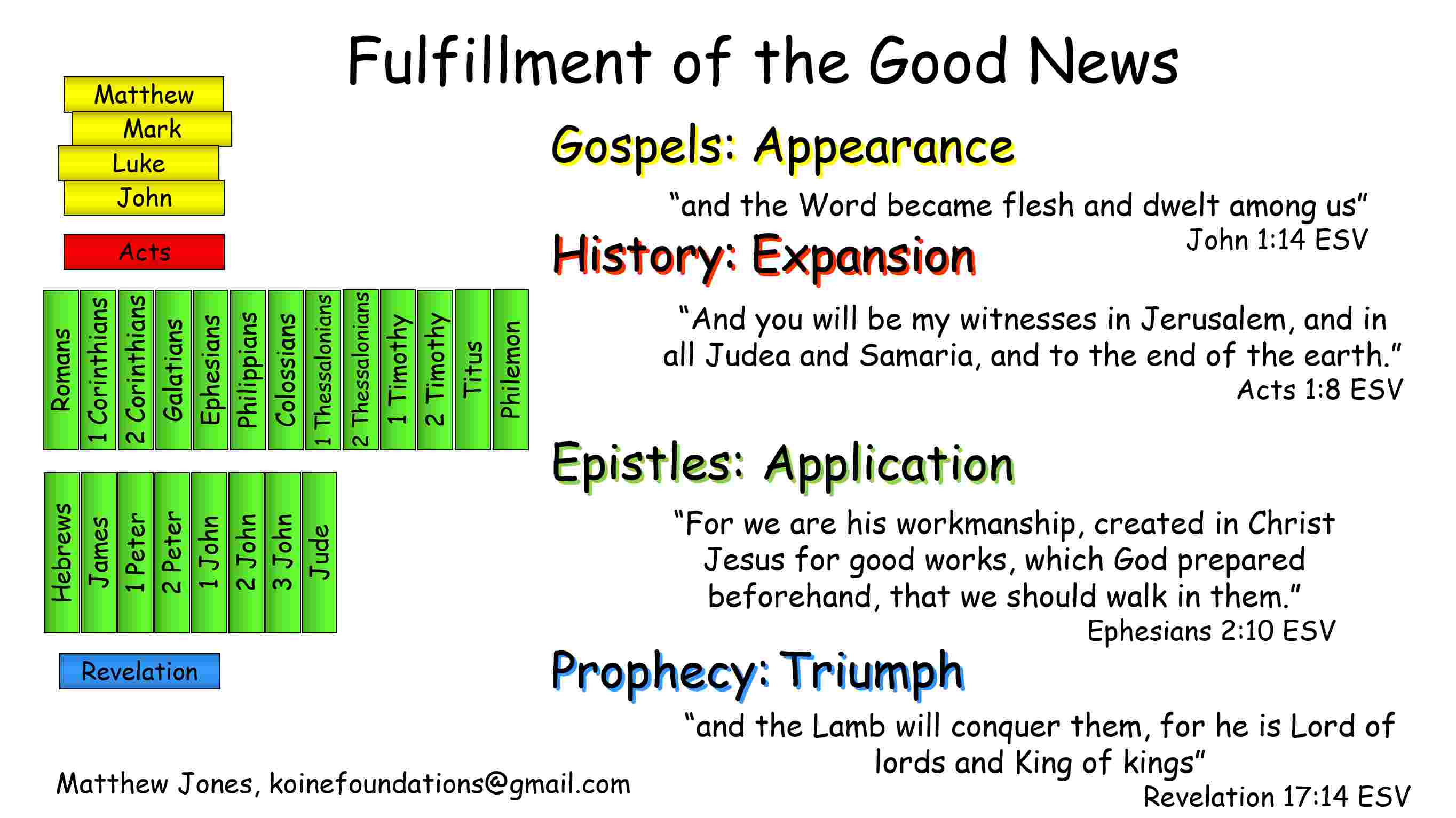
The order of the 27 books of the New Testament Canon provides a logical outline for the fulfillment of the Good News.
(1) Gospels: Appearance of the Good News
First, there are four Gospels – Matthew, Mark, Luke, John. The Gospels announce the APPEARANCE of the Good News.
As the Apostle John writes in his gospel:
And the Word became flesh and dwelt among us, and we have seen his glory, glory as of the only Son from the Father, full of grace and truth. (John 1:14 ESV)
The four Gospels announce the appearance of the Good News among us – Jesus Christ. They describe his birth, life, death, and resurrection. They record His teachings and reveal the nature of God, because the Son, Jesus Christ, came to reveal the Father.
(2) Acts: Expansion of the Good News
The Gospels are followed by the book of Acts, a history of the early Christian church. It continues the story where the Gospels leave off and presents the EXPANSION of the Good News.
The church rapidly expanded in obedience to a command by Jesus which He originally gave to His disciples:
And you will be my witnesses in Jerusalem, and in all Judea and Samaria, and to the end of the earth. (Acts 1:8b ESV)
Acts records the expansion of the Good News about Jesus Christ from where it appeared in Judea and how it spread to the rest of the world as the followers of Jesus obeyed this command.
(3) Epistles: Application of the Good News
Next are 21 Epistles (Romans through Jude). The first 13 written by Paul, and the next 8 written by various other authors. These Epistles explain the APPLICATION of the Good News.
The Good News has moral implications for living. You don’t just get saved and then live or act anyway you want to. The Good News should affect your entire life going forward from salvation – everything you think, say, and do. So, the Good News is good news not only about salvation (how to know God), but also good news about living victoriously in this world (how to live)
Paul writes this about believers:
For we are his workmanship, created in Christ Jesus for good works, which God prepared beforehand, that we should walk in them. (Ephesians 2:10 ESV)
There is a walk, a way of living, that goes along with being saved. This walk is expressed through good works. The Epistles explain the application of the Good News that affects how believers are supposed to live – how they should walk in good works.
The Epistles arose out of the ministry of Paul and other apostles. They are simply letters written to various churches or specific people that provide answers to problems they encountered in their daily living.
(4) Revelation: Triumph of the Good News
And finally, Revelation is an epistle that contains prophecy that predicts the TRIUMPH of the Good News.
The book of Revelation presents the final triumph of the Good News over the evil spiritual and human forces of this world that oppose the Good News. It predicts the establishment of Christ’s everlasting kingdom.
As Revelation 17:14 declares:
They will make war on the Lamb, and the Lamb will conquer them, for he is Lord of lords and King of kings, and those with him are called and chosen and faithful. (Revelation 17:14 ESV)
The New Testament Canon begins with a helpless baby in a Bethlehem manger and ends with Him as the conquering King of kings and Lord of lords.
Word Focus Lexicon
Lexical Form: εὐαγγέλιον -ου, τό
Transliteration: euangelion
Gloss: Good News, the Gospel
Part of Speech: Neuter Noun
New Testament Frequency: 76
English Derivatives: evangelist, evangelical
Strong’s Number: G2098 (Link to Blue Letter Bible Lexicon)
The Greek word εὐαγγέλιον / euangelion is usually translated into English as ‘Good News’ or ‘Gospel’, which also means ‘good news.’ The word ‘Gospel’ comes from the Old English word gōdspel (gōd: ‘good’ + spel: ‘news’, ‘story’).
In Classical Greek εὐαγγέλιον / euangelion referred to a message of victory carried from the battlefield. However, by the time of the New Testament it had a more general meaning of ‘good news’ or ‘joyful news’.
In the New Testament, the Good News is the complete account of the arrival, life, death and resurrection of the Savior, Jesus Christ. It is a message of hope and victory over our misery and sin.
Notes
1 The word ‘Gospel’ comes in a round-about way from the Greek word εὐαγγέλιον / euangelion which means ‘Good News’. The original Old English translation of this Greek word was ‘godspell’, which also meant ‘good news’. Our modern word ‘gospel’ comes from this Old English word.
2 Carson, D. A. and Moo, Douglas J. An Introduction to the New Testament. (Grand Rapids: Zondervan, 1992, 2005 by D. A. Carson and Douglas J. Moo.) Page 113.
Bibliography
Beetham, Christopher A., Editor. The Concise New International Dictionary of New Testament Theology and Exegesis. Zondervan Academic, 2021.
Carson, D. A. and Moo, Douglas J. An Introduction to the New Testament. Zondervan, 1992, 2005 by D. A. Carson and Douglas J. Moo.
Danker, Frederick William. The Concise Greek-English Lexicon of the New Testament. The University of Chicago Press, 2009.
Gilbrant, Thoralf, International Editor. The New Testament Greek-English Dictionary. The Complete Biblical Library, 1990.
Gundry, Robert H. A Survey of the New Testament. Zondervan Publishing House, 1970.
Guthrie, Donald. New Testament Introduction. Inter-Varsity Press, 1970 by The Tyndale Press.
Hall, Terry. How the Bible Became a Book. Victor Books, 1990 by SP Publications, Inc.
Liddell, Henry George and Scott, Robert. A Greek-English Lexicon. Oxford University Press. 1940. With a Supplement, 1996.
Tenney, Merrill C. New Testament Survey. William B. Eerdmans Publishing Co., 1953, 1961, 1985.
Vos, Howard F. Beginnings in the New Testament. Moody Press, 1973 by The Moody Bible Institute of Chicago.
Unless otherwise noted as below, English translations of Bible verses are by the author from the Greek text and are not quotations from any copyrighted Bible version or translation.
Scripture quotations marked (ESV) are from the Holy Bible, English Standard Version, copyright © 2001, 2007, 2011, 2016, 2025 by Crossway Bibles, a division of Good News Publishers. Used by permission. All rights reserved.
All scripture quotations marked (NET) are taken from the NET Bible® copyright ©1996-2006 by Biblical Studies Press, L.L.C. Scripture quoted by permission. All rights reserved.
 Koine Foundations
Leave a comment