
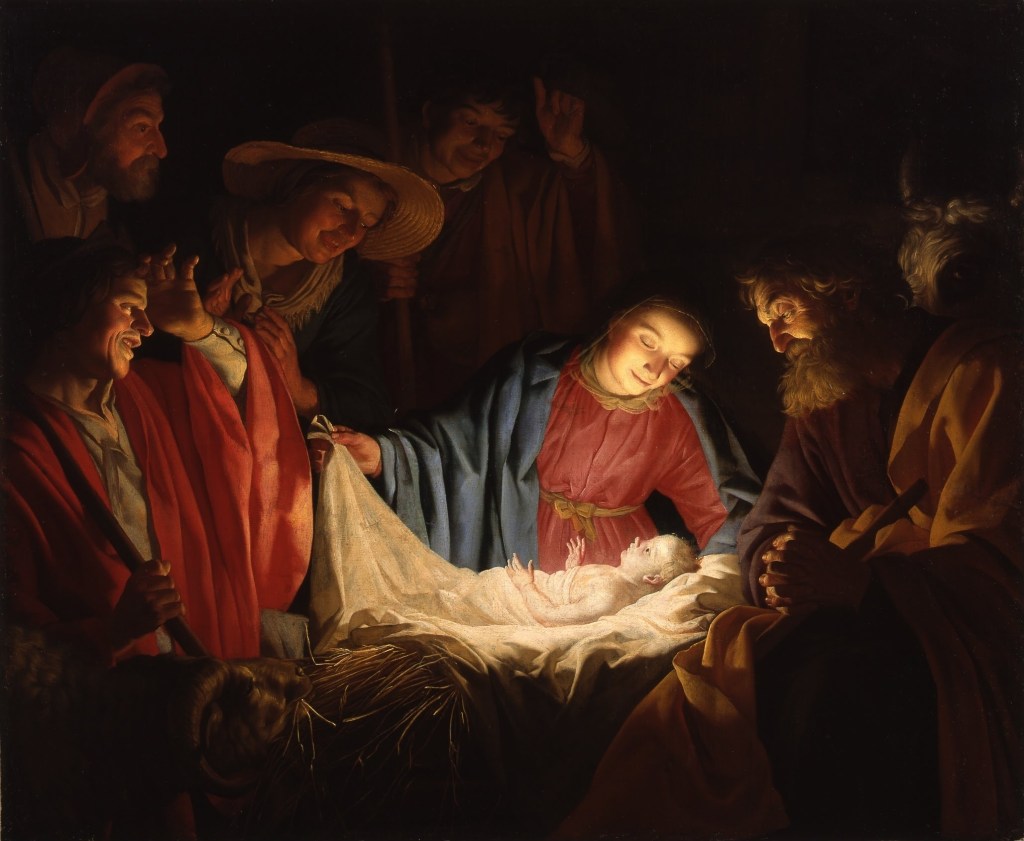
15 When the angels went away from them into heaven, the shepherds said to one another, “Let us go over to Bethlehem and see this thing that has happened, which the Lord has made known to us.” 16 And they went with haste and found Mary and Joseph, and the baby lying in a manger.
(Luke 2:15-16 ESV)
B.C. – Before Christ
In this post I will comment on the historical background of the Gospels beginning about 500 years before the birth of Jesus.
The Jewish people returned to Palestine from exile in Babylon in three major waves in 538 BC led by Zerubbabel and Joshua the High Priest (Ezra 2:1ff.), in 457 BC led by Ezra (Ezra 7:1ff.), and in 444 BC led by Nehemiah (Nehemiah 2:1ff.). The people rebuilt Jerusalem and the Temple, and restored Temple worship. For about 100 more years they remained under the rule of the Persian Empire.
However, over in Greece other events were brewing. Philip the Macedonian was gaining control over all of Greece through military conquest and diplomacy, and transformed Greece into a dominant power. He ruled from 359 to 336 BC, when he was assassinated.
His son Alexander became king at age 20. You know him as Alexander the Great. Over the next 13 years he conquered and carved out the largest empire of the ancient world that stretched 3000 miles from Greece to India and into North Africa (the orange area on the map below). As you can see from the map, the Jewish people in Palestine also came under Greek control in 333 BC (area inside black circle).
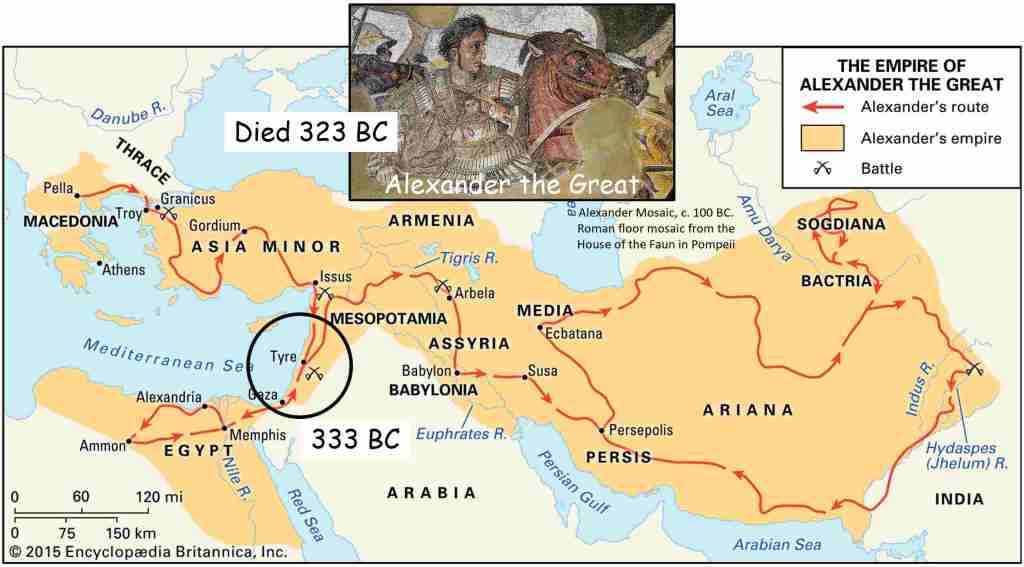
Alexander had been tutored by the Greek philosopher Aristotle, which instilled in him a love for all things Greek. Through his conquests, he spread Greek culture and the Greek language. Greek became the international language of commerce and government throughout his empire and would remain the international language for at least four centuries, even after Latin speaking Rome conquered the Greek empire. So, Greek was the international language during the time of Jesus’ life and the writing of the New Testament because of the conquests of Alexander the Great.
Many Jews learned Greek, and the Hebrew Scriptures (what Christians call the Old Testament) were translated from Hebrew into Greek, because newer generations of Jews could no longer understand Hebrew. The Greek translation of the Old Testament is called the Septuagint.
Returning to Alexander the Great, he was undefeated in battle, but mysteriously died at age 32 in 323 BC, possibly from malaria or possibly from being poisoned by a rival. Immediately after his death, his empire split apart between his four military generals.
Palestine and the Jews remained under various Greek rulers who fought for control of the area. Some tried to impose Greek culture and religion on the Jews. Obviously this did not sit well with them.
Finally, the Jews revolted in 167 BC after the Temple was looted, an altar to Zeus was built in the Temple, pigs were sacrificed, and Jewish worship was outlawed. The conflict is known as the Maccabean Revolt (167-160 BC). It is recorded in the Book of Maccabees in the Apocrypha.
Eventually, the Jews won independence from Greek rule and Judea was established as an independence state in 143 BC. This only lasted for about 80 years until the Romans conquered Palestine in 63 BC and Judea became a Roman province.
In the period of independence after the Maccabean Revolt and before Roman rule, two Jewish parties came into existence – the Pharisees and the Sadducees. They would eventually play a major role in the events recorded in the Gospels and in the life of Christ. So, if you ever wondered where they came from, this was the time and place.
At the beginning, the Pharisees were a sort of “back to the Bible” movement. They wanted to make sure Jews did not make the same mistakes of the past that led God to judge the nation of Israel and send them into exile. This movement started well but ended up being legalistic and eventually made oral traditions equal in authority with the written Scriptures.
The Sadducees were men who held positions of wealth and power. They were primarily priests that controlled what went on in the Temple.
This table summarizes some of the differences between the two parties:
| Pharisees | Sadducees |
|---|---|
| Focus: Mosaic Law | Focus: Temple Ritual |
| Gave equal authority to their oral traditions and the written Torah | Held to a literal interpretation of the Torah only. |
| Middle-class tradesmen and businessmen. | Men of wealth who held positions of power. |
| Synagogue leaders. | Priests. |
| Resisted Greek and Roman rule. | Accommodated Greek and Roman rule. |
| Their beliefs formed the basis of Rabbinic Judaism and all forms of Judaism today. | Ceased to exist after the destruction of Jerusalem and the Temple in 70 AD. |
By the time of the New Testament, both groups held political power and were the members of the Sanhedrin, the Jewish ruling council.
As mentioned earlier, Jewish independence only lasted about 80 years. The Roman Empire conquered Judaea under the Roman general Pompey in 63 BC and Judea became a Roman province.
At the time of Jesus’ birth, the Jews were hoping for a ‘messiah’ who would liberate them from foreign Roman rule. This expectation was based on centuries of prophetic tradition that predicted a future political and military leader descended from King David who would restore the independent Kingdom of Israel.
Because of the long period of Greek and Roman rule, many Greeks and Romans lived in Palestine. So, the areas in which Jesus lived and ministered were a mixture of Jewish, Greek, and Roman cultures which spoke Aramaic, Greek, and Latin.
In 37 BC, the Romans made Herod the Great king over Judea and the stage was set for the events of the New Testament. Herod the Great was the ruler of Judea until his death in 4 BC. He was ruler at the time Jesus was born. He was known for his massive building programs, including the rebuilding and expansion of the Temple in Jerusalem. He was also known for acts of cruelty to protect his power, such as killing his wife and two oldest sons, and killing male babies after the birth of Jesus (Matthew 2:16-18).
The life of Jesus and events recorded in the Gospels take place in the historical setting of first century Judea, the area we today call Israel in the Middle East (area in the black circle below). During the time covered by the New Testament, the Roman Empire ruled the Mediterranean world of the Middle East, Asia Minor, Europe, and North Africa.
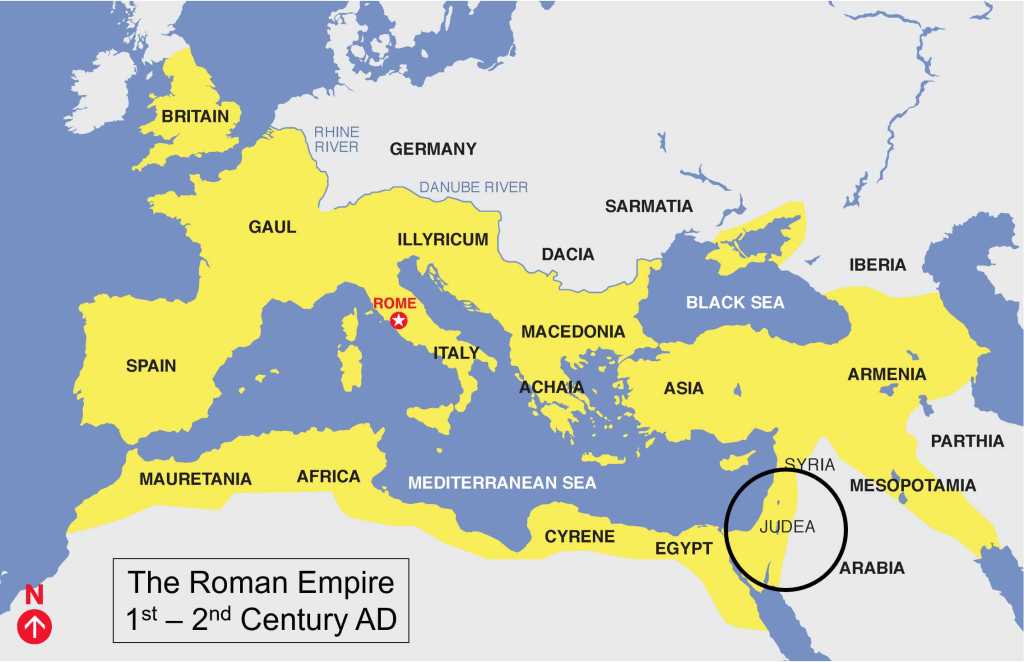
The events in the Gospels are set squarely on a historical footing, with many references to people, places, and events that verify the reliability of the New Testament. These help scholars assign approximate dates to the events in the life of Jesus.
Let’s look at dates for the significant events in the life of Jesus, starting with His birth. However, due to the uncertainty of ancient historical records, most events can only be given an approximate date.
The Birth of Jesus
Matthew in his Gospel writes this regarding the birth of Jesus:
Now after Jesus was born in Bethlehem of Judea in the days of Herod the king, behold, wise men from the east came to Jerusalem…
(Matthew 2:1 ESV)
From this we learn that Jesus was born during the reign of king Herod, who was known as Herod the Great. Most scholars date his reign from 37 BC to 4 BC when he died, though some scholars believe his death was around 1 BC. For the sake of this post, let’s assume the 4 BC date, which is the more widely held view.
Matthew continues:
After listening to the king, they [the wise men] went on their way. And behold, the star that they had seen when it rose went before them until it came to rest over the place where the child was. (Matthew 2:9 ESV)
Many people have tried to determine the exact date of Jesus birth by the appearance of the star. Much has been written on this topic. You may even have a footnote in your Bible about this. However, the appearance of the star does not really help date the birth of Jesus. First, because there were a number of astronomical events in 7, 6, 5, 4, and 1 BC such as a comet, a conjunction of planets, and several eclipses of the moon. And second, the fact that Matthew describes the motion of the star that it “went before them until it came to rest over the place where the child was” indicates that perhaps it was not even a natural phenomenon at all, but a miraculous event or an angel. So, it does not help provide a date for Jesus’ birth.
But Matthew tells us more:
13 Now when they had departed, behold, an angel of the Lord appeared to Joseph in a dream and said, “Rise, take the child and his mother, and flee to Egypt, and remain there until I tell you, for Herod is about to search for the child, to destroy him.” 14 And he rose and took the child and his mother by night and departed to Egypt 15 and remained there until the death of Herod. This was to fulfill what the Lord had spoken by the prophet, “Out of Egypt I called my son.” (Matthew 2:13-15 ESV)
So, Joseph, Mary, and baby Jesus remained in Egypt until the death of Herod in 4 BC. So, obviously Jesus must have been born before 4 BC when Herod died.
Matthew gives us another time clue based on an event before the death of Herod. He continues:
Then Herod, when he saw that he had been tricked by the wise men, became furious, and he sent and killed all the male children in Bethlehem and in all that region who were two years old or under, according to the time that he had ascertained from the wise men. (Matthew 2:16 ESV)
Based on information given to Herod by the wise men, Herod had boys two years old and younger killed in Bethlehem before his own death. This implies that Jesus was under two years of age at the time of the executions. They occurred near the end of Herod’s reign, which gives us an estimate that Jesus was born sometime during 6 to 4 BC, several years before Herod’s death
Luke also provides information in his Gospel that helps date Jesus’ birth to this same time of 6 to 4 BC. This is about as close as known historical records allow us to date the birth of Jesus – somewhere in the 6 to 4 BC range.
The Ministry of Jesus
The Gospels do not attempt to be complete biographies of the life of Jesus. There is much left out after his birth, most of the next 30 years of his life. Their focus is on His ministry as the Good News. But the Gospels do provide some information to map out the ministry of Jesus.
Luke in his Gospel provides this information:
1 In the fifteenth year of the reign of Tiberius Caesar, Pontius Pilate being governor of Judea, and Herod being tetrarch of Galilee, and his brother Philip tetrarch of the region of Ituraea and Trachonitis, and Lysanias tetrarch of Abilene, 2 during the high priesthood of Annas and Caiaphas, the word of God came to John the son of Zechariah in the wilderness. (Luke 3:1-2 ESV)
Luke tells us that John the Baptist began his ministry in the fifteenth year of the reign of Tiberius Caesar. Now you might think that this would give us an exact year, but history is complicated.
Tiberius became emperor after the death of Ceasar Augustus in 14 AD. If that is when Luke begins his 15 years, then the date of the beginning of John’s ministry would be in 28 or 29 AD. But, Tiberius might have begun a coregency with Augustus in 11/12 AD. If Luke is counting from that date then John began his ministry in 26 or 27 AD. Scholars don’t know which date Luke is using as his starting point in this verse.
Also, as you recall, Jesus was baptized by John, which marked the beginning of Jesus’ ministry. There is no indication in the Gospels about how long John had been baptizing before he baptized Jesus. Perhaps it was a few months, or perhaps it was a year or two. So that adds uncertainty to the year when Jesus started His ministry.
Luke also notes that:
Jesus, when he began his ministry, was about thirty years of age…
(Luke 3:23 ESV)
So, Jesus was probably at least 30, possibly even 31 or 32 years old when he began His ministry. Considering all the data, it is reasonable that Jesus began His ministry around 27 AD.
The gospels do not provide enough information that can be used to precisely determine the length of Jesus’ ministry. What is written in the Gospels could be packed into less than a year, but that seems unlikely. It seems more likely that Jesus’ ministry was 2 or 3 years in length based on the mention of three annual Passover visits to Jerusalem in the Gospel of John (2:13, 6:4, 12:1).
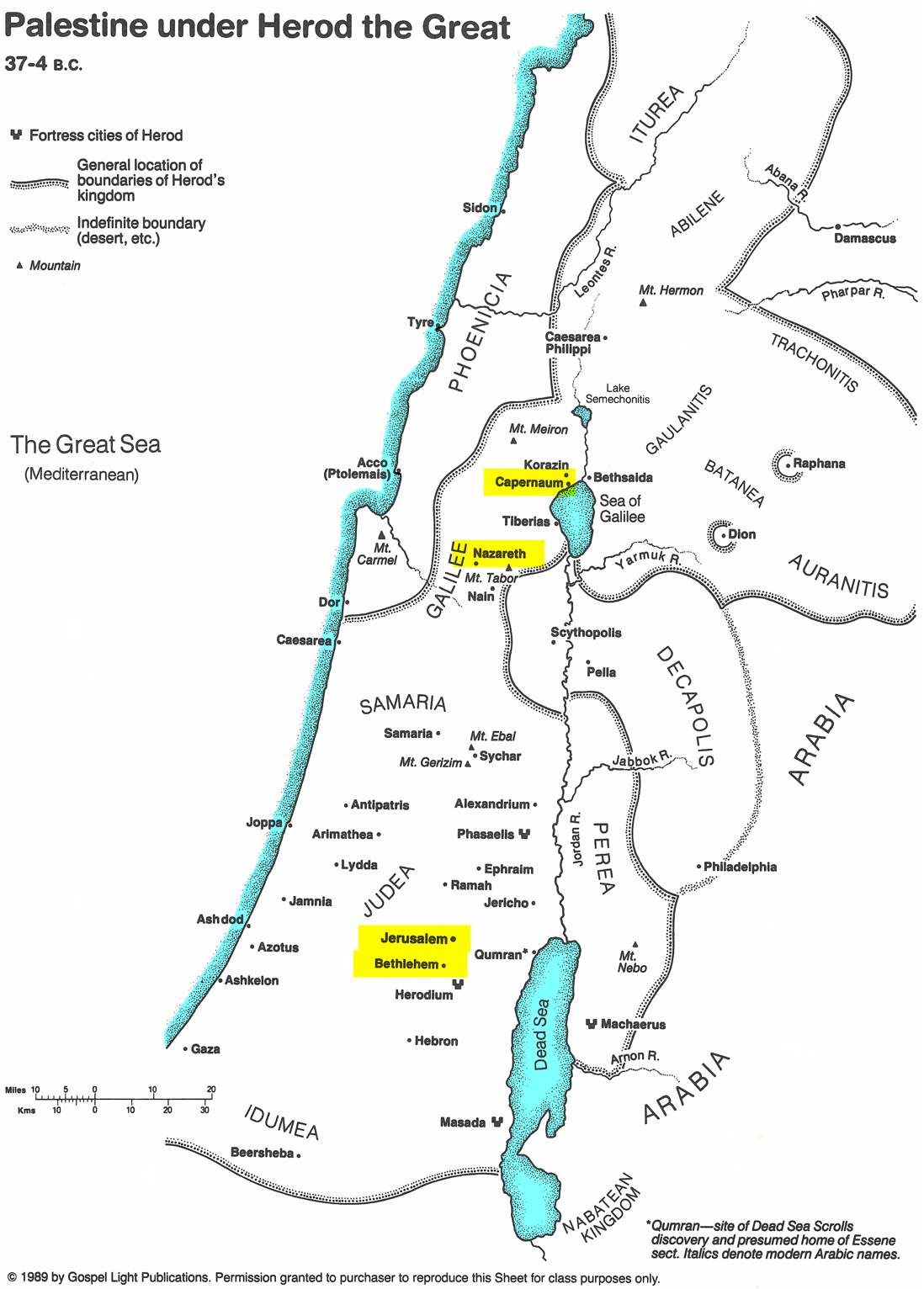
Regarding Jesus’ ministry, though born in the Judean city of Bethlehem, Jesus was raised in the Galilean town of Nazareth. This is where Jesus began his ministry and Matthew, Mark, and Luke focus heavily on this area of his ministry in their Gospels. It was an area of mixed population. Galilee was known as ‘Galilee of the Gentiles’. Its Jewish inhabitants had a distinctive Galilean accent, and were despised by the ‘proper’ speaking Jews living down in Judea. The town of Capernaum became the headquarters for Jesus’ Galilean ministry, and most of His disciples were from this region.
But Jesus also traveled into Gentile territory. For example, the Gospels tell us about Jesus’ encounters with Gentiles in the cities of Tyre (Mark 7:24-30) and Caesarea Philippi (Mark 8:27), and the regions of Decapolis (Mark 7:31) and Samaria (John 4:5).
The final part of Jesus ministry was in Judea, moving ultimately to the city of Jerusalem, and the climax of His work in the crucifixion and resurrection. The Gospels spend a lot of time on the final week of Jesus – from the triumphal entry into Jerusalem on Palm Sunday, leading up to the crucifixion and resurrection.
Jesus was crucified on a Friday, but the year is also a matter of debate, with the most likely years being 30 or 33 AD. 30 AD is perhaps slightly preferrable. The uncertainty is because the Gospels do not explicitly state the exact date of his crucifixion, and the historical records available are not precise enough to pinpoint a single year.
Key Dates in the Life of Jesus
| 6-4 BC – Born | During the reign of Roman Emperor Caesar Augustus (27 BC – 14 AD) and the reign of Herod the Great, provincial governor of Judea (37-4 BC). |
| 27 AD – Begins Public Ministry | During the reign of Roman Emperor Tiberius Caesar (14-37 AD). |
| 30 or 33 AD – Crucified | The year is uncertain. |
Word Focus Lexicon
Lexical Form: ποιμήν ποιμένος, ὁ
Transliteration: poimēn
Gloss: shepherd
Part of Speech: Masculine Noun
New Testament Frequency: 18
Strong’s Number: G4166 (Link to Blue Letter Bible Lexicon)
ποιμήν / poimēn refers to a person who tends a herd of animals. Sheep and goat herding was an important and respected vocation in biblical Palestine. The word could also be used figuratively to refer to someone who cares for or protects in a general sense, such as a spiritual leader like a church pastor who cares for his congregation. The pastor would be called a shepherd. This leads to a range of metaphors in the Bible, such as a congregation being called a flock (1 Peter 5:2), followers of Christ being called sheep (John 10:27), and judgment referred to as separating the sheep from the goats (Matthew 25:32-33).
Jesus referred to Himself as the Good Shepherd (John 10:11) who gathers the lost sheep, cares for them, and gives His life for the sheep.
Bibliography
Balz, Horst and Schneider, Gerhard, Editors. Exegetical Dictionary of the New Testament. William B. Eerdmans Publishing Company, 1990.
Beetham, Christopher A., Editor. The Concise New International Dictionary of New Testament Theology and Exegesis. Zondervan Academic, 2021.
Bromiley, Geoffrey W. Theological Dictionary of the New Testament, Abridged in One Volume. William B. Eerdmans Publishing Company, 1985.
Carson, D. A. and Moo, Douglas J. An Introduction to the New Testament. Zondervan, 1992, 2005 by D. A. Carson and Douglas J. Moo.
Danker, Frederick William. The Concise Greek-English Lexicon of the New Testament. The University of Chicago Press, 2009.
Gilbrant, Thoralf, International Editor. The New Testament Greek-English Dictionary. The Complete Biblical Library, 1990.
Gundry, Robert H. A Survey of the New Testament. Zondervan Publishing House, 1970.
Guthrie, Donald. New Testament Introduction. Inter-Varsity Press, 1970 by The Tyndale Press.
Liddell, Henry George and Scott, Robert. A Greek-English Lexicon. Oxford University Press. 1940. With a Supplement, 1996.
Tenney, Merrill C. New Testament Survey. William B. Eerdmans Publishing Co., 1953, 1961, 1985.
Verbrugge, Verlyn D. New International Dictionary of New Testament Theology: Abridged Edition. Zondervan, 2000.
Vos, Howard F. Beginnings in the New Testament. Moody Press, 1973 by The Moody Bible Institute of Chicago
Williams, Peter J. Can We Trust the Gospels. Crossway, 2018 by Peter John Williams.
Unless otherwise noted as below, English translations of Bible verses are by the author from the Greek text and are not quotations from any copyrighted Bible version or translation.
Scripture quotations marked (ESV) are from the Holy Bible, English Standard Version, copyright © 2001, 2007, 2011, 2016, 2025 by Crossway Bibles, a division of Good News Publishers. Used by permission. All rights reserved.
 Koine Foundations
Leave a comment