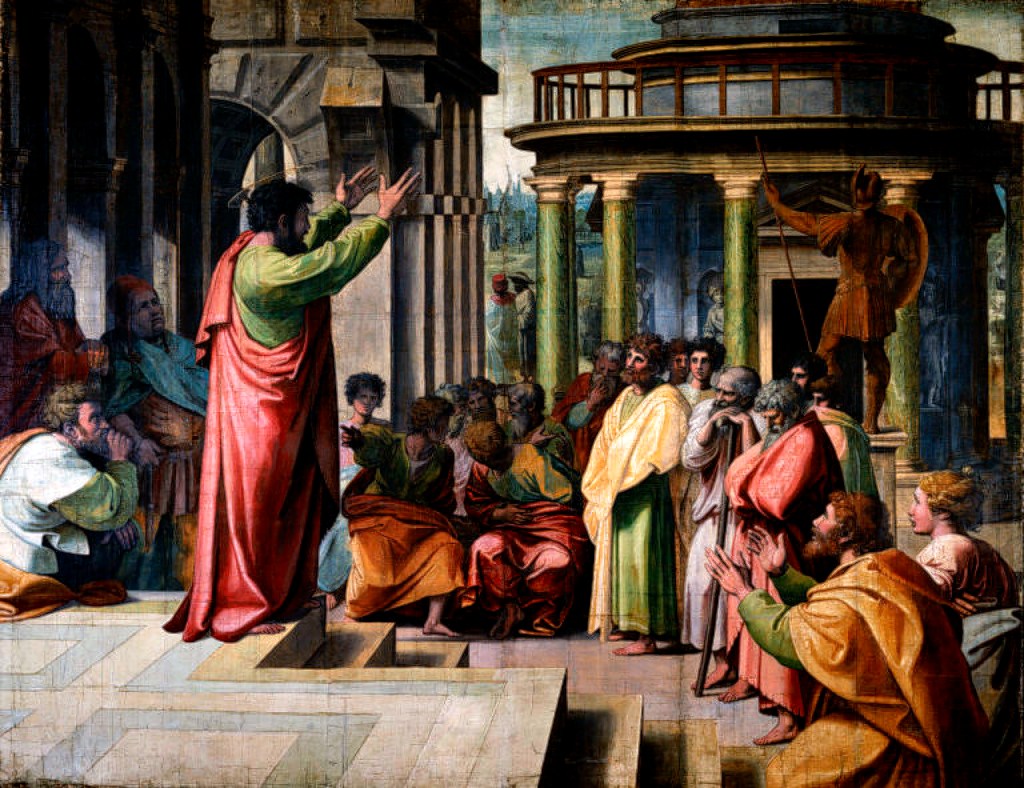
22 Then Paul stood in the middle of the Areopagus and said, “Men of Athens, I see that in every way you are very religious. 23 For as I was passing through and looking closely at the things you worship, I even found an altar with this inscription: ‘to an unknown god‘. Therefore, what you worship in ignorance, this I proclaim to you. 24 The God who made the universe and everything in it is the Lord of heaven and earth. He does not live in temples made by hands.”
(Acts 17:22-24 TBA)
Introduction
In this post I continue my comments on the book of Acts beginning with Paul’s Second Missionary Journey in Acts chapter 16.
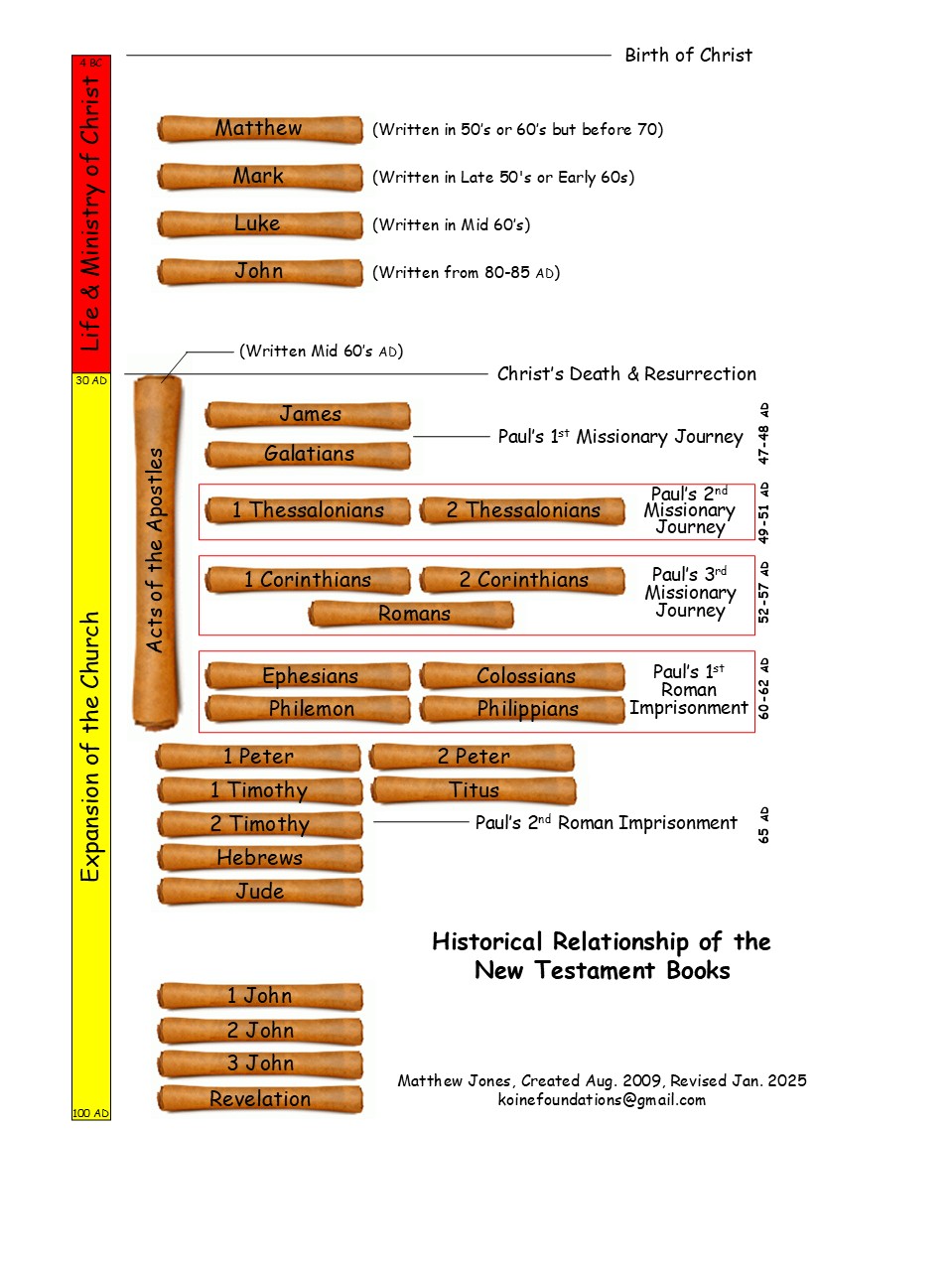
As noted in Part 1 and Part 2, Acts describes the EXPANSION of the Good News to the whole world as Christians obeyed Jesus’ command to be witnesses to the ends of the earth.
As also noted, a number of other New Testament books called Epistles that were written by Paul fit into the events recorded in Acts chapters 13 to 28. These Epistles explain the APPLICATION of the Good News to daily living in a corrupt culture. So, I will also continue my comments on these books where they fit into the Acts narrative.
Paul’s Second Missionary Journey
Reference: Acts 15:36-18:22
Date: 49-51 AD
After the Jerusalem Council settled the issues around Gentile converts to Christianity (see prior post), Paul and Barnabas spent about a year in Antioch teaching and preaching (Acts 15:35).
Then Paul set out from Antioch on his Second Missionary Journey. He took with him Silas as a ministry partner, rather than Barnabas who had accompanied him on the first journey. Silas was a Jewish believer from Jerusalem (Acts 15:36-41).
Paul and Barnabas had split company because of a disagreement over Mark who had also accompanied them on the First Missionary Journey, but had abandoned the mission part way through. Barnabas wanted to take Mark along again on this Second Missionary Journey. Luke does not explain why Paul was opposed, other than it involved Mark’s departure from the mission. Whatever the reason, Paul regarded Mark’s departure as desertion, suggesting that it was for more than merely personal reasons.
For more information about the split between Paul and Barnabas, see my other post about their Sharp Disagreement.
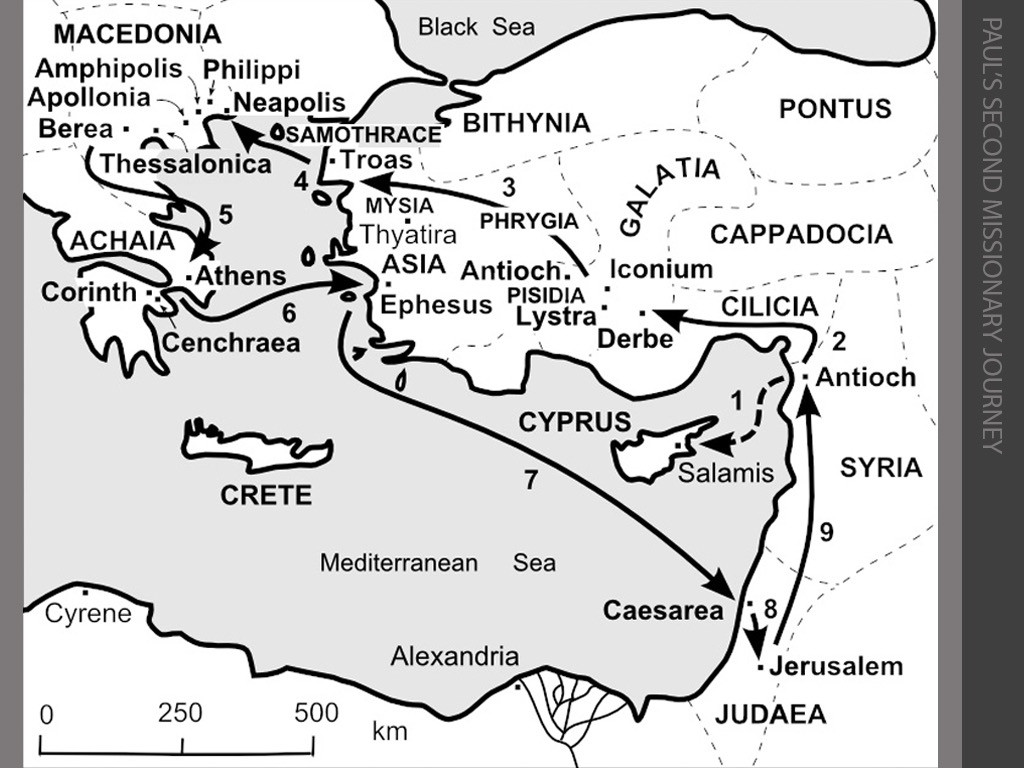
Paul and Silas first revisited the churches founded on the First Missionary Journey in Asia Minor. Here also Timothy joined their mission. They then headed into Europe (Macedonia on the map above) after Paul had a vision from God to go there (Acts 16:6-10). They shared the Good News and established churches there in a number of cities including:
Philippi (Acts 16:11-40), where Paul and Silas were thrown into prison but delivered by an earthquake that resulted in the jailer and his family accepting Christ.
Thessalonica (Acts 17:1-9), where many people responded positively to the Good News. However, Paul and Silas were eventually forced to flee the city because of violent opposition to their preaching.
Berea (Acts 17:10-15), where the Jewish believers were praised for carefully examining the Scriptures to determine if what Paul and Silas proclaimed was true. Silas and Timothy remained in Berea while Paul continued on to Athens.
Athens (Acts 17:16-34), where Paul addressed the Areopagus because the Athenian philosophers wanted to hear about the strange new religion he was proclaiming. For more about this episode see my previous post entitled God.
Corinth (Acts 18:1-17), where Paul ministered for 18 months, along with Silas and Timothy who rejoined him from Macedonia.
While in Corinth, Paul received news about the Thessalonian churches. In response to the news, he wrote epistles (letters) to these churches now known as First Thessalonians and Second Thessalonians.
The Epistles of 1 & 2 Thessalonians
Author: Paul
Audience: Believers in the city of Thessalonica (see map above)
Date: 50-51 AD
From these letters we learn that the Thessalonian believers were standing strong in their faith in spite of being persecuted. However, they had questions about basic Christian beliefs, but especially about the Rapture and Christ’s Second Coming. In addition, some of the believers were so convinced that the return of Christ would happen soon that they quit working. Perhaps they reasoned, “If Christ is returning soon, why bother working?” (See 2 Thessalonians 3:10-12.)
Paul’s letters to them provided encouragement in the face of persecution, explained the Rapture and Second Coming, and admonished them to live godly lives while patiently watching for Christ’s return. Paul admonishes them:
Walk in a manner worthy of God, who calls you into his own kingdom and glory. (1 Thessalonians 2:12 ESV)
Do not grow weary in doing good. (2 Thessalonians 3:13 ESV)
Paul’s Third Missionary Journey
Reference: Acts 18:23-21:14
Date: 51-57 AD
After completing the Second Missionary Journey, Paul returned to Jerusalem and then almost immediately set out on a Third Missionary Journey from Antioch again.
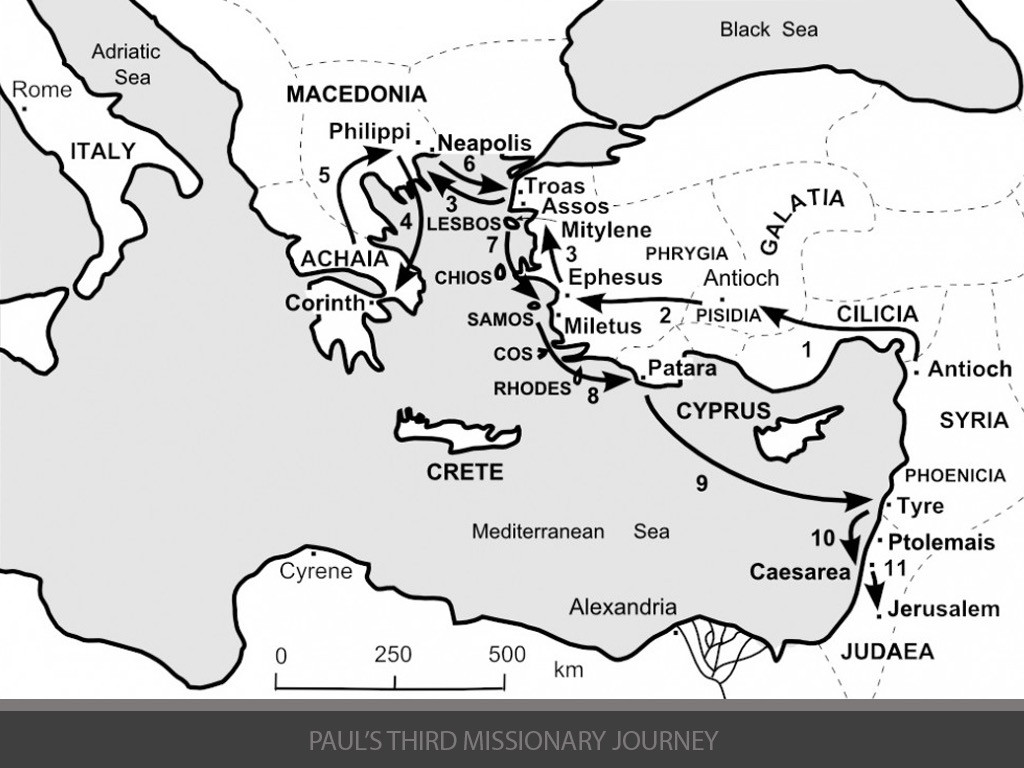
He visited churches he had established on his First Missionary Trip and then established a ministry at the city of Ephesus where he stayed for about three years. While in Ephesus, Paul wrote an epistle to the church in the city of Corinth that he had established on his Second Mission Journey. This letter is lost to history and not part of the New Testament (it is referred to in 1 Corinthians 5:9-11). In response he received troubling news about the condition of the church in Corinth.
The Epistles of 1 & 2 Corinthians
Author: Paul
Audience: Believers in the city of Corinth (see map above)
Date: 1 Corinthians: 54-55 AD
Date: 2 Corinthians: 55-56 AD
Corinth was an extremely pagan and worldly city. It was a major port city and trade center. This resulted in great prosperity but also great immorality – all the vices associated with being a port city. It had dozens of temples and shrines, 1000 sacred prostitutes who served at the Temple of Aphrodite, and an area of the marketplace that was devoted to taverns. The city’s name became synonymous with immorality in the Roman world – a person who lived a life of drunkenness and sexual immorality was said to be “living like a Corinthian”.
It was natural for a church in this extremely pagan, immoral society to bristle with difficulties. Paul got reports of internal fighting, immorality, and lawsuits against one another in the Church. Also, the believers had questions about celibacy, idol worship, and the resurrection (Greeks did not believe in the resurrection of the body).
In response, Paul wrote a second epistle to the church, which we now call First Corinthians. His intention was to address these issues and answer their questions.
Apparently the Corinthian believers did not take this instruction to heart. And so, Paul then visited the city, which he refers to as a “painful visit” (see 2 Corinthians 2:1). A few months later he wrote a third epistle which is also lost to history and not in the New Testament (it is referred to in 2 Corinthians 2:3-9). In it he pleaded with them to change their behavior. A little later, while in Macedonia, he received word that the church had repented. He then wrote a fourth epistle, what we now call Second Corinthians. He followed this with a visit to the city to repair damaged relations with them.
So, First and Second Corinthians address internal problems in the Corinthian church, and instruct the believers about how to live for Christ in an immoral society. Paul writes:
I appeal to you, brothers, by the name of our Lord Jesus Christ, that all of you agree, and that there be no divisions among you, but that you be united in the same mind and the same judgment. (1 Corinthians 1:10 ESV)
First and Second Corinthians address the struggles of believers called out of a pagan society when the moral implications of the Good News come into conflict with the immoral views of the society. These books are very relevant to believers living in today’s worldly, pagan culture.
The Epistle of Romans
Author: Paul
Audience: Believers in the city of Rome (see map above)
Date: 57 AD
At this point in his ministry, Paul wanted to eventually go to Rome, so Luke tells us in Acts 19:21. While on his final visit to Corinth, he wrote an epistle to the believers in Rome, perhaps in preparation for the visit he hoped to make in the near future. Paul had never been to Rome when he wrote this letter.
It is not known how the church in Rome came into existence. Roman Jews were in Jerusalem on the day of Pentecost (see Acts 2:10) and they may have returned to Rome to establish a church. Or it may have been established by believers from churches such as Corinth and Ephesus.
Romans is possibly the most theologically important of all the letters written by Paul, because it contains his most comprehensive explanation of the Good News. The book inspired the reformation when Martin Luther discovered in it the truth of justification by faith. Romans shows how sinful men and women receive the righteousness of God through faith in Jesus Christ.
For all have sinned and fall short of the glory of God. (Romans 3:23 ESV)
Sin results in physical and spiritual death.
For the wages of sin is death, but the free gift of God is eternal life in Christ Jesus our Lord. (Romans 6:23 ESV)
However, through Jesus Christ, God provided a solution to our sin and separation from God, resulting in eternal life to those who accept it.
At the end of the Third Missionary Journey, Paul returned to Jerusalem to report to the church leadership.
In the next post I will continue the account in Acts with Paul’s trip to Rome.
Word Focus Lexicon
Lexical Form: θεός -οῦ, ὁ
Transliteration: theos
Gloss: god, God
Part of Speech: Masculine Noun
New Testament Frequency: 1318
Strong’s Number: G2316 (Link to Blue Letter Bible Lexicon)
θεός / theos is the Greek word for god. It is the most frequently used noun in the New Testament (1318 times). Just like our English word ‘god’, the Greek word does double duty, being used to refer to the true God and to false gods. In both English and Greek, context determines which sense is meant. For example, in verse 23 at the top of this post the word refers to an unknown false god. While in verse 24 it refers to the true creator God who is Lord of heaven and earth. The original Greek text does not distinguish the difference by using a capital letter. In English we capitalize the word ‘God’ out of reverence, though to most people it is simply a spelling convention.
Bibliography
Balz, Horst and Schneider, Gerhard, Editors. Exegetical Dictionary of the New Testament. William B. Eerdmans Publishing Company, 1990.
Beetham, Christopher A., Editor. The Concise New International Dictionary of New Testament Theology and Exegesis. Zondervan Academic, 2021.
Bromiley, Geoffrey W. Theological Dictionary of the New Testament, Abridged in One Volume. William B. Eerdmans Publishing Company, 1985.
Bruce, F.F. Commentary on the Book of the Acts, The New International Commentary on the New Testament. Wm. B. Eerdmans Publishing Co., Reprinted 1984.
Carson, D. A. and Moo, Douglas J. An Introduction to the New Testament. Zondervan, 1992, 2005 by D. A. Carson and Douglas J. Moo.
Danker, Frederick William. The Concise Greek-English Lexicon of the New Testament. The University of Chicago Press, 2009.
Dickson, John. A Doubter’s Guide to the Bible. Zondervan, 2014 by John Dickson.
Gilbrant, Thoralf, International Editor. The New Testament Greek-English Dictionary. The Complete Biblical Library, 1990.
Gundry, Robert H. A Survey of the New Testament. Zondervan Publishing House, 1970.
Guthrie, Donald. New Testament Introduction. Inter-Varsity Press, 1970 by The Tyndale Press.
Liddell, Henry George and Scott, Robert. A Greek-English Lexicon. Oxford University Press. 1940. With a Supplement, 1996.
Marshall, I. Howard. The Acts of the Apostles, Tyndale New Testament Commentaries. William B. Eerdmans Publishing Company, 1980 by I. Howard Marshall.
Tenney, Merrill C. New Testament Survey. William B. Eerdmans Publishing Co., 1953, 1961, 1985.
Verbrugge, Verlyn D. New International Dictionary of New Testament Theology: Abridged Edition. Zondervan, 2000.
Vos, Howard F. Beginnings in the New Testament. Moody Press, 1973 by The Moody Bible Institute of Chicago
English translations of Bible verses marked (TBA) are translations by the author from the Greek text and are not quotations from any copyrighted Bible version or translation.
Scripture quotations marked (ESV) are from the Holy Bible, English Standard Version, copyright © 2001, 2007, 2011, 2016, 2025 by Crossway Bibles, a division of Good News Publishers. Used by permission. All rights reserved.
 Koine Foundations
Leave a comment