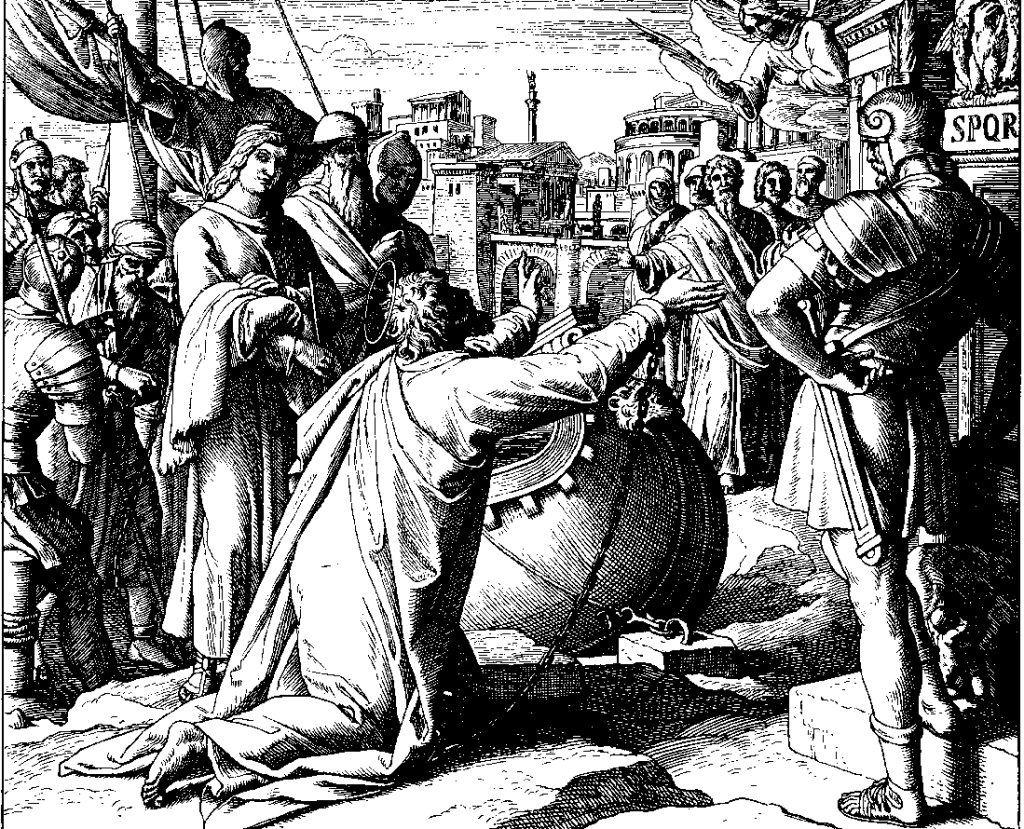
When we entered Rome, Paul was allowed to stay by himself with the soldier who guarded him. (Acts 28:16 TBA)
Introduction
In this post I complete my comments on the book of Acts, focusing on Paul’s journey to Rome beginning at Acts 21:15. This journey occurs after his Third Missionary Journey.
As noted in Part 1, Part 2, and Part 3, Acts describes the EXPANSION of the Good News to the whole world as Christians obeyed Jesus’ command to be witnesses to the ends of the earth.
As also noted, a number of other New Testament books called Epistles that were written by Paul fit into the events recorded in Acts chapters 13 to 28. These Epistles explain the APPLICATION of the Good News to daily living in a corrupt culture. So, I will also continue my comments on these books where they fit into the Acts narrative.
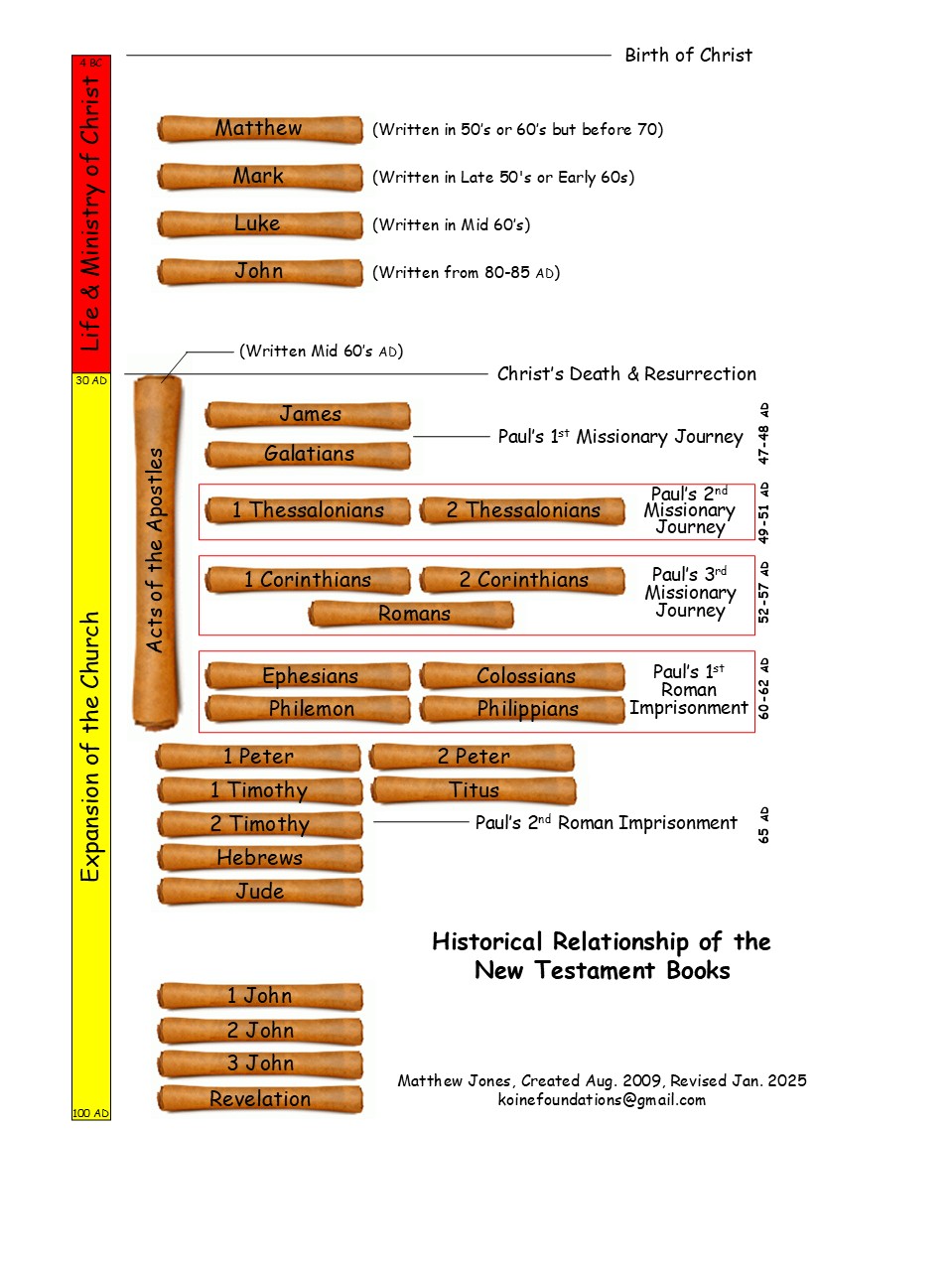
Paul’s Journey to Rome
Reference: Acts 21:15-28:16
Date: 57-60 AD
At the end of his Third Missionary Journey, Paul returned to Jerusalem to report to the church leadership. While there he went to the Temple and a riot erupted because he was recognized as the one who had been preaching the Good News across the world. Some of the Jews also thought that he had brought a Gentile into the Temple, which was forbidden under Jewish law.
Paul was arrested by the Roman authorities, and so began his hoped-for journey to Rome, but not quite in the manner he expected. The entire incident from arrest to arrival in Rome covered a period of three to four years. The major events are as follows:
(1) Paul reports to the church leaders in Jerusalem (Acts 21:17-26).
(2) Paul is arrested in the Temple (Acts 21:27-36).
(3) Paul addresses the Jewish mob in the Temple (Acts 21:37-22:21).
(4) Paul is questioned by the Roman soldiers (Acts 22:22-29).
(5) Paul makes a defense before the Jewish Sanhedrin (Acts 22:30-23:11).
(6) A plot to kill Paul is discovered and he is transferred to Caesarea where he will be imprisoned for two to three years (Acts 23:12-35).
(7) In Caesarea, Paul has a hearing before Felix the governor but no action is taken. Felix is eventually succeeded as governor by Festus (Acts 24:1-27).
(8) Paul has a hearing before Festus and the Jewish authorities, but because of political considerations Festus wants to transfer the trial to Jerusalem. (Acts 25:1-9).
(9) After several years in prison, Paul is tired of waiting for a trial and appeals to Caesar. As a Roman citizen he had the right to have his case tried before Caesar in Rome (Acts 25:10-12).
(10) In Caesarea, Paul makes a defense before King Agrippa and his sister Bernice (Acts 25:13-26:32).
(11) Paul is finally shipped off (literally) to Rome for trial. During the six to nine month voyage, Paul is shipwrecked during a storm, but finally ends up in Rome (Acts 27:1-18:16).
Paul’s First Roman Imprisonment
Reference: Acts 28:17-31
Date: 60-62 AD
In Rome, Paul awaited trial before Caesar under house arrest for two years but was free to preach the Good News. This is where the book of Acts ends, with Paul in Rome awaiting trial.
While under house arrest in Rome, Paul wrote four letters, Ephesians, Colossians, Philemon and Philippians, in that order. Because they were written while Paul was imprisoned, they are often called the Prison Epistles.

The Epistles of Ephesians and Colossians
Author: Paul
Audience: Believers in the cities of Ephesus and Colossae
Date: 60-61 AD
The Epistles of Ephesians and Colossians are very similar in content. Both were written at the same time and delivered to their designated churches by the same messenger, Tychicus (Ephesians 6:21, Colossians 4:7). (Tychicus is also mentioned in Acts 20:4, 2 Timothy 4:12, and Titus 3:12.)
Like most of Paul’s other letters, Ephesians and Colossians begin with theological truth and then focus on the practical applications of that truth to daily living in ways that are compatible with the Good News – how believers are to live holy lives because they are saved. At the heart of the practical sections in both books is the concept of “putting off” and “putting on”.
Paul summarizes it this way in Ephesians 4:22-24:
22 You were taught, with regard to your former way of life, to put off your old self, which is being corrupted by its deceitful desires; 23 to be made new in the attitude of your minds; 24 and to put on the new self, created to be like God in true righteousness and holiness. (Ephesians 4:22-24 NIV)
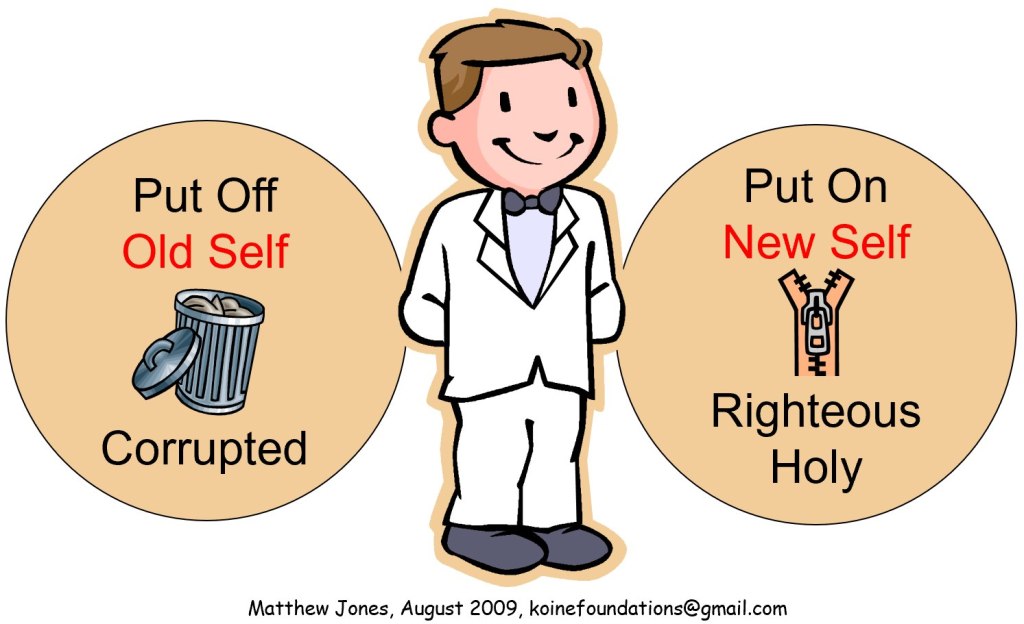
After introducing the general concept of “put off” and “put on”, Paul provides specific examples. Some are listed below based on Ephesian 4:25-32.
| Put Off | Put On |
|---|---|
| Falsehood | Speaking the Truth |
| Stealing | Honest Word, Charity |
| Unwholesome Speech | Edifying Speech |
| Bitterness, Rage, Anger, Brawling, Slander, Malice | Kindness, Compassion, Forgiveness |
The Epistle to Philemon
Author: Paul
Audience: Philemon, an individual who lived in Colossae
Date: 60-62 AD
The Epistle to Philemon is written to Philemon, a resident of Colossae, who had become a Christian during Paul’s Second Missionary Journey. A slave of Philemon named Onesimus stole some of Philemon’s money and fled to Rome, where somehow he came into contact with Paul who led him to Christ. Paul is now sending Onesimus back to his master with this letter, asking Philemon to accept Onesimus back without punishment and as a Christian brother.
Paul writes to Philemon:
15 Perhaps the reason he was separated from you for a little while was that you might have him back forever – 16 no longer as a slave, but better than a slave, as a dear brother. (Philemon 1:15-16 NIV)
The Epistle of Philippians
Author: Paul
Audience: Believers in the city of Philippi
Date: 60-62 AD
The last letter written from Paul’s Roman imprisonment is to the Philippians. It is a very personal letter to believers who were most likely Paul’s closest friends. The letter focuses on unity and joy in the face of suffering. The Philippians are admonished to put aside internal bickering and reminded that true joy comes from Jesus Christ alone, even in the face of persecution and suffering.
By this time, Paul had been in custody for six years (from 57 AD in Palestine to 62 AD in Rome). He could have allowed this to discourage him. But instead he was full of joy. And what we learn from this is that God uses all the circumstances in the lives of believers for good. Paul’s imprisonment, though it could be viewed as a bad thing, was good because it allowed him time to write four important letters and make a significant impact on spreading the Good News in Rome, even into the very household of Caesar himself.
And so, Paul says to the Philippians and to us:
Rejoice in the Lord always. I will say it again: Rejoice! (Philippians 4:4 NIV)
In the next post I will comment on the New Testament books that were written after the events recorded in Acts.
Word Focus Lexicon
Lexical Form: Ῥώμη -ης, ἡ
Transliteration: rhōmē
Gloss: Rome
Part of Speech: Feminine Proper Noun
New Testament Frequency: 8
Strong’s Number: G4516 (Link to Blue Letter Bible Lexicon)
Ῥώμη / Rhōmē is the Greek word for Rome, the capital city of the Roman empire.
Bibliography
Balz, Horst and Schneider, Gerhard, Editors. Exegetical Dictionary of the New Testament. William B. Eerdmans Publishing Company, 1990.
Beetham, Christopher A., Editor. The Concise New International Dictionary of New Testament Theology and Exegesis. Zondervan Academic, 2021.
Bromiley, Geoffrey W. Theological Dictionary of the New Testament, Abridged in One Volume. William B. Eerdmans Publishing Company, 1985.
Bruce, F.F. Commentary on the Book of the Acts, The New International Commentary on the New Testament. Wm. B. Eerdmans Publishing Co., Reprinted 1984.
Carson, D. A. and Moo, Douglas J. An Introduction to the New Testament. Zondervan, 1992, 2005 by D. A. Carson and Douglas J. Moo.
Danker, Frederick William. The Concise Greek-English Lexicon of the New Testament. The University of Chicago Press, 2009.
Dickson, John. A Doubter’s Guide to the Bible. Zondervan, 2014 by John Dickson.
Gilbrant, Thoralf, International Editor. The New Testament Greek-English Dictionary. The Complete Biblical Library, 1990.
Gundry, Robert H. A Survey of the New Testament. Zondervan Publishing House, 1970.
Guthrie, Donald. New Testament Introduction. Inter-Varsity Press, 1970 by The Tyndale Press.
Liddell, Henry George and Scott, Robert. A Greek-English Lexicon. Oxford University Press. 1940. With a Supplement, 1996.
Marshall, I. Howard. The Acts of the Apostles, Tyndale New Testament Commentaries. William B. Eerdmans Publishing Company, 1980 by I. Howard Marshall.
Tenney, Merrill C. New Testament Survey. William B. Eerdmans Publishing Co., 1953, 1961, 1985.
Verbrugge, Verlyn D. New International Dictionary of New Testament Theology: Abridged Edition. Zondervan, 2000.
Vos, Howard F. Beginnings in the New Testament. Moody Press, 1973 by The Moody Bible Institute of Chicago
English translations of Bible verses marked (TBA) are translations by the author from the Greek text and are not quotations from any copyrighted Bible version or translation.
Scripture quotations marked (ESV) are from the Holy Bible, English Standard Version, copyright © 2001, 2007, 2011, 2016, 2025 by Crossway Bibles, a division of Good News Publishers. Used by permission. All rights reserved.
Scripture quotations marked (NIV) are from the New International Version, copyright © by Biblica, Inc. Used with permission. All rights reserved worldwide.
 Koine Foundations
Leave a comment