This post continues a long series that comments on the New Testament book of First John. In this post I comment on some of the major elements of the structure and present an outline of the book.
As noted in the previous post, First John was written to address a crisis that was disrupting the churches that the Apostle John pastored in Asia Minor (modern day Turkey). It appears that some members were teaching beliefs that were contrary to the Good News revealed by Jesus Christ. These disruptors had separated, perhaps to form their own churches, but their teachings had sown doubts among the members that remained. These disruptors considered themselves spiritually superior because they felt they possessed the true knowledge of God in which Jesus Christ was no longer central.
In response, John wrote a pastoral letter (now called First John), not to attack the disruptors, but to encourage and reassure the remaining members he cared for that what they believed was the truth handed down directly from Jesus Christ. What he wrote had authority because he was an ear-witness and eye-witness of the life and teachings of Jesus.
Literary Devices
The contents of First John may have actually been preached as a sermon before it was written down into a letter to be distributed to a number of other churches. Some scholars think that the brief New Testament book of Second John is actually the cover letter that accompanied First John. This may explain why First John does not have the typical features of a letter such as the identity of the author, personal greetings, and a farewell. Rather, it has the character of a pastoral message of encouragement and reassurance that was intended to be read aloud.
John uses a number of literary devices to compose his sermon, including:
Lexical Cohesion. John uses extensive repetition of words to link together the various sections of his sermon. Here are a few examples of words and related words that are frequently repeated:
| love (verb) | ἀγαπάω / agapaō G25 | 28x |
| love (noun) | ἀγάπη / agapē G26 | 18x |
| beloved (adj) | ἀγαπητός / agapētos G27 | 6x |
| know (verb) | γινώσκω / ginōskō G1097 | 25x |
| know (verb) | εἴδω / eidō G1492 | 15x |
| abide (verb) | μένω / menō G3306 | 24x |
| sin (verb) | ἁμαρτάνω / hamartanō G264 | 10x |
| sin (noun) | ἁμαρτία / hamartia G266 | 17x |
| world (noun) | κόσμος / kosmos G2889 | 23x |
In some instances the repetition is closely spaced, such as in the use of “overcome” in these two verses:
5:4 for everyone born of God overcomes the world, and this is the overcoming power that has overcome the world – our faith. 5:5 Who then is the one who overcomes the world? None other than the one who believes that Jesus is the Son of God. (1 John 5:4-5)
Janus Phrases. This literary device is named after the two-faced Roman god Janus, whose faces looked forward and backward. (The month January is named after Janus.) Thus a Janus Phrase looks forward and backward – it acts as both the conclusion of one section and the beginning of a new section. In several places, John uses Janus verses to tie different sections tightly together.
Chiasmus. A chiasmus is a literary device that uses a sequence of words or ideas that are later repeated in reverse order. Sometimes the point where the chiasmus reverses is the focus of the chiasmus. The ideas can be diagrammed as A-B-C C’-B’-A’ These are common in ancient literature.
There are a number of these throughout First John that give structure to entire sections and even single verses. An example of the latter is 1 John 2:24. In good English the verse reads as follows, but the chiasmus is lost in translation:
2:24 As for you, see to it that what you heard from the beginning abides in you. If what you heard from the beginning abides in you, then you will also abide in the Son and in the Father. (I John 2:24)
A word-for-word translation that brings out the chiasmus at the beginning of this verse would be:
(A) what you heard (B) from the beginning (C) in you let it abide, (C’) if in you it abides (B’) what from the beginning (A’) you heard…
For those who are interested, here is the Greek text also diagrammed:
(A) ὑμεῖς ὃ ἠκούσατε (B) ἀπ᾽ ἀρχῆς (C) ἐν ὑμῖν μενέτω (C’) ἐὰν ἐν ὑμῖν μείνῃ (B’) ὃ ἀπ᾽ ἀρχῆς (A’) ἠκούσατε…
Inclusio. An inclusio is a literary device where similar material is placed at the beginning and ending of a section. It creates a bracket or envelope structure. The inclusio material is like the two slices of bread in a sandwich.
Commentators debate where inclusios occur in First John, but perhaps a clear example is 1 John 1:6-7 and 2:9-11 which bracket the entire section that deals with walking in the light.
Beginning of inclusio:
1:6 If we say, “We have fellowship with ˹God˺,” and yet are walking in the darkness, then we are lying and not living by the truth. 1:7 But if we walk in the light, as ˹God˺ Himself is in the light, then we have fellowship with one another, and the blood of Jesus His Son cleanses us from every sin. (1 John 1:6-7)
Ending of inclusio:
2:9 The one who says, “I am in the light,” and yet hates his fellow believer, is still in the darkness. 2:10 The one who loves his fellow believer abides in the light and there is nothing in him to cause others to stumble. 2:11 But the one who hates his fellow believer is in the darkness and is walking in the darkness. He does not know where he is going because the darkness has blinded his eyes. (1 John 2:9-11)
Notice the common ideas of walking, light, and darkness.
Vague Use of Pronouns
One of the characteristics of First John is the author’s vague use of pronouns (“he”, “him”, etc.). It is sometimes unclear whether the subject of a verb or the antecedent of a pronoun refers to God, to the Father, to the Son, or to Jesus Christ. Verse 2:29 is an example:
2:29 If you know that he is righteous, you also know that everyone who practices righteousness has been born of him.
Do the highlighted pronouns “he” and “him” refer to God, to Christ, or to a combination of God and Christ? In fact, scholars debate whether the “he” refers to God or Christ. Most agree that “him” refers to God.
John’s vagueness is perhaps due to his elevated view of the equality and unity of the Father and the Son. In the Expositor’s Bible Commentary, Glenn Barker makes this insightful comment regarding John’s theology and writing style:
“God is revealed in Christ Jesus. To see the Son is to see the Father; to know the Father is to know the Son. The deeds of the one are the deeds of the other. So completely are the wills of the Father and the Son joined that it is many times a matter of indifference [to John] as to which one is in view.” [BARKER p. 338]
Scholars call this vague use of pronouns the Johannian Trinitarian Ambiguity. In my translation I have attempted to clarify the referent of some pronouns by replacing them with what I believe to be the corresponding proper noun such as God, Christ, Jesus, etc. The replacement is indicated by word(s) enclosed in short brackets. For example, for verse 2:29 my translation reads:
2:29 If you know that ˹God˺ is righteous, you also know that everyone who practices righteousness has been born of ˹God˺.
Abiding
The Greek word menō (μένω) is an important verb in First John and occurs 24 times in various tenses and moods. The dictionary definition is “to be in a situation for a length of time”. [DANKER p. 227]
It can be translated in many ways such as abide, stay, remain, dwell, live, continue, tarry. I have consistently translated it as “abide” throughout my translation.
The use of menō is John’s distinctive way to describe the believer’s relationship with God through Jesus Christ. Abiding is the mutual continuous personal relationship between the believer and God that begins when a person becomes a believer.
– Mutual: God and the believer.
– Continuous: Constant and sustained.
– Personal: A close interactive familial relationship.
2:24 As for you, see to it that what you heard from the beginning abides in you. If what you heard from the beginning abides in you, then you will also abide in the Son and in the Father. 2:25 And this is the promise that He Himself promised us – eternal life. (1 John 2:24-25)
Note the lexical cohesion in this verse around the word “abide”.
John also uses the word in relation to abiding in the light, abiding in the word of God, and abiding in love.
Outline of First John
It is difficult to outline First John. Many scholars suggest that John develops his material in a circular, rather than a linear manner and there are a number of suggested outlines based on spirals or cycles. Click here to see a good ten minute video by the Bible Project that presents a cycle based outline of First John.
Other scholars suggest that the material in First John is a series of sections simply connected by related ideas with no discernable outline.
There are other scholars who view the material in First John as organized more linearly into two or three major sections (in addition to a prologue and epilogue). If two sections, they begin at 1:5 and 3:11 with the nearly identical wording, “this is the message you/we have heard.” If three, the sections revolve around the topics of “God is light,” “God is righteous,” and “God is love.”
Based on my study, I propose the following outline which is inspired by that of James M. Gray in his book Synthetic Bible Studies. [GRAY pp. 318-321]
I. Prologue (1:1-4)
II. First Proclamation: God is Light (1:5-2:28)
Fellowship Depends on Walking in the Light
III. Second Proclamation: God is Righteous (2:29-4:6)
Fellowship Depends on Practicing Righteousness
IV. Third Proclamation: God is Love (4:7-5:4)
Fellowship Depends on Expressing Mature Love
V. Epilogue (5:5-17)
VI. Proclamation Summaries (5:18-21)
Simply stated, in First John, he encourages and reassures his church members by emphasizing foundational truths handed down from Jesus Christ. These foundational truths are organized around three “proclamations”: God is light, God is righteous, and God is love. He develops the theological and practical implications of these three proclamations in relation to fellowship with God and with fellow believers.
Go back to Book Background
Go forward to Verses Prologue Overview
Your Personal Study
Read First John 1:1-4 in your preferred translation, or click here to read from my translation of First John.
1. See if you can find a chiasmus in these verses and the focus of the chiasmus.
2. Hard Question: If you found a focus, what is the importance of the focus?
3. What does John state as the purpose for writing First John?
First John Translation.
First John Translation with Outline and Notes.
Bibliography of source information used for this series of posts.
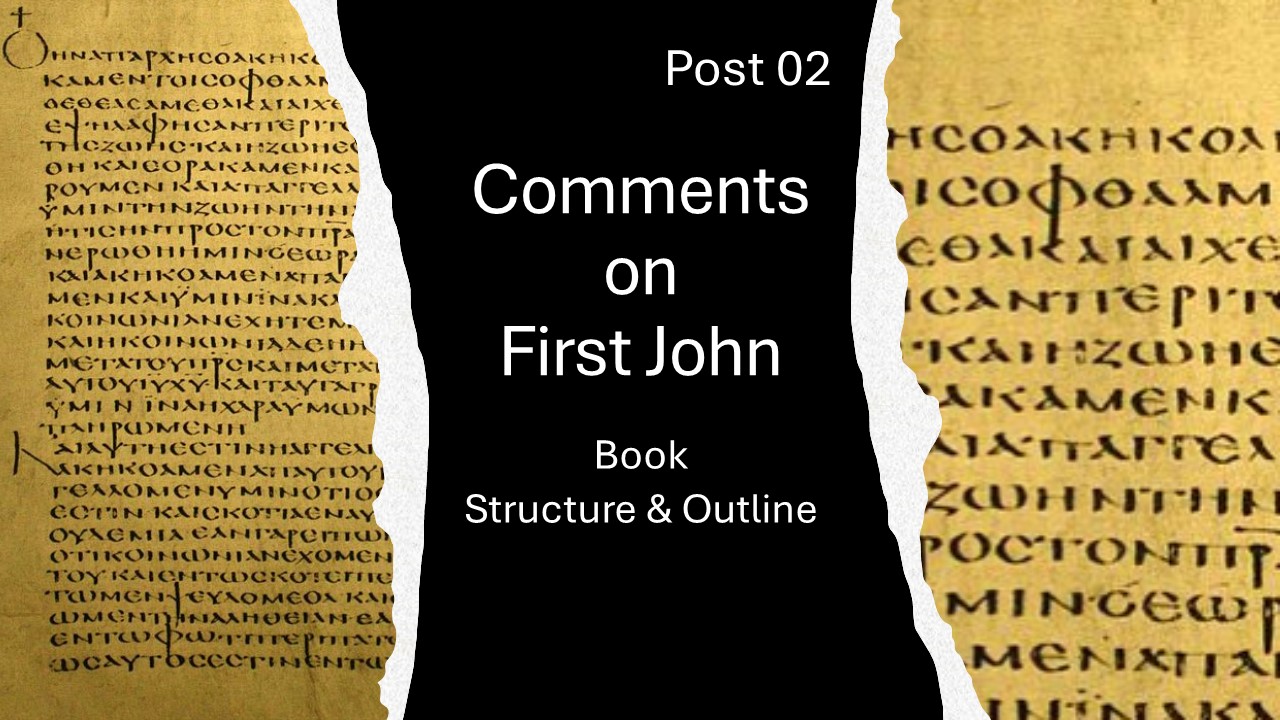
Title Slide Image Credit: First John in Codex Alexandrinus, Public domain, via Wikimedia Commons.
Unless otherwise noted, English translations of Bible verses are by the author from the Greek text and are not quotations from any copyrighted Bible version or translation.
How you can have eternal life.
© Copyright 2022-2024 by Matthew Jones
koinefoundations@gmail.com


Leave a Reply