In my previous post I commented on the question of what is the shortest verse in the New Testament. I concluded that John 11:35 is the shortest verse in most English translations: “Jesus wept.” However, the shortest verse in the original Greek text is First Thessalonians 5:16: πάντοτε χαίρετε / pantote chairete (“Rejoice always“).
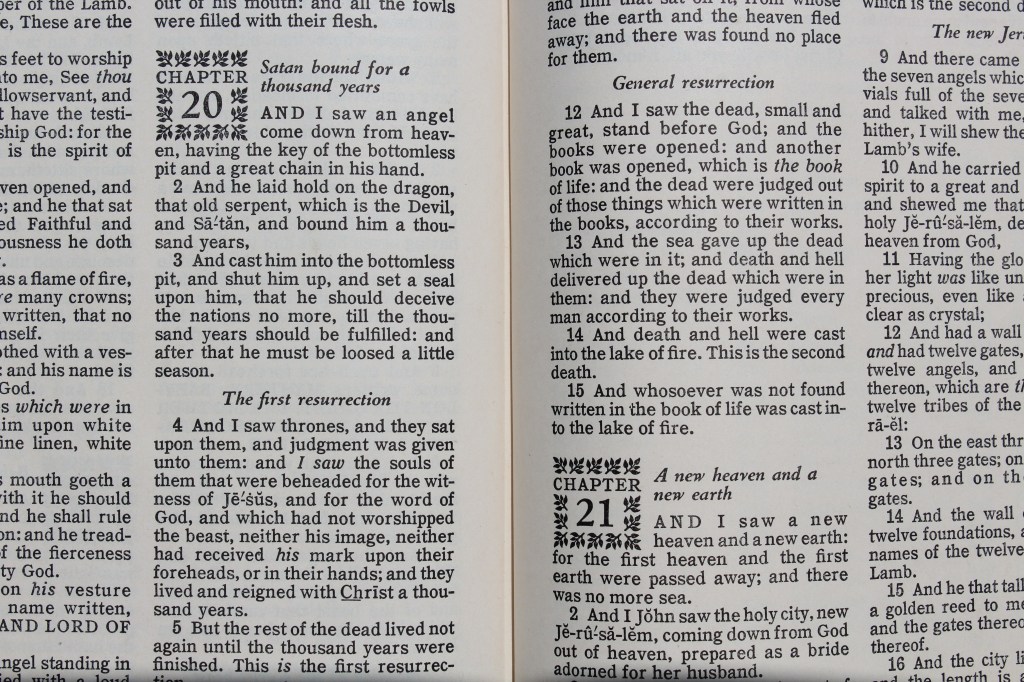
Perhaps you are curious about the longest verse in the New Testament. The hands-down winner in English translations and the Greek text is Revelation 20:4 (KJV). It has a whopping 68 words in the King James Version. Other English translations are even longer. For example, the New International Version (NIV) uses 71 words and the New American Standard Bible (NASB 1995) uses 76 words to translate the Greek text. The original Greek text is 58 words (MGMT)
Then I saw thrones, and those who had been given authority to judge were seated on them. I also saw the souls of those who had been beheaded because of their testimony about Jesus and because of the Word of God. These had not worshipped the Beast or his image and had not received the mark on their forehead and on their hand. They came to life and reigned with Christ for a thousand years. (Revelation 20:4)
You may be curious about who decided that John 11:35 should be just three Greek words and Revelation 20:4 should be 58 Greek words. Who divided up the Greek text to create verse divisions in the New Testament?
You might have assumed that it was the original author that divided up the text, just like we divide our modern written text into sentences and paragraphs as we write. But that is not how Ancient and Koine Greek were written. Originally, Greek was written without breaks between sentences or paragraphs. In fact, there were not even spaces between words and there was no punctuation. The image shown below is a reproduction of Second Thessalonians 1:1-2 that illustrates how the Greek text looked in early copies of the New Testament and how Greek was written without breaks or punctuation.

Writing without spaces between words is called scriptio continua, or continuous writing. Here is a translation of this Greek text that follows the same line divisions as the above illustration.*
Line 1: Paul and Silvanus and Timothy, to the
Line 2: Church of the Thessalonians, in God the Father
Line 3: of us and the Lord Jesus Christ. Grace to you and peace
Line 4: from God the Father and the Lord Jesus Christ.
Verse divisions and verse numbers are not part of the original text of the New Testament (or the Old Testament). The Apostle John did not break what he wrote into small verses like John 11:35 and Revelation 20:4. They were added long after the New Testament was completed to make it easier to find specific parts of Scripture. Imagine trying to find something in the Bible if there were no chapter or verse references: “Please turn to where Jesus teaches about the Golden Rule in the book of Matthew” (7:12).
Chapter divisions were added to the Bible over 1100 years after the New Testament was completed. Several schemes were developed, but the one created around 1227 AD by Cardinal Stephen Langton, an Archbishop of Canterbury, is what is used in our modern Bibles.
Verse divisions were added to the Bible around 1500 years after the New Testament was completed. Again, several schemes were developed, but the one created around 1550 AD by a Parisian printer named Robert Estienne is what is used in our modern Bibles. He is also referred to as Robert Stephanus.
These schemes quickly gained acceptance and the first English Bible to use both chapter and verse designations was the historically significant Geneva Bible published in 1560. They are used in nearly all modern Bibles of all languages.
Chapter and verse divisions are useful for reference and Bible study. However, they often do not correspond with the author’s structure, and sometimes make it difficult to see the flow of the author’s material. They also tend to make us focus on the scripture as small pieces rather than as a whole, breaking the content into artificial segments.
There is no special spiritual significance attached to being the shortest or longest verse in the Bible. But it is interesting trivia.
*The Greek letters that have an overline above them are called nomina sacra, which is Latin for “sacred names.” Nomina sacra (singular, nomen sacrum) are abbreviations of sacred names used in art and Greek manuscripts of the Bible. Click here to read a previous post that explains these.
Unless otherwise noted, English translations of Bible verses are by the author from the Greek text and are not quotations from any copyrighted Bible version or translation.
 Koine Foundations
Leave a comment