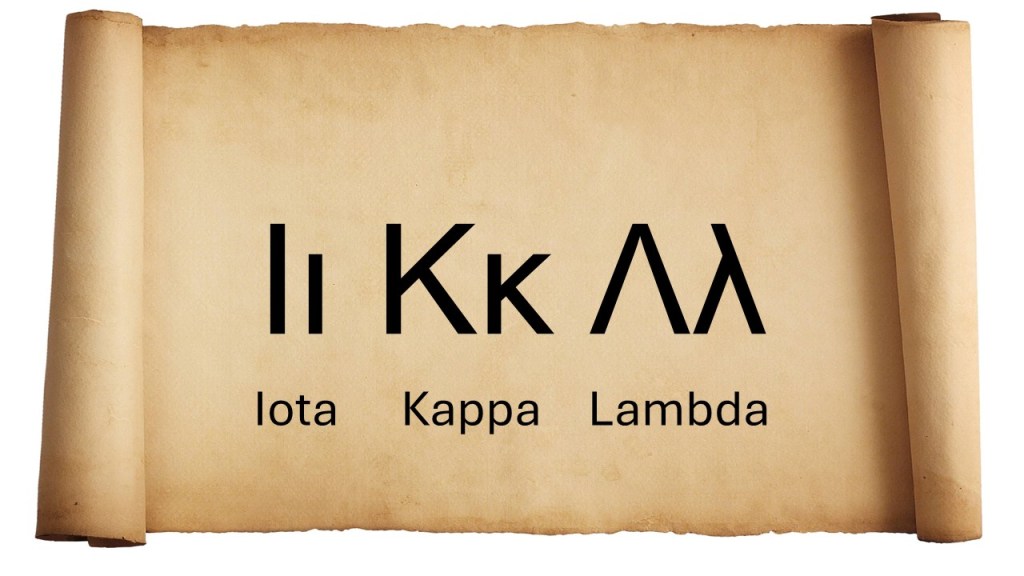
Lesson 6: This post is the sixth in a series that explains how to pronounce the Koine Greek alphabet and Greek words. Each post explains three Greek letters and provides example words that contain only the letters covered to that point. This post explains the letters iota, kappa, and lambda and the digraphs αι and ει.
ἰῶτα / iota

Iota is similar in appearance to the upper-case and lower-case I/i in the English alphabet. However, never put a dot above the lower-case Iota.
Iota always sounds like the i in the English word ski.
Because Iota is the smallest letter in the Greek alphabet, the letter is used in English phrases like “I don’t care one iota”. This means, “I don’t care at all, not even a little”. Jesus uses the word iota in Matthew 5:18 where He says, “not one iota or pen stroke will pass away from the Law, until all is accomplished.” By saying this, Jesus is affirming the authority of the Old Testament, right down to the smallest detail.
κάππα / kappa

Kappa is similar in appearance and sound to the upper-case and lower-case K/k in the English alphabet.
Kappa usually sounds like the k in skit (its primary sound), but occasionally sounds like the g in go. Most Greek consonants have only one sound, but a few have several sounds depending on what letter they come before or after. Kappa is an example of this. In this post you will only learn the primary sound.
λάμβδα / lambda

Lambda does not look like the L/l in the English alphabet, but it has the same sound.
Lambda sounds like the l in the English word let.
When pronouncing the name of the letter be sure to include the \v\ sound at the end of the first syllable: LAHMV-thah. In Greek, the name of the letter is spelled λάμβδα, where the beta (β) sounds like the v in vet.
Vowel Digraphs αι and ει
A digraph is a combination of two letters that represent one sound. In English, there are around fifty vowel digraphs such as the ea in teach, the oo in moon, and the oe in doe. Notice that these combinations of two vowels have only one vowel sound.
In Koine Greek there are only four vowel digraphs that you need to learn: αι ει οι ου.
In this post you will learn the sounds of αι and ει because you have been introduced to the letters alpha (α), epsilon (ε) and iota (ι). You will learn οι and ου in Lesson 11.
αι and ει are identical in sound to two letters you already know.

αι sounds just like the letter epsilon – like the e in end. An English vowel digraph that looks similar and has the same sound is the ai in said.

ει sounds just like the letter iota – like the i in ski. An English vowel digraph that looks similar and has the same sound is the ei in seize.
If a digraph has a breathing mark and/or accent mark in a word, the mark is always written over the second vowel in the digraph. For example: αί αἱ αἷ
Example Words
Practice saying the example words to learn the sounds represented by the alphabet letters in this lesson.
ἀδικία
unrighteousness
[noun]
Unrighteousness is violating a standard such as God’s commandments.
This word has four syllables.
Example Verse: If we confess our sins, God is faithful and righteous to forgive us for our sins and cleanse us from all unrighteousness. (1 John 1:9)
ἀλήθεια
truth
[noun]
Note the digraph ει that sounds like the i in ski. This word has four syllables.
English Derivative: Alethea (feminine name).
Example Verse: Then Jesus was saying to the Jews who had believed Him, “If you remain in My word, you are truly My disciples. And you will know the truth and the truth will set you free.” (John 8:31-32)
καί
and, even, also
[conjunction]
Note the digraph αι that sounds like the e in end. Note also that the accent mark is over the second letter of the digraph.
καί is the second most frequently used word in the New Testament (9161 times). In Greek, conjunctions are frequently used to join one sentence to another. Many sentences begin with a conjunction.
Example Verse: Grace to you and peace from God our Father and the Lord Jesus Christ. (Philippians 1:2)
Example Verse: “And forgive us of our debts, as we also have forgiven our debtors.” (Matthew 6:12)
Practice & Review
ἀββά
father
ἄɣω
I lead, bring, go
ὧδε
here
ἐɣώ
I
ɣῆ
earth, land, soil
ζωή
life
θεά
goddess
ἀδικία
unrighteousness
ἀλήθεια
truth
καί
and, even, also
The table below shows the Greek alphabet in order from alpha to omega. Verbs are highlighted in yellow. Lower-case sigma, highlighted in blue, has two forms.

Here are two options to hear the the entire Greek alphabet recited:
- Click here to listen to a 30 second audio file of the alphabet.
- Click here to view a 1 minute video of the alphabet.
*Symbols enclosed in left slashes such as \ä\ are Merriam-Webster Pronunciation Symbols. These are the standard pronunciation symbols used in the Merriam-Webster dictionary. They are provided as another way to know the sound of each Greek letter. Click here for a downloadable PDF document that explains the symbols and includes a one-page chart on the last page. They are also explained in any hardcopy edition of the Merriam-Webster dictionary.
Bibliography
Danker, Frederick William (Editor). A Greek-English Lexicon of the New Testament and other Early Christian Literature, Third Edition (BDAG). The University of Chicago Press. 2000.
Unless otherwise noted, English translations of Bible verses are by the author from the Greek text and are not quotations from any copyrighted Bible version or translation.
© Copyright 2022 by Matthew Jones
koinefoundations@gmail.com
 Koine Foundations
Leave a comment