Lesson 11: This post is the eleventh and last in a series that explains how to pronounce the Koine Greek alphabet and Greek words. Each post explains three Greek letters and provides example words that contain only the letters covered to that point. This post explains the vowel digraphs οι and ου, and another sound for gamma.
Vowel Digraphs οι and ου
A digraph is a combination of two letters that represent one sound. In English, there are around fifty vowel digraphs such as the ea in teach, the oo in moon, and the oe in doe. Notice that these combinations of two vowels have only one vowel sound.
In Koine Greek there are only four vowel digraphs that you need to learn: αι ει οι ου.
In Lesson 6 you learned the sounds of αι and ει. In this lesson you will learn the sounds of οι and ου.

οι sounds just like the letter upsilon – like the u in the English word flu.

ου sounds like the ou in the English word soup.
The sounds of the digraphs οι and ου are similar. οι is pronounced with tightly rounded lips and the tongue touching the tops of the lower front teeth. The digraph ου is pronounced with less rounded lips and the tongue further back in the mouth lightly touching, or just behind, the lower front teeth.
Here is a summary of the four digraph sounds:
αι sounds like ε (epsilon), like the e in end.
ει sounds like ι (iota), like the i in ski.
οι sounds like υ (upsilon), like the u in flu.
ου sounds like the ou in soup.
Another Sound for gamma
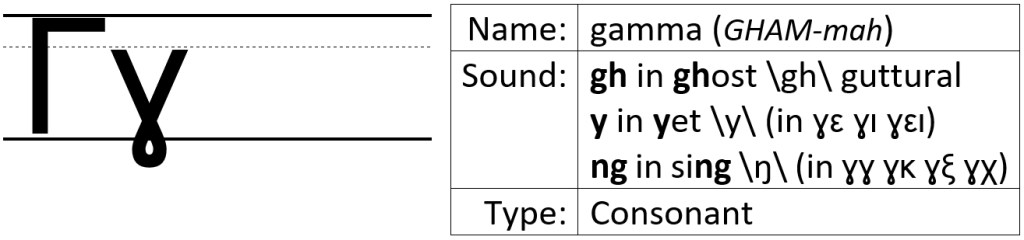
Gamma is the most complex letter in regard to pronunciation. It has three sounds that are common in words depending on the vowel or consonant that follows it. In two previous posts you learned two of the sounds – the guttural gh in ghost (Lesson 4) and the y in yet (Lesson 7).
Gamma also sounds like the ng in the English word sing when it is followed by the letters gamma (ɣ), kappa (κ), xi (ξ), or chi (χ). These four letters are called gutturals because they are produced in the throat. Since Gamma is a guttural, when any of these letters come after it there are two gutturals side by side. This is difficult to pronounce, so the Gamma is softened to the ng sound.
In Lesson 7 you learned that a single gamma sounds like the y in yet when it is followed by the vowels ε (epsilon) or ι (iota), or the digraph ει (epsilon-iota). However, in a double gamma (ɣɣ) the second gamma retains the guttural gh in ghost sound regardless of the vowel or digraph that follows it.
In the ɣκ (gamma-kappa) combination, the gamma is pronounced like the ng in sing and the kappa like the g in go. Kappa shifts its sound from the k in skit to the g in go.
Example Words
Practice saying the example words to learn the sounds represented by the alphabet letters in this lesson.
κοιλία
stomach, womb
[noun]
κοιλία contains the digraph οι.
Example Verse: And it happened that when Elizabeth heard Mary’s greeting, the baby leapt in her womb and Elizabeth was filled with the Holy Spirit. (Luke 1:41)
ἀκούω
I hear, listen
[verb]
As with the English word “hear”, ἀκούω can also mean “understand” or “comprehend”.
ἀκούω contains the digraph ου.
English Derivative: Acoustic.
Example Verse: And when King Herod heard this, he was troubled, and all Jerusalem along with him. (Matthew 2:3)
ἄɣɣελος
messenger, angel
[noun]
The double gamma (ɣɣ) sounds like the ng in sing plus the gh in ghost.
English Derivatives: Angel, evangelist.
Example Verse: Don’t neglect hospitality to strangers, for by this some have unknowingly entertained angels. (Hebrews 13:2)
ἄɣκυρα
anchor
[noun]
The gamma-kappa (ɣκ) sounds like the ng in sing plus the g in go.
English Derivative: Anchor.
Example Verse: And fearing that we might run aground somewhere on a rugged shore, the sailors cast four anchors from the stern and longed for day to come. (Acts 27:29)
Practice & Review
ἀββά
father
ἄɣω
I lead, bring, go
ὧδε
here
ἐɣώ
I
ɣῆ
earth, land, soil
ζωή
life
θεά
goddess
ἀδικία
unrighteousness
ἀλήθεια
truth
καί
and, even, also
εἰμί
I am
ɣεμίζω
I fill
λαμβάνω
I take, receive
ἔξω
outside
πέμπω
I send
ἀνήρ
man, husband
παραβολή
parable
διδάσκαλος
teacher
πιστεύω
I believe
σταυρός
cross
ɣυνή
woman, wife
τεσσεράκοντα
forty
ἔχω
I have, hold
ὁδός
way, road
ψυχή
soul, life
φῶς
light
κοιλία
stomach, womb
ἀκούω
I hear, listen
ἄɣɣελος
messenger, angel
ἄɣκυρα
anchor
The table below shows the Greek alphabet in order from alpha to omega. Verbs are highlighted in yellow. Lower-case sigma, highlighted in blue, has two forms.

Here are two options to hear the the entire Greek alphabet recited:
- Click here to listen to a 30 second audio file of the alphabet.
- Click here to view a 1 minute video of the alphabet.
*Symbols enclosed in left slashes such as \ä\ are Merriam-Webster Pronunciation Symbols. These are the standard pronunciation symbols used in the Merriam-Webster dictionary. They are provided as another way to know the sound of each Greek letter. Click here for a downloadable PDF document that explains the symbols and includes a one-page chart on the last page. They are also explained in any hardcopy edition of the Merriam-Webster dictionary.
Bibliography
Danker, Frederick William (Editor). A Greek-English Lexicon of the New Testament and other Early Christian Literature, Third Edition (BDAG). The University of Chicago Press. 2000.
Unless otherwise noted, English translations of Bible verses are by the author from the Greek text and are not quotations from any copyrighted Bible version or translation.
© Copyright 2022 by Matthew Jones
koinefoundations@gmail.com
 Koine Foundations
Leave a comment