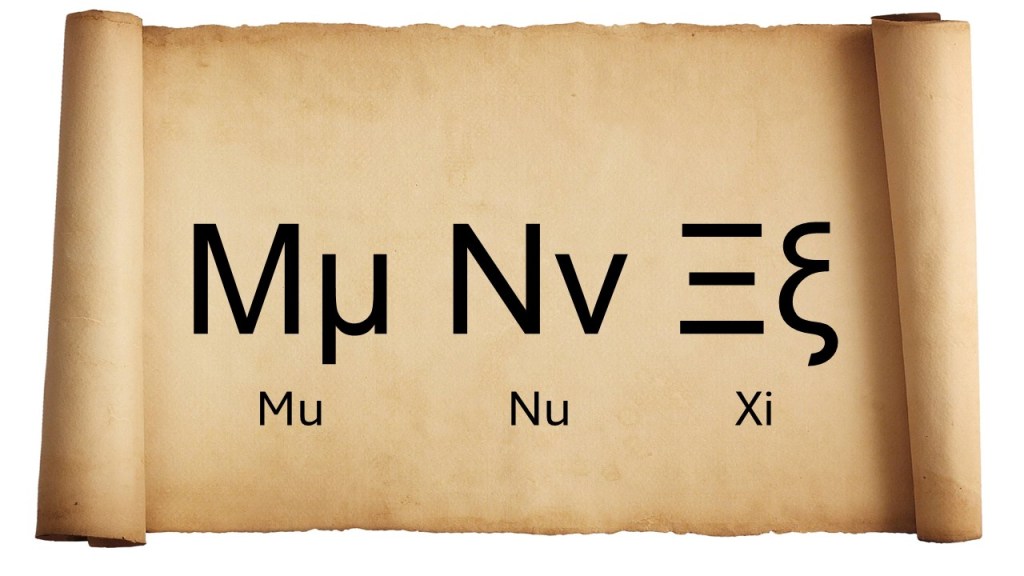
Lesson 7: This post is the seventh in a series that explains how to pronounce the Koine Greek alphabet and Greek words. Each post explains three Greek letters and provides example words that contain only the letters covered to that point. This post explains the letters mu, nu, and xi and another sound for gamma.
μῦ / mu

Mu is identical in sound to the M/m in the English alphabet. The upper-case mu is identical in appearance to the upper-case M in the English alphabet. Do not confuse the lower-case mu (μ) with the lower-case letter u in the English alphabet.
Note that the lower-case mu has a tail on its left side that goes slightly below the base line.
Mu sounds like the m in the English word met
νῦ / nu

Nu is identical in sound to the N/n in the English alphabet. The upper-case nu is identical in appearance to the upper-case N in the English alphabet. Do not confuse the lower-case nu (ν) with the lower-case letter v in the English alphabet.
Note that the bottom of the lower-case nu comes to a point – it is not rounded.
Nu sounds like the n in the English word net.
ξῖ / xi

Xi does not look like any letter in the English alphabet, but it is identical in sound to the letter X/x in the English alphabet. Note that the lower-case xi has a tail that goes below the base line.
Xi sounds like the ks in the English word elks.
Xi is known as a “double consonant” since it combines the sounds of \k\ and \s\.
Another Sound for Gamma
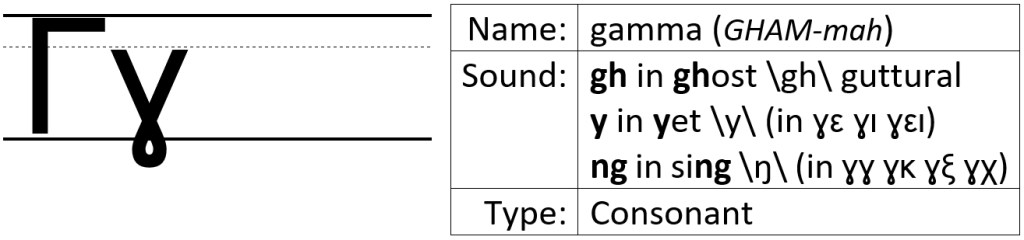
In Lesson 4 you learned that gamma has three common sounds. So far you have only learned example words where gamma sounds like a guttural gh in the English word ghost. However, gamma often sounds like the y in English word yet. This occurs when a single gamma is followed by the vowels ε (epsilon) or ι (iota), or the digraph ει (epsilon-iota). This does not apply to double gammas (ɣɣ) followed by these vowels or digraph. You will learn about the ng sound of gamma in Lesson 11.
Example Words
Practice saying the example words to learn the sounds represented by the alphabet letters in this lesson.
εἰμί
I am
[verb]
εἰμί a linking verb like the English verb “to be”. A linking verb renames or describes its subject. It links the subject to a subject complement (also called a predicate nominative).
Note that the digraph ει sounds like the i in ski. Note also that the smooth breathing mark is over the second letter of the digraph.
Example Verse: Then Jesus spoke to them again saying, “I am the light of the world. The one who follows me will never walk in darkness, but will have the light of life.” (John 8:12)
ɣεμίζω
I fill
[verb]
Note that the gamma (ɣ) has the sound of the y in yet.
Example Verse: Then a fierce gale arose, and the swells were rushing into the boat so that the boat was quickly filled. (Mark 4:37)
λαμβάνω
I take, receive
[verb]
Example Verse: [Jesus speaking] “Truly, truly I say to you, the one who receives whomever I send, receives Me. And the one who receives Me, receives the one who sent Me.” (John 13:20)
ἔξω
outside
[adverb of place]
English Derivative: Exoskeleton.
Example Verse: Now Peter was sitting outside in the courtyard and a servant girl approached him saying, “You also were with Jesus the Galilean.” (Matthew 26:69)
Practice & Review
ἀββά
father
ἄɣω
I lead, bring, go
ὧδε
here
ἐɣώ
I
ɣῆ
earth, land, soil
ζωή
life
θεά
goddess
ἀδικία
unrighteousness
ἀλήθεια
truth
καί
and, even, also
εἰμί
I am
ɣεμίζω
I fill
λαμβάνω
I take, receive
ἔξω
outside
The table below shows the Greek alphabet in order from alpha to omega. Verbs are highlighted in yellow. Lower-case sigma, highlighted in blue, has two forms.

Here are two options to hear the the entire Greek alphabet recited:
- Click here to listen to a 30 second audio file of the alphabet.
- Click here to view a 1 minute video of the alphabet.
*Symbols enclosed in left slashes such as \ä\ are Merriam-Webster Pronunciation Symbols. These are the standard pronunciation symbols used in the Merriam-Webster dictionary. They are provided as another way to know the sound of each Greek letter. Click here for a downloadable PDF document that explains the symbols and includes a one-page chart on the last page. They are also explained in any hardcopy edition of the Merriam-Webster dictionary.
Bibliography
Danker, Frederick William (Editor). A Greek-English Lexicon of the New Testament and other Early Christian Literature, Third Edition (BDAG). The University of Chicago Press. 2000.
Unless otherwise noted, English translations of Bible verses are by the author from the Greek text and are not quotations from any copyrighted Bible version or translation.
© Copyright 2022 by Matthew Jones
koinefoundations@gmail.com
 Koine Foundations
Leave a comment