
They all ate and were satisfied. Afterward the disciples gathered twelve baskets full of broken pieces of bread and fish. The number of those that ate was 5000 men. (Mark 6:42-44 TBA)
Introduction
In this post we continue with our exploration of the New Testament by looking at the four Gospels – Matthew, Mark, Luke, and John.
Although the Gospels were probably not the first New Testament books to be written, they come first in the Canon as the main source of historical information about the life and ministry of Jesus, and as the APPEARANCE of the Good News.
The word ‘gospel’ means ‘good news’. The Gospels record the Good News about God’s saving act through Jesus Christ. (See Mark 1:1.)
As Carson and Moo explain in their introduction to the New Testament, no other books before the New Testament Gospels had ever been given that designation. A ‘gospel’ was a new type of literature invented by Christians. [1] Or more specifically, if Mark was the first Gospel written, he was the first person to ever create this kind of literature that interweaves biographical and historical material with theological material. [2]
The Synoptic Gospels
The three Gospels named Matthew, Mark, and Luke are known as the Synoptic Gospels. The word ‘synoptic’ means ‘seeing together’. They are called this because they are similar in organization and share a lot of common material as if seen with the same eyes. The Gospel of John is very different in its structure and content from these three.
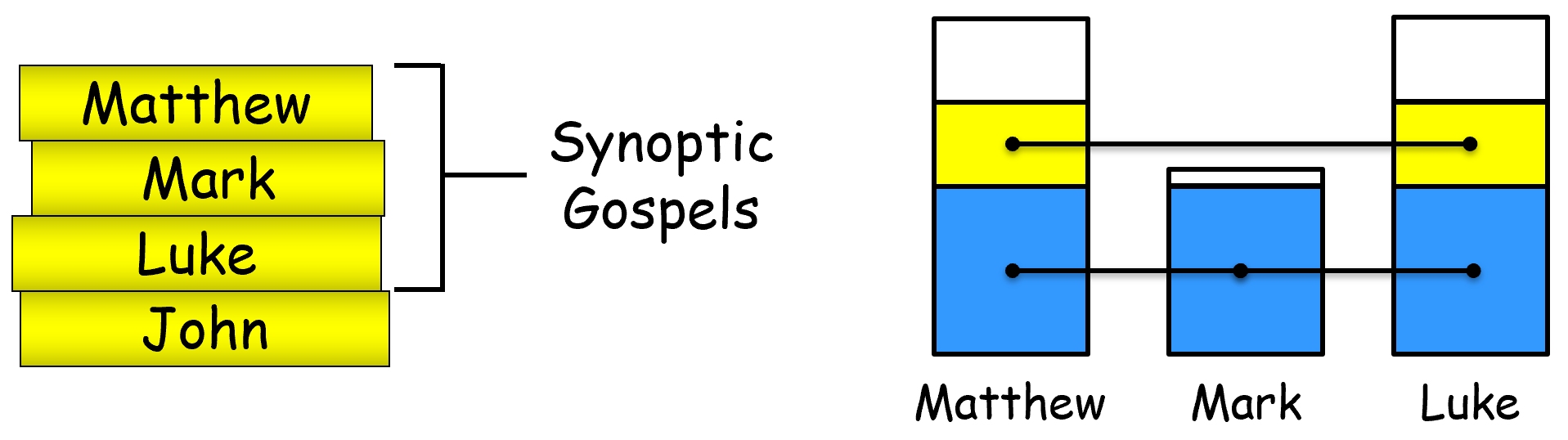
For example, over 90% of Mark’s material appears in both Matthew and Luke (blue area), making up about 50% of each of those two Gospels. Of the remaining 50% in Matthew and Luke, about half is common to both of them (yellow area). So only about 25% of the material in Matthew and Luke is unique to that book (white area).
The similarities between Matthew, Mark and Luke have led to the question, “Why are they so much alike – even being word for word in some places. But why are there also significant differences?” Bible scholars call this mixture of similarities and differences the Synoptic Problem, which is an inquiry into the literary relationship between Matthew, Mark, and Luke.
It seems obvious that in some way they had access to the same material about Jesus, whether it was through a shared oral tradition, or perhaps one Gospel writer copied what another wrote, or perhaps they collaborated.
This has led to a number of theories about how they were written and the Synoptic Problem is discussed in most good commentaries on the Gospels. Scholars propose two main theories.

The most popular theory in modern times is that Mark was written first, as indicated by it being the shortest Gospel. Matthew and Luke later utilized Mark’s material and added their own additional material from other sources such as oral tradition or a body of written tradition referred to by scholars as Q which is now lost. Q stands for the German word Quelle, which means ‘source’.
This theory is called the Marcan Priority. Of course, this is all speculation. No Q document has ever been found, begging the question, “If such an important document as Q really did exist, why did it not survive and also become included as a Gospel in the New Testament?”
Another theory is the view of the early church writers and commentators, who believed that Matthew was the first gospel to be written. Luke was second, which utilized some of Matthew’s material along with information from other sources Luke researched. Mark was third, being an abbreviated combination of Matthew and Luke, and influenced by Peter, Mark’s mentor.
These are just theories. The bottom line is that scholars think that either Mark was the first Gospel written, or that Matthew was the first Gospel written.
Portraits of Christ
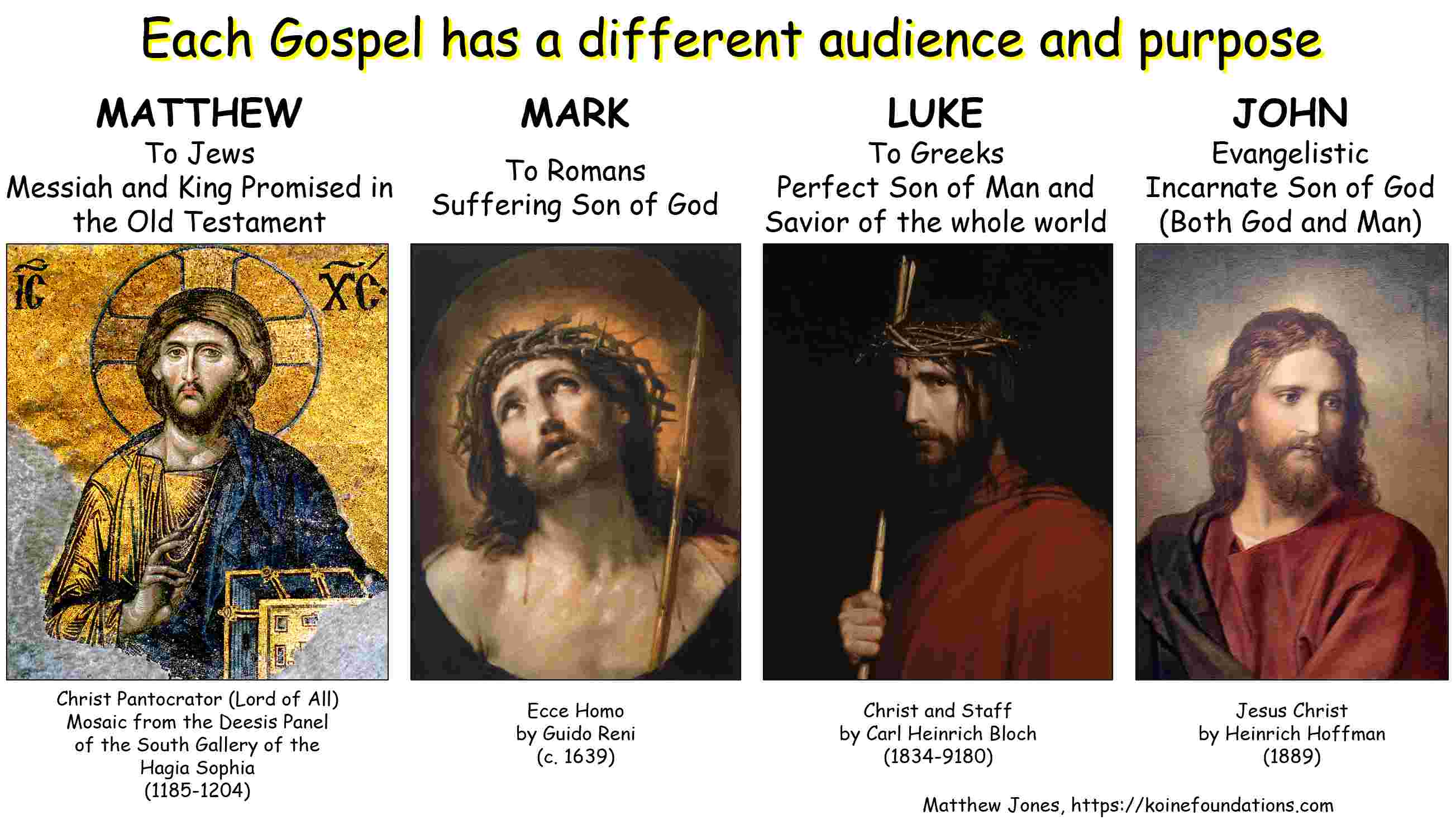
Even though the four Gospels have similarities, each Gospel has a different audience and purpose. They make use of similar material in unique ways.
The Gospel writers are like four different artists painting a picture of the same subject. Each painting is different based on the elements that the artist wants to highlight. Each artist uses different colors and textures, but the portrait is about the same subject. In the case of the Gospels, it is about the life and ministry of Jesus.
Matthew, Mark, Luke, and John selected and organized the materials about Jesus, sometimes the same materials, in four different ways for a particular audience and purpose. Because of the difference in audience and purpose, the Gospel writers focus on different details, so that some details are included or some are omitted, and the material is organized in different orders. This is what you would expect from four people describing the same events.
The differences in the four Gospels actually complement each other and give a more complete picture of the life and ministry of Jesus.
Comparison of the Gospels
The table below summarizes and compares basic information about the four Gospels.
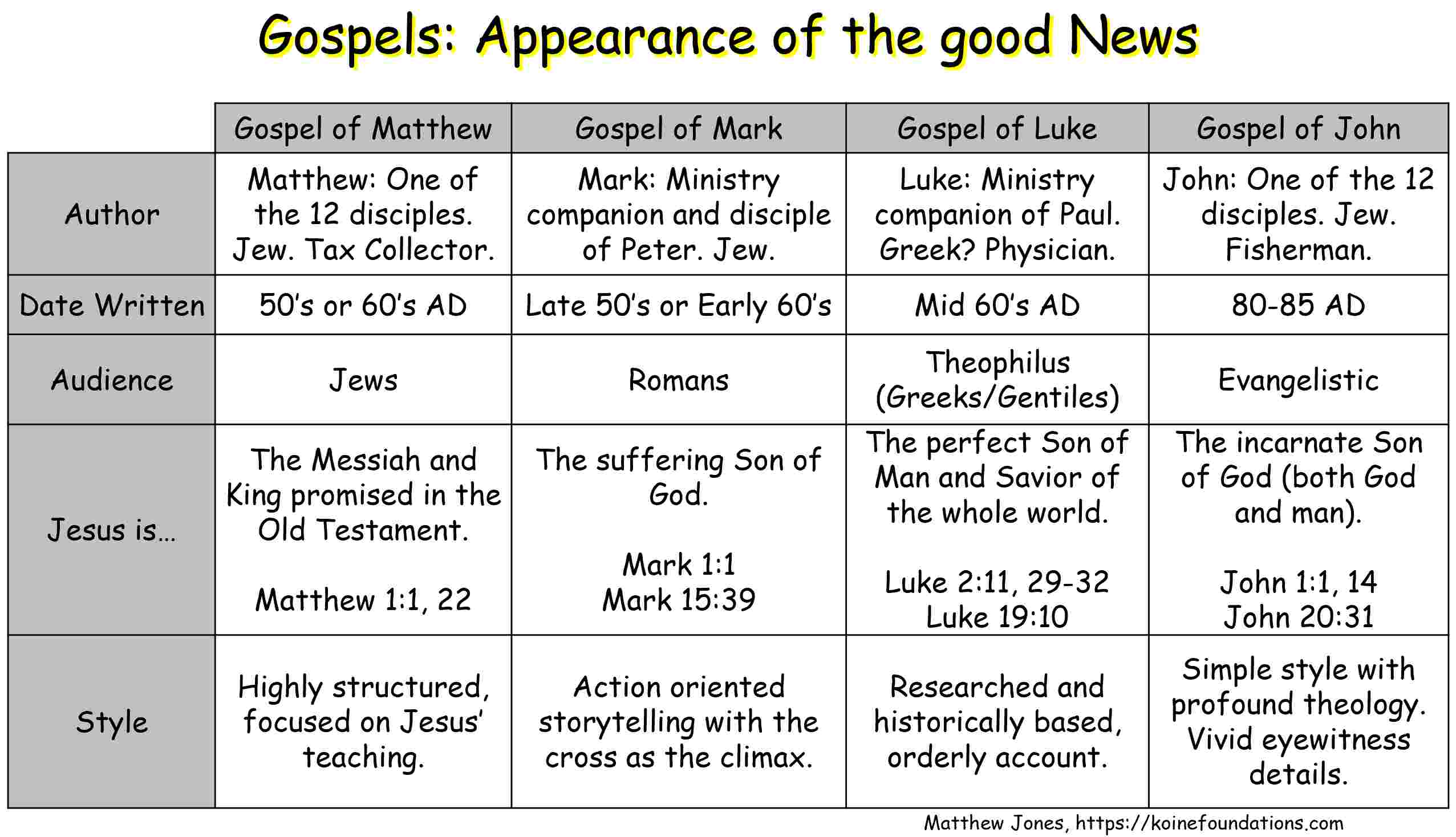
The authors of the Gospels are Matthew, Mark, Luke and John as the books are titled. These authors were always assigned to these books by early Christians. There were never any other authors suggested.
The dates for when the Gospels were written are approximate based on the theory that Mark was written first. Of course, the Gospels did not come with dates written on them. As explained in a previous post, the fact that the Gospels were being copied and quoted in other books by the end of the first century and the beginning of the second century makes these estimated dates reasonable. The eyewitnesses of Christ and first generation of Christians after Jesus resurrection in 30 or 33 AD, would have certainly begun very quickly to write down what they saw and heard.
Gospel of Matthew: The author is Matthew, a tax collector for the Romans whom Jesus chose to be one of the Twelve Disciples. Tax collectors were despised by the Jews and viewed as being on the same level as prostitutes and criminals because they worked for the Roman occupiers to collect taxes, usually by overcharging to make a profit.
Note that Matthew is the only gospel that mentions Jesus paying the Temple tax (17:24-27), and the only Gospel to refer to Matthew as “Matthew the tax collector” (10:3).
Gospel of Mark: The author is John Mark, a cousin of Barnabas (Colossians 4:10) and a ministry companion of Paul and Peter. Ancient Christian historians tell us that Mark wrote the Gospel in association with Peter, possibly from Rome when Peter was in prison and about to be executed.
Gospel of Luke: The author is Luke, a ministry companion of Paul on his missionary journeys. He was a physician (Colossians 4:14) which is bolstered by the use of medical terms throughout the book.
It is often claimed that all of the authors of the New Testament were Jewish, except for Luke, who was a Gentile. However, I would note that there is very little evidence that Luke was a Gentile. Some scholars believe he was actually a Jew known as a Hellenized Jew, which was a Jew who spoke Greek and adopted certain aspects of Greek culture. If Luke was a Jew, then the entire New Testament was written by Jewish Christians, which would fit with what Paul wrote in Romans 3:2…
The Jews were entrusted with the oracles of God. (Romans 3:2 ESV)
…meaning all the Scriptures were revealed through the Jewish people.
Gospel of John: The author is John, one of the Twelve Disciples, and a fishing partner with his brother James, and also with Peter. He was the last disciple to die, perhaps living a long life into his 90’s. He wrote his Gospel late in his life, perhaps when he was around 85 years old.
Word Focus Lexicon
Lexical Form: συνοπτικός -ή -όν
Transliteration: sunoptikos
Gloss: synoptic
Part of Speech: Adjective
New Testament Frequency: 0
Strong’s Number: N/A – Word not in the New Testament
συνοπτικός / sunoptikos is a word created during the mid-1700’s that was applied to tables and charts that provided a general view of the subject matter. It was later applied to the Gospels of Matthew, Mark, and Luke because they offered a similar view of the life of Christ. The word was created from the Greek root words σύν / sun meaning ‘with’, and οπτικός / optikos meaning ‘seeing’ or ‘viewing’. Together they form the idea of ‘seeing together’.
The Synoptic Gospels share many accounts and similar wording, leading scholars to study their relationships to understand their origins, often using parallel columns for comparison. The image at the top of this post illustrates one of the shared accounts – Jesus’ miracle of feeding over 5000 people with just five loaves of bread and two pieces of fish. This account actually appears in all four Gospels, making it the only miracle apart from the Resurrection to be recorded in every Gospel. This highlights its immense significance in Christian tradition. It is found at Matthew 14:13–21; Mark 6:30–44; Luke 9:10–17; John 6:1–14.
Footnotes
[1] Carson, D. A. and Moo, Douglas J. An Introduction to the New Testament. (Grand Rapids: Zondervan, 1992, 2005 by D. A. Carson and Douglas J. Moo.) Page 113.
[2] Ibid., Page 192.
Bibliography
Balz, Horst and Schneider, Gerhard, Editors. Exegetical Dictionary of the New Testament. William B. Eerdmans Publishing Company, 1990.
Beetham, Christopher A., Editor. The Concise New International Dictionary of New Testament Theology and Exegesis. Zondervan Academic, 2021.
Bromiley, Geoffrey W. Theological Dictionary of the New Testament, Abridged in One Volume. William B. Eerdmans Publishing Company, 1985.
Carson, D. A. and Moo, Douglas J. An Introduction to the New Testament. Zondervan, 1992, 2005 by D. A. Carson and Douglas J. Moo.
Danker, Frederick William. The Concise Greek-English Lexicon of the New Testament. The University of Chicago Press, 2009.
Gilbrant, Thoralf, International Editor. The New Testament Greek-English Dictionary. The Complete Biblical Library, 1990.
Gundry, Robert H. A Survey of the New Testament. Zondervan Publishing House, 1970.
Guthrie, Donald. New Testament Introduction. Inter-Varsity Press, 1970 by The Tyndale Press.
Liddell, Henry George and Scott, Robert. A Greek-English Lexicon. Oxford University Press. 1940. With a Supplement, 1996.
Tenney, Merrill C. New Testament Survey. William B. Eerdmans Publishing Co., 1953, 1961, 1985.
Verbrugge, Verlyn D. New International Dictionary of New Testament Theology: Abridged Edition. Zondervan, 2000.
Vos, Howard F. Beginnings in the New Testament. Moody Press, 1973 by The Moody Bible Institute of Chicago
English translations of Bible verses marked (TBA) are translations by the author from the Greek text and are not quotations from any copyrighted Bible version or translation.
Scripture quotations marked (ESV) are from the Holy Bible, English Standard Version, copyright © 2001, 2007, 2011, 2016, 2025 by Crossway Bibles, a division of Good News Publishers. Used by permission. All rights reserved.


 Koine Foundations
Leave a reply to Matthew Jones Cancel reply