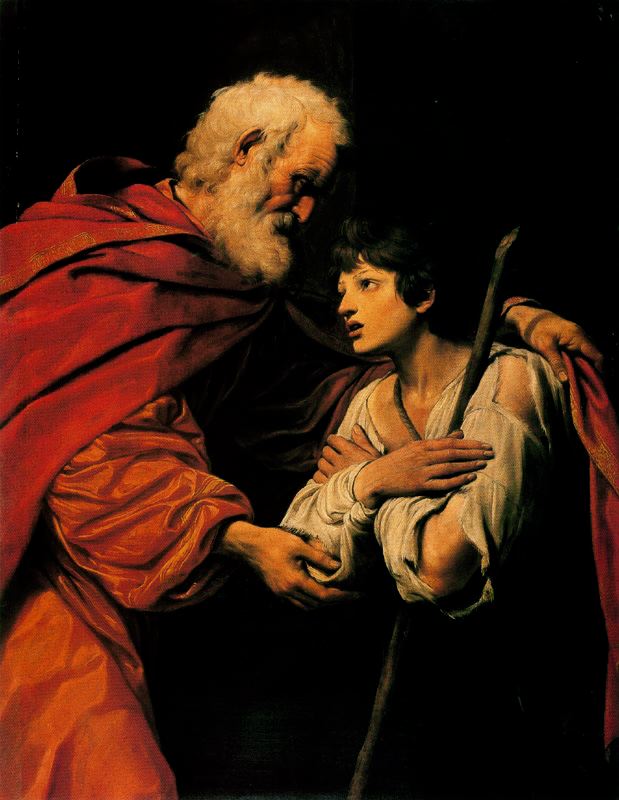
Jesus said all these things to the crowds in parables. Indeed, He was saying nothing to them without using a parable. (Matthew 13:34 TBA)
Introduction
In the previous post I provided an overview of the four Gospels – Matthew, Mark, Luke, and John. In this post I will comment on Matthew and Luke in a little more detail providing introductory information. In the next post I will cover Mark and John.
The Gospel of Matthew
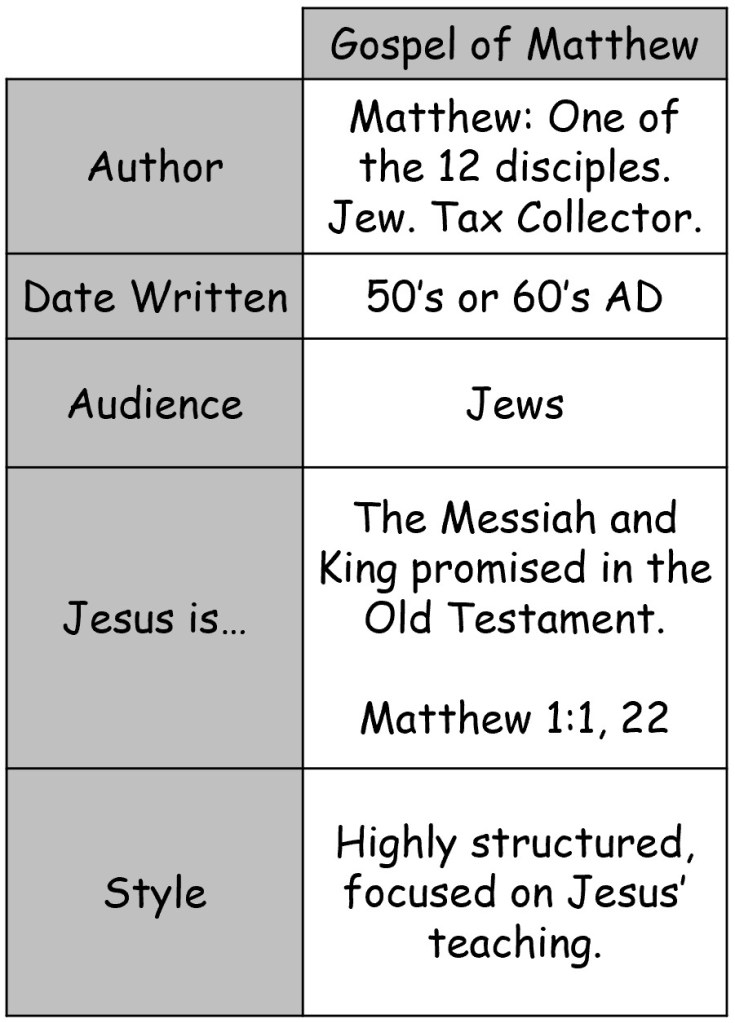
The Gospel of Matthew was probably placed first in the New Testament by the early church because it is a natural bridge connecting the Old Testament promise of the Good News with the New Testament fulfillment of the Good News.
It was written for a Jewish audience, so it presents the Good News that Jesus is the Jewish Messiah and King promised in the Old Testament. This focus can be seen throughout the book. For example, it opens with a genealogy like those in the Old Testament, that immediately proclaims in the first sentence that Jesus is the son of David (thus in the royal line of King) and the son of Abraham (thus of Jewish descent and in the line of the Messiah).
The book of the genealogy of Jesus Christ, the son of David, the son of Abraham. (Matthew 1:1 ESV)
Likewise, in the account of the wise men, they ask King Herod:
“Where is he who has been born king of the Jews?” (Matthew 2:2 ESV)
And at Jesus’ crucifixion, the inscription placed over the cross by Pilate reads:
“This is Jesus, the King of the Jews.” (Matthew 27:37 ESV)
In many other places there is a clear link to the Jewish people, and to Jesus as Messiah and King.
Its link to the Old Testament is also seen in the many times that Matthew cites the Old Testament. There are over 100 quotations or allusions from about 25 Old Testament books. The quotations are sometimes introduced with the formula:
“This was to fulfill what was spoken by the prophet…”
[Click here for a list of verses.]
Five Sermons
A notable feature regarding the style of Matthew is that it is a highly structured book that preserves large blocks of Jesus’ teaching. Matthew emphasizes Jesus as a teacher, and a large part of the book is structured around five great sermons or discourses. The most familiar sermon is the Sermon on the Mount which contains the Beatitudes. Each block of teaching ends with a comment similar to:
“when Jesus finished these sayings/instructions/parables…”
(Matthew 7.28; 11.1; 13.53; 19.1; 26.1).
| Sermon | Reference |
|---|---|
| The Sermon on the Mount | 5:1-7:29 |
| Instructions to the Disciples | 10:1-11:1 |
| Parables of the Kingdom of Heaven | 13:1-53 |
| Teachings about Church Order | 18:1-19:1 |
| Olivet Discourse (End Times) | 24:1-26:1 |
Two Divisions
The Gospel of Matthew is also structured around two major divisions that begin with a similar phrase:
(1) From that time Jesus began to preach, saying, “Repent, for the kingdom of heaven is at hand.” (Matthew 4:17 ESV)
This begins a division that focuses on the rise of Jesus’ preaching career which brought Him into public prominence.
(2) From that time Jesus began to show his disciples that he must go to Jerusalem and suffer many things from the elders and chief priests and scribes, and be killed, and on the third day be raised. (Matthew 16:21 ESV)
This begins a division that focuses on the decline of Jesus’ popularity and leads to the culmination of His ministry at the cross.
The Genealogy of Jesus in Matthew and Luke
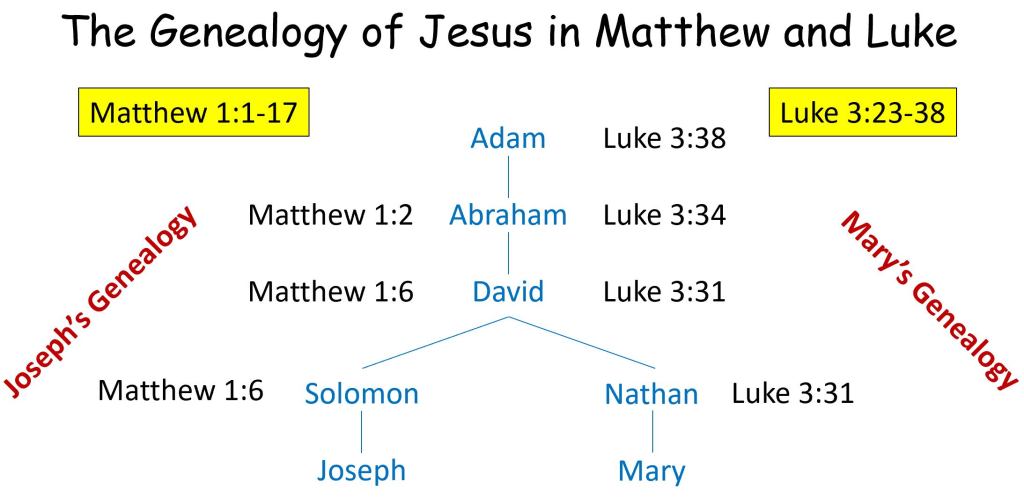
(Illustration modified from Nelson’s Complete Book of Bible Maps and Charts, copyright 1993 by Thomas Nelson, Inc., page 342.)
One of the features in Matthew that people often have questions about is the genealogy in Matthew 1:1-17, which is different from the genealogy recorded in Luke 3:23-38.
Critics often point to this as an error in the Gospels. However, it appears that what is happening is that Matthew gives the genealogy of Jesus through His father Joseph, going back as far as Abraham, and Luke gives it through His mother Mary, going back to Adam.
Thus, Matthew’s genealogy is through Joseph, who was himself a descendant of King David through David’s son Solomon. As Joseph’s adopted Son, Jesus became his legal heir, so far as his inheritance was concerned. Note the wording of Matthew 1:16:
…and Jacob the father of Joseph the husband of Mary, of whom Jesus was born, who is called Christ. (Matthew 1:16 ESV)
Matthew is careful to state that Joseph is not the biological father of Jesus, but is the husband of Mary who gave birth to Him. The words “of whom” refer to Mary in the Greek text, not to Joseph. [1]
Luke, on the other hand, seems to record the genealogical line of Mary. This seems to be implied by the wording of Luke 3:23:
Jesus, when he began his ministry, was about thirty years of age, being the son (as was supposed) of Joseph, the son of Heli… (Luke 3:23 ESV)
The phrase “as was supposed” indicates that Jesus was not really the biological son of Joseph, even though this was commonly assumed by the public. Mary’s genealogy is then listed instead, because Joseph’s would not be relevant. Mary’s line also comes from King David through his son Nathan. Therefore, Jesus was descended from King David naturally through Nathan and legally through Solomon.
Further support for this explanation is how Matthew and Luke write about the birth of Jesus. Matthew tells the story from the viewpoint of Joseph – his consideration of divorcing Mary, his dreams, and his flight to Egypt with his family. Whereas Luke tells the story from the viewpoint of Mary – the visit by the angel Gabriel, and her visit to her cousin Elizabeth.
There is another possible alternative to explain the different genealogical lists in Matthew and Luke. It is also possible that what is listed in Matthew is not a biological genealogy, but a line of royal succession proving that Jesus rightly inherits the title to royal succession. It is a legal ancestry that shows the line of descent for kingship, even though Jewish kings were no longer being crowned. Thus, both Matthew and Luke could be Joseph’s genealogies. Matthew lists the line of royal succession through Joseph to Jesus and Luke lists the biological/ancestral genealogy of Joseph.
The ability of Matthew and Luke to record these genealogies was not a problem. The information was readily available from Mary or through research. The ability to trace ancestry was common in Jesus’ day. The Jewish historian Josephus mentions in his writings that Jews living outside of Israel sent the names of their children to Jerusalem to be registered in the official archives, and that genealogies could be investigated in the archives.
The Gospel of Luke
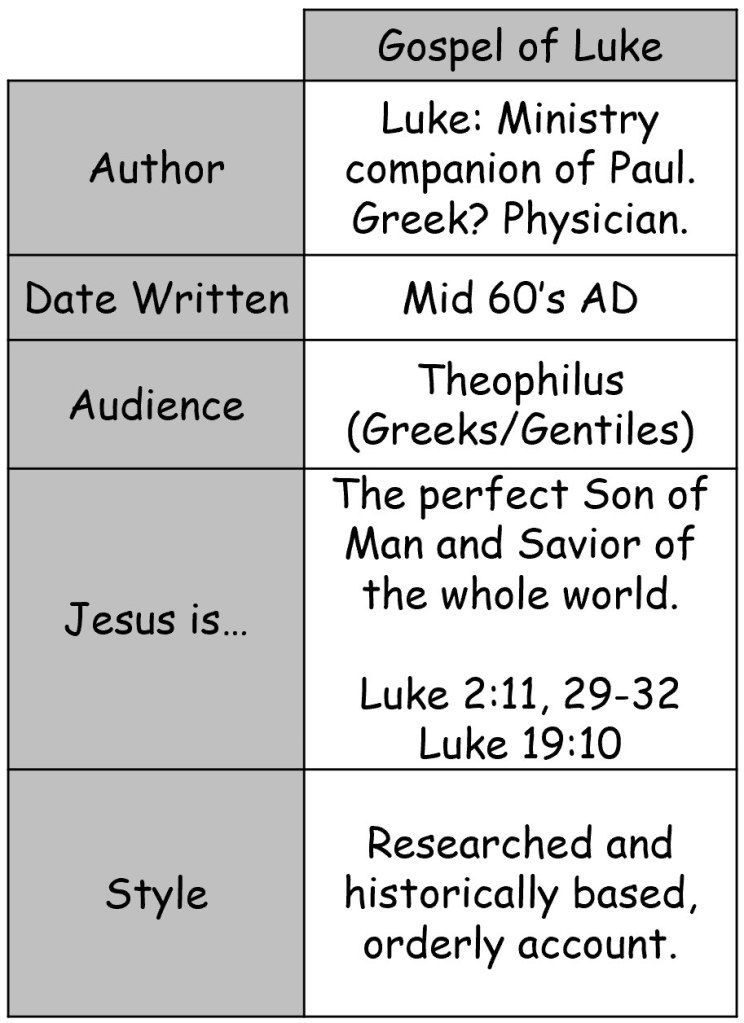
The Gospel of Luke is a researched and historically based, orderly account of the ministry of Jesus and the longest book in the New Testament. It contains much information not found in the other gospels such as material about Jesus’ birth in a manger, the appearance of the angels to the shepherds, and the parables of the Good Samaritan and Prodigal Son – two of the greatest short stories of all time. The book is written in a very refined style of Greek, which we would expect since Luke was an educated Greek man.
Theophilus
Luke is different from the other Gospels because it is addressed to a specific individual – “most excellent Theophilus” (1.3 ESV). It is not known who Theophilus was. Luke does not tell us and there is no record of him in early Christian literature. But it seems clear that he was a real person of some importance. Because he is addressed as “most excellent,” a title often used when referring to someone of honor or rank, he may have been some sort of high-ranking official in the Roman government. He may also have been Luke’s patron, the person who paid the costs of Luke’s writing. [2]
Because Luke writes to assure Theophilus of the “certainty concerning the things you have been taught” (1:4 ESV), he was probably a recent convert to the faith. [3]
The formal dedication to Theophilus also suggests that the book was intended for publication and was therefore written to a wide audience such as all Gentiles – Greeks and Romans.
Luke’s Portrait of Jesus
In his Gospel, Luke presents Jesus as the Savior of the whole world. The Good News about Him is a universal message.
And the angel said to them, “Fear not, for behold, I bring you good news of great joy that will be for all the people. For unto you is born this day in the city of David a Savior, who is Christ the Lord.” (Luke 2:10-11 ESV)
[See also Luke 2:29-32 and 19:10.]
Luke illustrates the universal nature of Jesus’ ministry by emphasizing his outreach to the poor, outcasts, women, and children.
Luke also emphasizes Jesus’ humanity which appealed to Greek readers. Greek thought was man centered. It put stress on the individual. It had high esteem for the genius, the hero, the ideal man. Jesus is shown to be all that the Greek could wish for, and more. He was the perfect man who was above the moral and spiritual imperfections of his gods. [4]
Luke the Physician
In Colossians 4:14, Paul refers to Luke as “the beloved physician”. Christian tradition supports the claim that he was a physician.
A number of scholars have shown that this is also supported by Luke’s descriptions of disease and his use of medical terms in his Gospel and in Acts. As one medical historian notes:
The many accounts of miraculous healing are told in Saint Luke more fully than in any other gospel, with understanding and in a language that only a doctor would use.
Otto L. Bettmann. A Pictorial History of Medicine. (Springfield: Charles C Thomas Pub Ltd, 1956). Page 49.
For example, Luke gives details that a physician would observe that Matthew, Mark and John do not give:
- Luke notes that Peter’s mother-in-law had a high fever using the appropriate medical terminology, rather than just saying that she had a fever as Matthew and Mark do (Luke 4:38).
- Luke notes that it was the right hand of the man that was withered, rather than generally stating that the man had a withered hand as Matthew and Mark do (Luke 6:6).
- Luke often adds details about the duration of the sickness (clinical history): the lame man was lame from birth (Acts 3:2); the woman with a bent spine was disabled for 18 years (Luke 13:11), and the woman with the discharge of blood had suffered for 12 years (Luke 8:43). These also show his sympathy for the person regarding how long they had suffered.
Luke uses many Greek medical terms that are found in the medical manuals of his day when he refers to diseases such as dropsy (Luke 14:2), curvature of the spine (Luke 13:11), and fever and dysentery (Acts 28:8).
These are just a few of many examples to support the claim that Luke was a physician. If you are interested in further information about this, click here for a link to an extended article about medical terminology in Luke.
Parables
I mentioned earlier that Luke is the only Gospel to record the parable of the Good Samaritan and the parable of the Prodigal Son. Many consider these to be two of the greatest short stories of all time. They have left a permanent impression on our culture. Who doesn’t know and use the phrases “Good Samaritan” or “Prodigal Son”, even without knowing where these phrases come from.
Parables were an important part of Jesus’ teaching. In fact, about one-third of what Jesus taught that is recorded in the Gospels is in the form of a parable. They are a teaching method that was perfected by Jesus.
Matthew, Mark, and Luke record around 40 parables. There are none in John because his focus is on the signs that Jesus performed. Click here for a list of the parables that includes a brief explanation of what each one teaches. The list is compiled by the Jesus Film Project which is a ministry of Cru.
Our English word ‘parable’ comes from the Greek word παραβολή / parabolē used in the New Testament. The Greek word has the sense of placing one thing beside another thing, and so metaphorically, to make a comparison. A story parable compares two things – one is familiar, the other is not. By looking at the familiar we can understand the unfamiliar.
So, a parable is a short story that gives a moral or spiritual lesson by comparing a familiar setting to a deeper truth. It makes complex ideas understandable through things that are familiar and simple. Most of Jesus’ parables illustrate one central truth.
Why did Jesus use parables? The disciples asked this same question of Jesus.
Then the disciples came and said to him, “Why do you speak to them in parables?” (Matthew 13:10 ESV)
This seems to be an important question, because the account is recorded in Matthew, Mark, and Luke. The shorter version of Jesus’ answer is recorded in Luke 8:10:
[Jesus] said, “To you it has been given to know the secrets of the kingdom of God, but for others they are in parables, so that ‘seeing they may not see, and hearing they may not understand.’” (Luke 8:10 ESV)
What Jesus’ answer means is that parables put a veil over the truth. They reveal truth to some listeners but conceal truth from other listeners.
Let me explain. The Gospels record the ministry of Jesus. Early on crowds followed Him. Jesus was popular, especially because of His miracles. Some of the people who followed believed, some did not believe.
So, at this point in His ministry when the disciples ask this question in Matthew 13, Jesus begins to look for more than superficial belief. He begins telling more parables to separate sincere followers from thrill seekers and unbelievers. His time of ministry on earth is limited. He must now focus on developing those who will carry on the ministry.
In fact, if you analyze the material recorded in the Synoptic Gospels you will discover that in Jesus’ ministry before Matthew 13 there are more miracles than parables, but after Matthew 13 there are more parables than miracles. I think the disciples sensed this change and it is why they asked Jesus about it.
Parables put a veil over the truth – they both reveal truth and conceal truth. They reveal truth to the sincere follower who digs beneath the surface to discover the meaning – to push aside the veil. They conceal truth from unbelievers who are too lazy or blind or unbelieving. Parables put the responsibility on the listener. So, Jesus begins using more parables to separate true believers from unbelievers.
Word Focus Lexicon
Lexical Form: παραβολή -ῆς, ἡ
Transliteration: parabolē
Gloss: parable
Part of Speech: Feminine Noun
New Testament Frequency: 50
Strong’s Number: G3850 (Link to Blue Letter Bible Lexicon)
παραβολή / parabolē is a noun related the the verb παραβάλλω / paraballō which means ‘to throw beside’, ‘come along side’, or ‘compare’. Thus a parable is a literary device (typically a short story) that is used to teach a truth through comparison, usually of a familiar thing with a deeper truth. The purpose is to make a complex truth understandable through a comparison with something that is familiar and simple.
The English word ‘parable’ is simply a transliteration of the Greek word.
The exact number of parables in the Gospels is debated, with the count ranging from 35 to 70. However, many authorities on the parables list around 40 to 50.
Though Jesus did not invent the parable, He elevated the art form, making it a unique focus of His teaching ministry. Surprisingly, New Testament and early Christian writers seldom use this teaching method of Jesus in their own works.
Footnotes
[1] The phrase in Greek is: Ἰωσὴφ τὸν ἄνδρα Μαρίας ἐξ ἧς ἐγεννήθη Ἰησοῦς. The name ‘Joseph’ (Ἰωσὴφ / Iōsēph) is masculine in gender. The name ‘Mary’ (Μαρίας / Marias) is feminine in gender. The pronoun ‘whom’ (ἧς / hēs) is also feminine in gender, so that its antecedent is Mary. In other words, Matthew states that Jesus was born of Mary, rather than stating that Joseph was the father of Jesus, as he did with all the preceding relationships.
[2] Other theories about the identity of Theophilus: 1) The name is a literary devise rather than an actual person. It means ‘loved of God’ or ‘friend of God’, and refers to all Christians. 2) He was a unknown benefactor or significant contributor to Paul’s mission work. 3) He was the Jewish high priest named Theophilus ben Ananus, who was high priest in Jerusalem from AD 37-41. He was the son of Annas and the brother–in-law of Caiaphus. 4) He was a later high priest named Mattathias ben Theophilus who served in Jerusalem from AD 65-66.
[3] Carson, D. A. and Moo, Douglas J. An Introduction to the New Testament. (Grand Rapids: Zondervan, 1992, 2005 by D. A. Carson and Douglas J. Moo.) Page 210.
[4] Vos, Howard F. Beginnings in the New Testament. (Chicago: Moody Press, 1973 by The Moody Bible Institute of Chicago.) Page 40.
Bibliography
Archer, Gleason L. Encyclopedia of Bible Difficulties. Zondervan Publishing House, 1982 by The Zondervan Corporation.
Balz, Horst and Schneider, Gerhard, Editors. Exegetical Dictionary of the New Testament. William B. Eerdmans Publishing Company, 1990.
Beetham, Christopher A., Editor. The Concise New International Dictionary of New Testament Theology and Exegesis. Zondervan Academic, 2021.
Bromiley, Geoffrey W. Theological Dictionary of the New Testament, Abridged in One Volume. William B. Eerdmans Publishing Company, 1985.
Carson, D. A. and Moo, Douglas J. An Introduction to the New Testament. Zondervan, 1992, 2005 by D. A. Carson and Douglas J. Moo.
Danker, Frederick William. The Concise Greek-English Lexicon of the New Testament. The University of Chicago Press, 2009.
Gilbrant, Thoralf, International Editor. The New Testament Greek-English Dictionary. The Complete Biblical Library, 1990.
Gundry, Robert H. A Survey of the New Testament. Zondervan Publishing House, 1970.
Guthrie, Donald. New Testament Introduction. Inter-Varsity Press, 1970 by The Tyndale Press.
Kistemaker, Simon. The Parables of Jesus. Baker Book House, 1980.
Liddell, Henry George and Scott, Robert. A Greek-English Lexicon. Oxford University Press. 1940. With a Supplement, 1996.
Lockyer, Herbert. All the Parables of the Bible. Zondervan Publishing House, 1963.
Nelson’s Complete Book of Bible Maps and Charts. Thomas Nelson Publishers, 1996, 1993 by Thomas Nelson, Inc.
Pentecost, J. Dwight. The parables of Jesus. Academie Books, 1982 by The Zondervan Corporation.
Stein, Robert H. Difficult Passages in the New Testament. Baker Book House, 1990.
Stein, Robert H. The Method and Message of Jesus’ Teachings. The Westminster Press, 1978.
Tenney, Merrill C. New Testament Survey. William B. Eerdmans Publishing Co., 1953, 1961, 1985.
Verbrugge, Verlyn D. New International Dictionary of New Testament Theology: Abridged Edition. Zondervan, 2000.
Vos, Howard F. Beginnings in the New Testament. Moody Press, 1973 by The Moody Bible Institute of Chicago
English translations of Bible verses marked (TBA) are translations by the author from the Greek text and are not quotations from any copyrighted Bible version or translation.
Scripture quotations marked (ESV) are from the Holy Bible, English Standard Version, copyright © 2001, 2007, 2011, 2016, 2025 by Crossway Bibles, a division of Good News Publishers. Used by permission. All rights reserved.


Leave a Reply