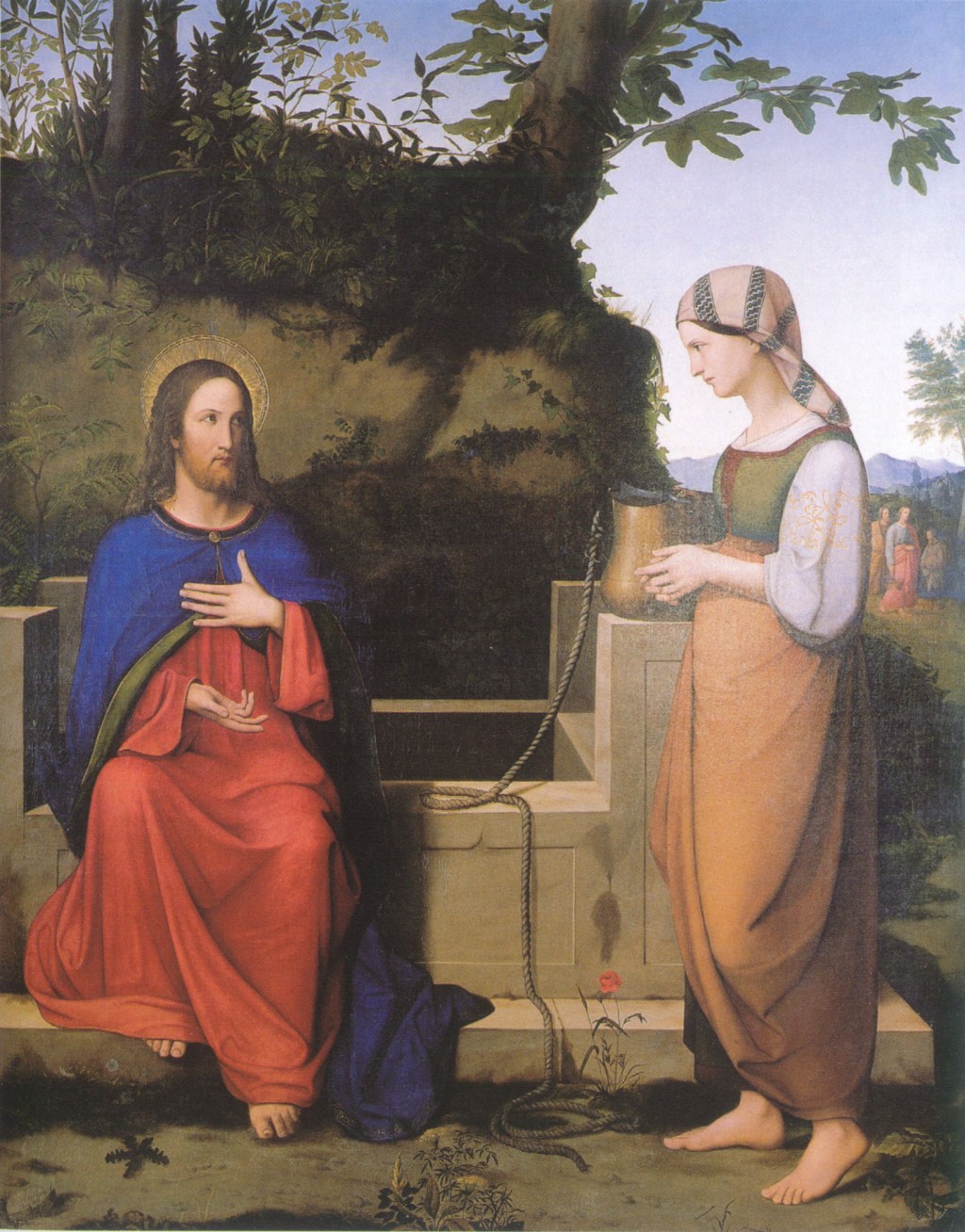
“Come. See a man who told me everything I ever did! Could He possibly be the Christ?” (John 4:29 TBA)
Introduction
In the previous post I commented on Matthew and Luke, providing introductory information. In this post I will do the same for Mark and John.
The Gospel of Mark

Mark is the shortest of the four Gospels. But Mark is a storyteller. He tells us more about the actions of Jesus than the teachings of Jesus. Most of the events he records also appear in Matthew and Luke, but Mark narrates them with greater detail and vividness.
Mark is often called the Gospel of Action. Its stories of Jesus ministry are quick moving, action-oriented narratives. The author shifts scenes rapidly using his favorite word “immediately” (εὐθύς / euthus) as a transition. He does not always use it with its strict sense of time, but often uses it as a transition to show that Jesus is constantly busy. The word occurs 41 times in Mark, more than in the entire rest of the New Testament books combined. (For example, see chapter 1, verses 10, 12, 18, 20, 21, 28, 29, 30, 42 and 43.)
Mark’s Gospel moves rapidly to the focus of the story – the cross. Almost 40% of his Gospel is devoted to a detailed account of the last eight days of Jesus’ life.
The Gospel is almost entirely objective in the way it tells its story – very little commentary or explanation is offered. Mark lets the narrative tell its own story. It is brief and pictorial – like a photo album of snapshots devoted to Jesus.
Mark is also a Gospel of personal reactions. Throughout the book his story records the responses of Jesus’ audience to these snapshots. The listeners are amazed (1:27), critical (2:7), afraid (4:41), puzzled (6:14), astonished (7:37), bitterly hostile (14:1). There are at least 23 such reaction references in Mark.
Mark features three groups of people: the disciples, the crowds and the religious leaders, none of whom understand Jesus. When the time comes for Jesus to go to the cross, the religious leaders arrest Him, the disciples abandon Him, and the crowds jeer Him. When He dies on the cross, only the Roman centurion recognizes that He is the Son of God (15:39).
Written to a Roman Audience
The Gospel was probably written to a Roman reading audience (Christian or non-Christian). Supporting this is the tradition of early Christian historians that the Gospel was written in Rome.
Some indications of a Roman audience are:
- Action and power are stressed in the book. Both were greatly admired by the Romans.
- Mark translates Aramaic words for the benefit of his readers (see 3:17; 5:41; 7:34; 14:36; 15:22, 15:34 for examples). Aramaic was the language spoken by the Jews in Palestine and probably the primary language used by Jesus.
- He explains or omits Jewish customs. (For example, see 13:18 where “Sabbath” is removed compared to Matthew 24:20.)
- He uses a number of Latin words, sometimes replacing the Greek word used by Matthew or Luke with its Latin equivalent. Below are some examples.
| English Translation (ESV) | Latin Term | Verse |
|---|---|---|
| tax | census (valuation tax) | Mark 12:14 |
| centurion | centurion (Roman military officer) | Mark 15:39 |
| legion | legion (Roman military unit) | Mark 5:9 |
| praetorium | praetorium (governor’s headquarters) | Mark 15:16 |
| denarius | denarius (Roman coin) | Mark 12:15 |
| penny | quadrans (small Roman coin) | Mark 12:42 |
| pot | sextarius (a pint vessel) | Mark 7:4 |
| executioner | speculator (military scout or attendant) | Mark 6:27 |
| scourging | flagellation (punishment by whipping) | Mark 15:15 |
Son of God
Mark’s portrait of Jesus is the suffering Son of God (Mark 1:1; 15:39).
What does ‘Son of God’ mean? We often use the phrase ‘son of’ as meaning ‘offspring’. For example, I am the son of Thomas (my father). But we also use it to imply equality and identity of nature. For example, the phrase Sons of Anarchy, does not meaning ‘offspring of anarchy’ but those who are by nature anarchists. Sons of Darkness are those who are by nature evil.
Son of God as a title for Jesus means He is by nature God. He is not the Son of God because He is the offspring of God, but because He is equal to or in nature God. Jesus has the same nature or essence as God. So, the title is a clear claim of His deity.
The title Son of God is never applied by Jesus to Himself in the Synoptic Gospels. However, when it is applied to Him by others, He accepts it in such a way as to assert His claim to it. (See Matthew 26:63-64 for example.)
Jesus is identified as the Son of God in the opening verse of the gospel (1:1), by the demons (3:11), and is confessed to be the Son of God by the Roman centurion as He dies near the end of the book (15:39). The titles in verses 1:1 and 15:39 serve as literary bookends. (See also 1:11 and 9:7.)
The Ending of Mark
Before we leave Mark, we must look at an issue that is unique to the book – its ending in chapter 16. Your Bible probably has brackets around verses 16:9-20, or a footnote about whether these verses are original. Verses 9 to 20 are known as the ‘long ending’ of Mark.
The genuineness of verses 9 to 20 (i.e., whether they were originally written by Mark or added later) is disputed because the oldest manuscripts [1] that are regarded as the most reliable do not have verses 9 to 20. There are also a few other ancient manuscripts that have a different shorter ending after verse 8. So there appears to have been some doubt even by early Christians about how the book ended.
Scholars are divided on whether verses 9 to 20 are original, that is, whether they were written by Mark. There are two major opinions:
The first opinion is that verses 9 to 20 are the original ending of Mark because: (1) the majority of manuscripts include this ending; (2) it can be traced back to the mid-second century; and (3) the book would have an abrupt ending if it ended at verse 8.
However most scholars think that Mark ends at verse 8 because: (1) the oldest manuscripts that are regarded as most reliable do not have these verses; (2) several ancient commentators (Jerome and Eusebius) state that the best manuscripts they had did not have verses 9 to 20; (3) the presence of several alternative endings suggests that there was uncertainty about the ending of Mark; and (4) the style and wording of the Greek in verse 9 to 20 is different from the rest of the Gospel implying a different author.
If the second view is correct, why would Mark abruptly end at verse 8?
Perhaps the original ending was lost early on because the last page of the book was lost. So, the long ending was a scribal attempt to add an appropriate conclusion for what was felt to be an inadequate ending at verse 8. The added ending summarizes information from the resurrection appearances found in the other Gospels.
Another idea is that Mark intended to end at verse 8. This fits the style of the book. Throughout his book, Mark refrains from making editorial comments about the significance of the history he narrates. He lets his story speak for itself, forcing his readers to work out the ultimate significance. An ending at verse 8 fits this style. The reader knows Jesus has been raised, but the confusion and astonishment of the women (16:8) leaves the reader wondering about just what it all means. And that is just the question Mark wants us to ask and find an answer to. [2]
Because of the uncertainty of these verses how should you treat them?
- Read them, keeping in mind that they may not be Mark’s inspired words but they do contain the same information about the resurrection found in the other Gospels. They do not contradict anything that is recorded in Matthew, Luke, and John.
- Do not base anything you believe solely on these verses. There should be confirmation from other passages of Scripture.
The Gospel of John
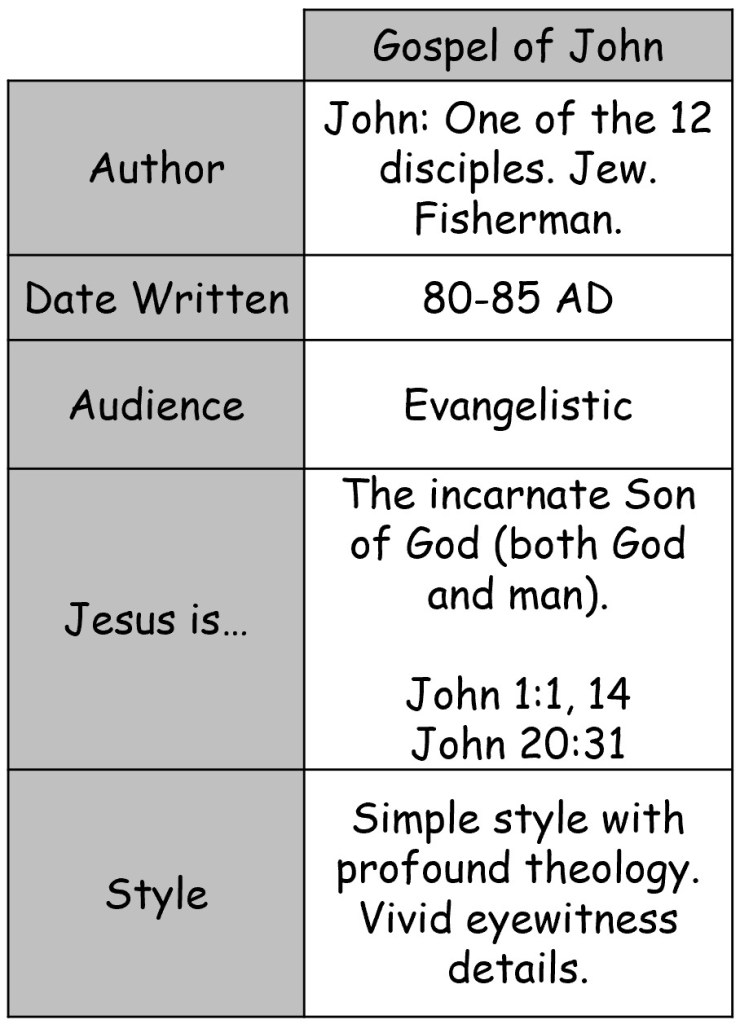
The Gospel of John is quite different in structure and style from the other three gospels. Most notably it has a simple style and vocabulary that exhibits profound theology – profound truths are couched in language plain enough for all to understand. It contains no parables, and has the vivid details of an eyewitness.
The book is built around seven signs or miracles performed by Jesus:
- Turns water into wine (2:1-11)
- Heals an official’s son (4:46-54)
- Heals a lame man (5:1-17)
- Feeds 5000 men (6:1-15)
- Walks on water/Stills the storm (6:16-21)
- Heals a blind man (9:1-41)
- Raises Lazarus from the dead (11:17-45)
And the claims of Jesus are declared in seven “I am” statements:
- I am the Bread of life (6:35)
- I am the Light of the world (8:12)
- I am the Door (10:7)
- I am the Good Shepherd (10:11)
- I am the Resurrection and the Life (11:25)
- I am the Way, the Truth, and the Life (14:6)
- I am the True Vine (15:1, 15:5)
The Gospel is probably not written to any specific audience but its purpose is clearly evangelistic. The key to the content of John is the purpose statement in John 20:30-31. Three words stand out in these verses: signs, believe and life.
30 Now Jesus did many other signs in the presence of the disciples, which are not written in this book; 31 but these are written so that you may believe that Jesus is the Christ, the Son of God, and that by believing you may have life in his name. (John 20:30-31 ESV)
As mentioned above, ‘signs‘ provide a clue to the organization of the Gospel around seven selected miracles. They are called signs because of their special purpose in pointing to or bearing witness that Jesus is God. Jesus is able to affect change in areas when man is not able – He can calm a storm, He can raise the dead.
The second important word is ‘believe‘. John is the gospel of believing. Indeed, the verb believe is the key word of the gospel, used 100 times. Because of this, the Gospel of John is often called the Gospel of Belief. Let me illustrate this.
[Note: All word frequencies mentioned below are based on the Greek text of the King James Version.]
The Greek verb ‘to believe’ (πιστεύω / pisteuō, Strong’s Number G4100) is used 248 times in the New Testament. John uses it 100 times in the Gospel of John, about 40% of all the times it is used in the entire New Testament.
How may times is this verb used in the other Gospels? It might surprise you that it is not that often.
| Book | ‘to believe’ verb G4100 |
|---|---|
| Total NT Use | 248 |
| Matthew | 11 |
| Mark | 15 |
| Luke | 9 |
| John | 100 |
There is a corresponding cognate noun meaning ‘belief’ or ‘faith’ (πίστις / pistis, Strong’s Number G4102) which is used 244 times in the New Testament. Coincidentally, almost the same number of times as the verb. Here is the frequency of this noun in the Gospels which is roughly similar to the use of the verb in Matthew, Mark, and Luke.
| Book | ‘to believe’ verb G4100 | ‘belief’ / ‘trust’ noun G4102 |
|---|---|---|
| Total NT Use | 248 | 244 |
| Matthew | 11 | 8 |
| Mark | 15 | 5 |
| Luke | 9 | 11 |
| John | 100 | 0 |
You might have expected John to also use the noun with high frequency like the verb. However, he never uses it. [3]
What conclusion can we draw from John’s frequent use of the verb compared to never using the related noun in his Gospel?
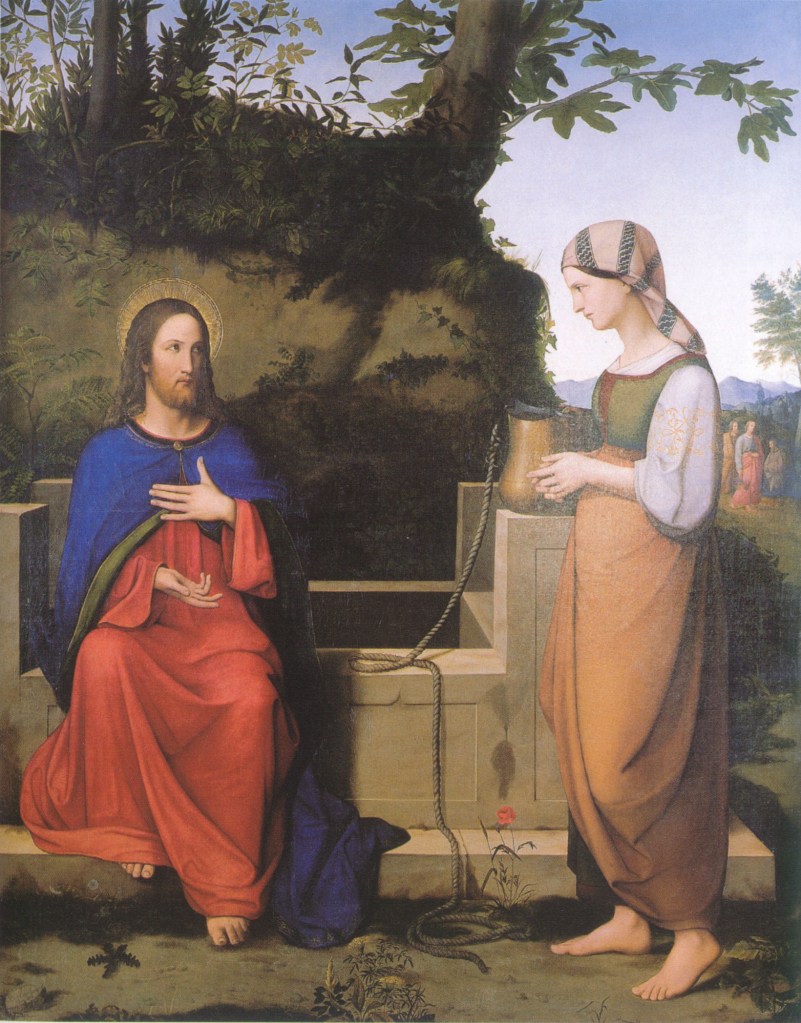
Let me suggest this. In his Gospel, John presents a number of stories where a person is confronted by Jesus and His message – such as the woman at the well as illustrated by the image at the top of this post. Then John shows us that person’s response of belief or unbelief. To John, belief or faith is not a thing. It is not something you have. It is something you do. It is a response to Jesus. Faith is an action. Believing in Christ means doing something about what you heard – taking an action. So, John describes faith with a verb (action), but never with a noun (thing).
Convinced by the signs, which are proofs of the identity of Jesus, the reader must move to the next step of believing – taking an action.
The third prominent word in these verses is life. This is the life that is given to the person who believes – to the person who takes action.
And this is eternal life, that they know you, the only true God, and Jesus Christ whom you have sent. (John 17:3 ESV)
The signs reveal Jesus to be God. Believing is the action in response to the signs. Life is the result given by God.
Portraits of Christ – Summary
The Gospels of Matthew, Mark, Luke, and John record the APPEARANCE of the Good News, who is Jesus Christ.
If you are Jewish, Matthew shows that Jesus is the Messiah and King promised in the Old Testament.
If you are Gentile, Mark shows that Jesus is the suffering Son of God.
Luke shows that Jesus is the Universal Savior.
And John demonstrates that Jesus is both God and man, and the one we must believe in for salvation.
Word Focus Lexicon
Lexical Form: πιστεύω
Transliteration: pisteuō
Gloss: I believe, I have faith in, I put trust in
Part of Speech: Verb
New Testament Frequency: 241
Strong’s Number: G4100 (Link to Blue Letter Bible Lexicon)
Although πιστεύω / pisteuō is not necessarily a theological word, it is always used in New Testament contexts related to believing in God or Jesus Christ. It is the principal word related to establishing a relationship with God through Jesus Christ. To believe in Jesus Christ is to believe and receive Him as God’s messenger and God’s solution for sin.
Footnotes
[1] Codex Vaticanus (B) and Codex Sinaiticus (א) are two of the most important early manuscripts (4th-century) that omit the longer ending of Mark (verses 16:9–20), ending abruptly at verse 8. This leads many scholars to believe this ending was not in the original Gospel but was a later scribal addition. While most other manuscripts (over 99%) do include the longer ending, the absence in these earliest manuscripts is a significant textual witness.
[2] Carson, D. A. and Moo, Douglas J. An Introduction to the New Testament. (Grand Rapids: Zondervan, 1992, 2005 by D. A. Carson and Douglas J. Moo.) Pages 189-190.
[3] In First John, the verb ‘to believe’ is used 9 times and the noun ‘belief’/’faith’ 1 time. John obviously prefers the verb to the noun. Neither word is used in Second John or Third John.
Bibliography
Balz, Horst and Schneider, Gerhard, Editors. Exegetical Dictionary of the New Testament. William B. Eerdmans Publishing Company, 1990.
Beetham, Christopher A., Editor. The Concise New International Dictionary of New Testament Theology and Exegesis. Zondervan Academic, 2021.
Bromiley, Geoffrey W. Theological Dictionary of the New Testament, Abridged in One Volume. William B. Eerdmans Publishing Company, 1985.
Carson, D. A. and Moo, Douglas J. An Introduction to the New Testament. Zondervan, 1992, 2005 by D. A. Carson and Douglas J. Moo.
Danker, Frederick William. The Concise Greek-English Lexicon of the New Testament. The University of Chicago Press, 2009.
Edwards, James R. The Gospel According to Mark, The Pillar New Testament Commentary. William B. Eerdmans Publishing Company, 2002.
France, R.T. The Gospel of Mark, The New International Greek Testament Commentary. William B. Eerdmans Publishing Company, 2002.
Gilbrant, Thoralf, International Editor. The New Testament Greek-English Dictionary. The Complete Biblical Library, 1990.
Gundry, Robert H. A Survey of the New Testament. Zondervan Publishing House, 1970.
Guthrie, Donald. New Testament Introduction. Inter-Varsity Press, 1970 by The Tyndale Press.
Hixson, Elijah and Gurry, Peter J., Editors. Myths and Mistakes in New Testament Textual Criticism. InterVarsity Press, 2019 by Elijah Hixson and Peter J. Gurry.
Jones, Timothy Paul. Misquoting Truth. InterVarsity Press, 2007 by Timothy Paul Jones.
Lane, William L. The Gospel of Mark, The New International Commentary on the New Testament. William B. Eerdmans Publishing Company, 1974.
Liddell, Henry George and Scott, Robert. A Greek-English Lexicon. Oxford University Press. 1940. With a Supplement, 1996.
Tenney, Merrill C. New Testament Survey. William B. Eerdmans Publishing Co., 1953, 1961, 1985.
Verbrugge, Verlyn D. New International Dictionary of New Testament Theology: Abridged Edition. Zondervan, 2000.
Vos, Howard F. Beginnings in the New Testament. Moody Press, 1973 by The Moody Bible Institute of Chicago
English translations of Bible verses marked (TBA) are translations by the author from the Greek text and are not quotations from any copyrighted Bible version or translation.
Scripture quotations marked (ESV) are from the Holy Bible, English Standard Version, copyright © 2001, 2007, 2011, 2016, 2025 by Crossway Bibles, a division of Good News Publishers. Used by permission. All rights reserved.
 Koine Foundations
Leave a comment