David Padfield/FreeBibleImages.org
10 Finally, be made strong in the Lord and in the power of His might. 11 Wear the full armor of God so that you can stand against the schemes of the Devil. 12 For our struggle is not against flesh and blood, but against the rulers, against the authorities, against the world powers of this dark domain, against the spiritual powers of evil in the heavenly realms. 13 For this reason, take up the full armor of God so that you can hold your ground in the evil day, and stand firm because you have made everything ready.
14 This being the case, take your stand having fastened truth around your waist, wearing the breastplate of righteousness, 15 and having shod your feet with the readiness that comes from the Good News whose message is peace. 16 In addition to all these*, having taken up the shield of faith with which you will be able to extinguish all the flaming arrows of the Evil One. 17 Also receive the helmet of salvation and the sword of the Spirit, which is the Word of God.
18 Take your stand praying in every situation in the Spirit by means of every kind of prayer and petition, and to this end, staying alert with all perseverance and petition for all the saints. (Ephesians 6:10-18)
*Or perhaps, “In all circumstances…” instead of “In addition to all these…“
Word Focus
truth
ἀλήθεια / alētheia
<Hear It>
In this post I continue with comments on Ephesians 6:10 to 18 – the Armor of God. Paul uses the picture of a Roman soldier preparing for battle to teach about the spiritual conflict in which the Christian is engaged. There are forces at work attempting to defeat and destroy the believer and Paul explains the resources that will assure victory over these forces.
In verse 14, Paul begins his list of six pieces of the spiritual armor that God provides and relates them to an ethical quality or virtue. They are set out and described in the order in which a soldier would dress himself for battle.
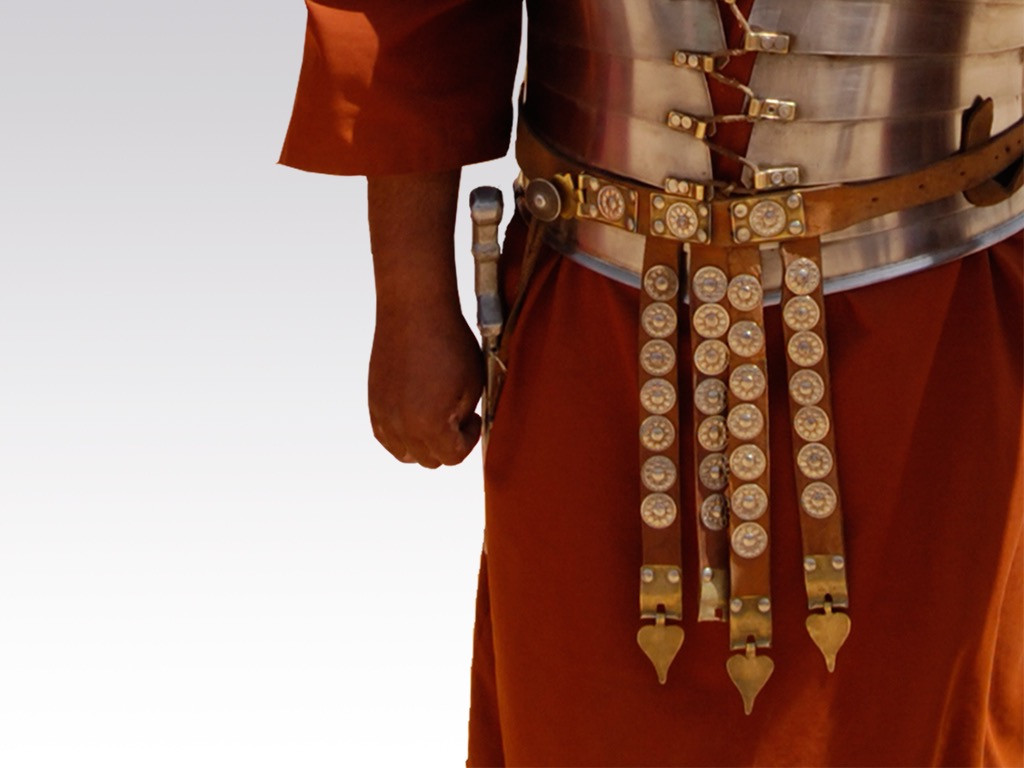
Paul does not mention the basic pieces of clothing that were worn under the armor. But generally, a Roman soldier wore a linen undergarment and over this he wore a short-sleeved, woolen tunic. The tunic was cut shorter than those worn by non-soldiers and sat just above the knees. This allowed more freedom of movement. The typical color of the military tunic was white (undyed wool) or red.
The first piece of the armor described by Paul is the Belt of Truth in verse 14:
This being the case, take your stand having fastened truth around your waist.
Paul does not actually use the word “belt” even though this first piece of the armor is often referred to as the “Belt of Truth”. Rather, he says that armoring up begins by “fastening truth around the waist“. Of course this implies a belt or girdle of some kind. In fact, the Roman soldier did wear a leather belt to keep the loose tunic from getting in the way, allowing freedom of movement, and as a place to fasten a sword and dagger. Illustrations from the time of Christ often show the soldier wearing two belts – one for the sword and one for the dagger.
The action of fastening a belt around the waist (or “girding the loins” as it is expressed in King James English), is a Biblical metaphor that refers to getting ready to do something. In ancient Biblical cultures where robes were worn, it was necessary to gather up and tuck the flowing garments under the belt before working or walking. This preparatory action allowed for unhindered movement. For examples of “tucking” or “girding” in the Bible, see 2 Kings 4:29, 2 Kings 9:1, Luke 12:35, and 1 Peter 1:13 (used metaphorically).
Paul compares the belt to truth (ἀλήθεια / alētheia). This is probably not referring to the Word of God directly, because that is represented by the sword in verse 17. Rather, it probably refers to the virtue of truthfulness or integrity – something that is demonstrated through one’s character and actions. Living with truthfulness or integrity means being honest, keeping your word, always living according to high moral and ethical values. Integrity is doing the right thing even when no one is watching. Of course those values are found in the Word of God, but integrity is living them out in your thoughts, words, and actions.
In verse 14, the phrase “having fastened truth around your waist“:
- Implies that this is a deliberate personal action. The believer has the responsibility to live with truthfulness and integrity.
- Implies that this is the first thing that must be done to be equipped to take a stand and hold one’s ground, since it is first in the list. The other pieces of armor are useless without this undergirding of complete truthfulness and integrity.
- Implies that truth “fastened around the waist” gives the believer unhindered freedom of movement in the battle, just like tucking up the long garments under the belt. Lack of complete truthfulness and integrity will hamper the believer in battle and life, and give the Devil an opportunity in his attacks.
In the next post I will comment on the breastplate of righteousness.
Here are links to all the posts for the Armor of God:
The Full Armor of God
Spiritual Opponents
Belt of Truth
Breastplate of Righteousness
Good News Boots
Shield of Faith
Helmet of Salvation
Sword of the Spirit
Pray and Stay Alert
Word Focus Lexicon
Lexical Form: ἡ ἀλήθεια ἀληθείας<Hear It>
Gloss: truth, truthfulness, reality
Part of Speech: First Declension Feminine Noun
New Testament Frequency: 109
Strong’s Number: G225 (Link to Blue Letter Bible Lexicon)
Bibliography
Bromiley, Geoffrey W. (Editor). Theological Dictionary of the New Testament, Abridged. Wm. B. Eerdmans Publishing Company. 1985.
Bruce, F.F. The Epistles to the Colossians, to Philemon, and to the Ephesians (The New International Commentary on the New Testament). Wm. B. Eerdmans Publishing Company. 1984.
Danker, Frederick William (Editor). A Greek-English Lexicon of the New Testament and other Early Christian Literature, Third Edition (BDAG). The University of Chicago Press. 2000.
Foulkes, Francis. The Epistle of Paul to the Ephesians (Tyndale New Testament Commentaries). Inter-Varsity Press. 1956.
Gilbrant, Thoralf (Editor). The New Testament Greek-English Dictionary. The Complete Biblical Library. 1990.
Kent Jr., Homer A. Ephesians, The Glory of the Church. Moody Press. 1971.
Lincoln, Andrew T. Word Biblical Commentary, Ephesians. Word Incorporated. 1990.
Salmond, S.D.F. The Expositors Greek Testament, Volume III. Wm. B. Eerdmans Publishing Company. 1990.
Stott, John R.W. The Message of Ephesians (The Bible Speaks Today). Inter-Varsity Press. 1979.
Wood, A. Skevington. The Expositor’s Bible Commentary, Volume 11. The Zondervan Corporation. 1978.
Unless otherwise noted, English translations of Bible verses are by the author from the Greek text and are not quotations from any copyrighted Bible version or translation.
 Koine Foundations
Leave a comment