David Padfield/FreeBibleImages.org
10 Finally, be made strong in the Lord and in the power of His might. 11 Wear the full armor of God so that you can stand against the schemes of the Devil. 12 For our struggle is not against flesh and blood, but against the rulers, against the authorities, against the world powers of this dark domain, against the spiritual powers of evil in the heavenly realms. 13 For this reason, take up the full armor of God so that you can hold your ground in the evil day, and stand firm because you have made everything ready.
14 This being the case, take your stand having fastened truth around your waist, wearing the breastplate of righteousness, 15 and having shod your feet with the readiness that comes from the Good News whose message is peace. 16 In addition to all these*, having taken up the shield of faith with which you will be able to extinguish all the flaming arrows of the Evil One. 17 Also receive the helmet of salvation and the sword of the Spirit, which is the Word of God.
18 Take your stand praying in every situation in the Spirit by means of every kind of prayer and petition, and to this end, staying alert with all perseverance and petition for all the saints. (Ephesians 6:10-18)
*Or perhaps, “In all circumstances…” instead of “In addition to all these…“
Word Focus
the sword of the Spirit
ἡ μάχαιρα τοῦ πνεύματος
hē machaira tou pneumatos
<Hear It>
In this post I continue with comments on Ephesians 6:10 to 18 – the Armor of God. Paul uses the picture of a Roman soldier preparing for battle to teach about the spiritual conflict in which the Christian is engaged. There are evil forces at work attempting to defeat and destroy the believer and Paul explains the resources that will assure victory over these forces.
In verses 14 to 17, Paul lists six pieces of spiritual armor that God provides and relates them to an ethical quality or virtue. They are set out and described in the order in which a soldier would dress himself for battle. The sixth and last piece of the armor described by Paul is the Sword of the Spirit in verse 17:
Also receive the helmet of salvation and the sword of the Spirit, which is the Word of God
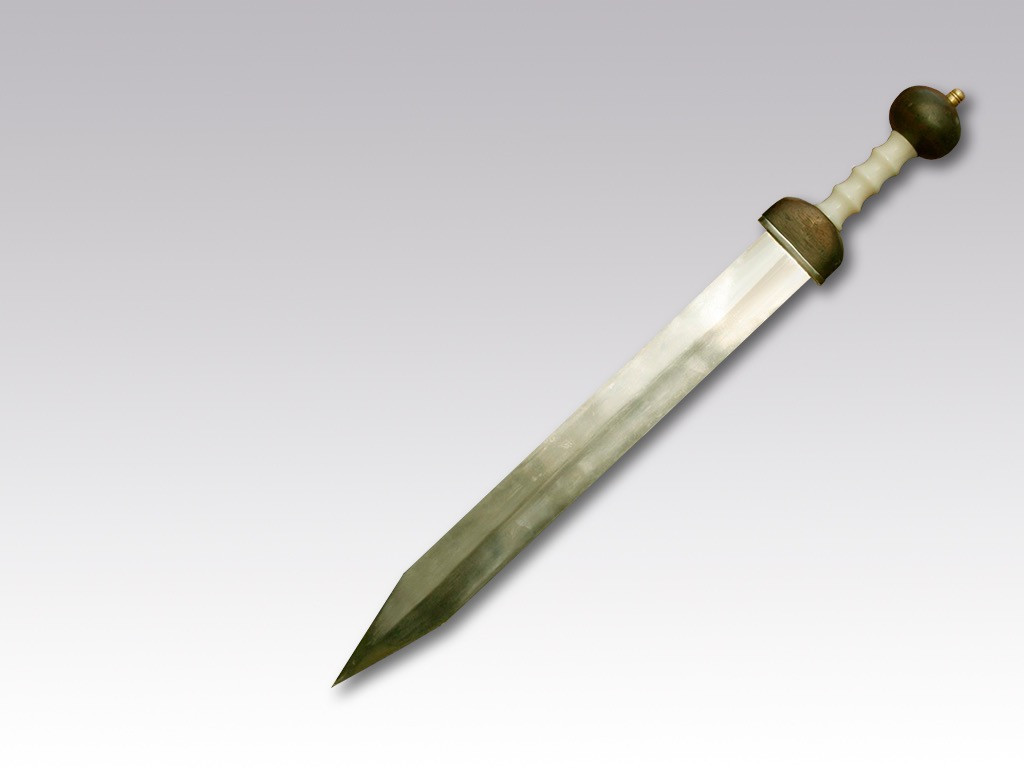
In close quarter combat, the primary weapon of the Roman soldier was the short thrusting sword called the gladius. It was about two feet long, double edged, and had a pointed tip that could easily pierce armor and flesh. Its short length, light weight, and double edge allowed it to be quickly withdrawn. In combat, it was used to stab the enemy’s stomach or slash his legs which were exposed below the shield.
In addition to the sword, the soldier was typically armed with two pila (javelins), though Paul does not mention them in his illustration. Before engaging in close quarter combat, these were hurled to disable the enemies’ shields and disrupt the enemy line. Then leading with his shield, the soldier would draw his sword the drive into the enemy line, thrusting with the sword. The gladius was designed to be used with a large shield.
Perhaps Paul does not mention the pila because his overall illustration is one of defense rather than offense. He lists the equipment that is necessary for the soldier to “hold your ground” and “stand firm” (verse 13).
In Paul’s illustration, the Christian soldier’s weapon is called “the sword of the Spirit“. This is explained by the next clause as being “the Word of God” – what God has revealed through the inspiration of the Holy Spirit in the Scriptures. Since a sword is used for both offense and defense, perhaps we should see both of these ideas also implied by the sword of the Spirit. It is used to attack things like false teaching which the Devil uses to deceive believers and is used to defend against things like temptation which the Devil uses to destroy believers.
Paul also describes the sword as being the sword “of the Spirit“. This probably describes both its origin as the sword supplied by the Holy Spirit, and its use by the Holy Spirit who gives it its effectiveness.
[See related post on the effectiveness of the Word of God as a sword that can pierce and judge: Sword – Hebrews 4:12-13.]
Jesus gave the perfect example of using the Word of God to defend against and defeat the Devil. When Jesus was tempted by the Devil in the wilderness (see Matthew 4:1-11), He recognized the Devil’s distortion of Scripture and countered with the relevant truth from the Word of God. Jesus was able to do this because He knew what was in the Word of God.
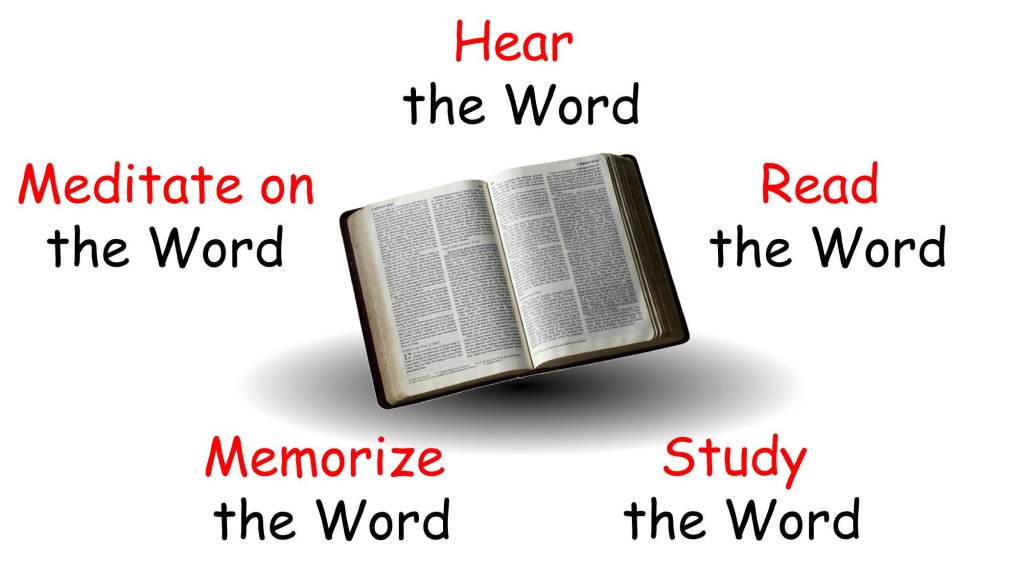
In order for the Christian warrior to follow Jesus’ example, he or she must also know the Word of God by hearing the Word, reading the Word, studying the Word, memorizing the Word, and meditating on the Word. Just as a soldier learns how to use a sword through practice before going into battle, so must the Christian warrior use these disciplines to understand how to use the Word and store it in his or her heart for effective use on the day of battle (Psalm 119:11).
In the next post I will comment on Communication and Watchfulness.
Here are links to all the posts for the Armor of God:
The Full Armor of God
Spiritual Opponents
Belt of Truth
Breastplate of Righteousness
Good News Boots
Shield of Faith
Helmet of Salvation
Sword of the Spirit
Pray and Stay Alert
Word Focus Lexicon
Lexical Form: ἡ μάχαιρα μαχαίρης <Hear It>
Gloss: sword, large knife
Part of Speech: First Declension Feminine Noun
New Testament Frequency: 29
Strong’s Number: G3162 (Link to Blue Letter Bible Lexicon)
Lexical Form: τὸ πνεῦμα πνεύματος <Hear It>
Gloss: spirit, wind, breath
Part of Speech: Third Declension Neuter Noun
New Testament Frequency: 379
Strong’s Number: G4151 (Link to Blue Letter Bible Lexicon)
Bibliography
Barkley, William. The Daily Study Bible, Letters to the Galatians and Ephesians. The Westminster Press. 1954, 1956, 1958.
Bromiley, Geoffrey W. (Editor). Theological Dictionary of the New Testament, Abridged. Wm. B. Eerdmans Publishing Company. 1985.
Bruce, F.F. The Epistles to the Colossians, to Philemon, and to the Ephesians (The New International Commentary on the New Testament). William B. Eerdmans Publishing Company. 1984.
Danker, Frederick William (Editor). A Greek-English Lexicon of the New Testament and other Early Christian Literature, Third Edition (BDAG). The University of Chicago Press. 2000.
Foulkes, Francis. The Epistle of Paul to the Ephesians (Tyndale New Testament Commentaries). Inter-Varsity Press. 1956.
Gilbrant, Thoralf (Editor). The New Testament Greek-English Dictionary. The Complete Biblical Library. 1990.
Kent Jr., Homer A. Ephesians, The Glory of the Church. Moody Press. 1971.
Lincoln, Andrew T. Word Biblical Commentary, Ephesians. Word Incorporated. 1990.
Salmond, S.D.F. The Expositors Greek Testament, Volume III. William B. Eerdmans Publishing Company. 1990.
Stott, John R.W. The Message of Ephesians (The Bible Speaks Today). Inter-Varsity Press. 1979.
Wood, A. Skevington. Ephesians, (The Expositor’s Bible Commentary, Volume 11). The Zondervan Corporation. 1978.
Unless otherwise noted, English translations of Bible verses are by the author from the Greek text and are not quotations from any copyrighted Bible version or translation.


Leave a Reply