David Padfield/FreeBibleImages.org
10 Finally, be made strong in the Lord and in the power of His might. 11 Wear the full armor of God so that you can stand against the schemes of the Devil. 12 For our struggle is not against flesh and blood, but against the rulers, against the authorities, against the world powers of this dark domain, against the spiritual powers of evil in the heavenly realms. 13 For this reason, take up the full armor of God so that you can hold your ground in the evil day, and stand firm because you have made everything ready.
14 This being the case, take your stand having fastened truth around your waist, wearing the breastplate of righteousness, 15 and having shod your feet with the readiness that comes from the Good News whose message is peace. 16 In addition to all these*, having taken up the shield of faith with which you will be able to extinguish all the flaming arrows of the Evil One. 17 Also receive the helmet of salvation and the sword of the Spirit, which is the Word of God.
18 Take your stand praying in every situation in the Spirit by means of every kind of prayer and petition, and to this end, staying alert with all perseverance and petition for all the saints. (Ephesians 6:10-18)
*Or perhaps, “In all circumstances…” instead of “In addition to all these…“
Word Focus
the helmet of salvation
ἡ περικεφαλαὶα τοῦ σωτηρίου
hē perikephalaia tou sōtēriou
<Hear It>
In this post I continue with comments on Ephesians 6:10 to 18 – the Armor of God. Paul uses the picture of a Roman soldier preparing for battle to teach about the spiritual conflict in which the Christian is engaged. There are evil forces at work attempting to defeat and destroy the believer and Paul explains the resources that will assure victory over these forces.
In verses 14 to 17, Paul lists six pieces of spiritual armor that God provides and relates them to an ethical quality or virtue. They are set out and described in the order in which a soldier would dress himself for battle. The fifth piece of the armor described by Paul is the Helmet of Salvation in verse 17:
Also receive the helmet of salvation…
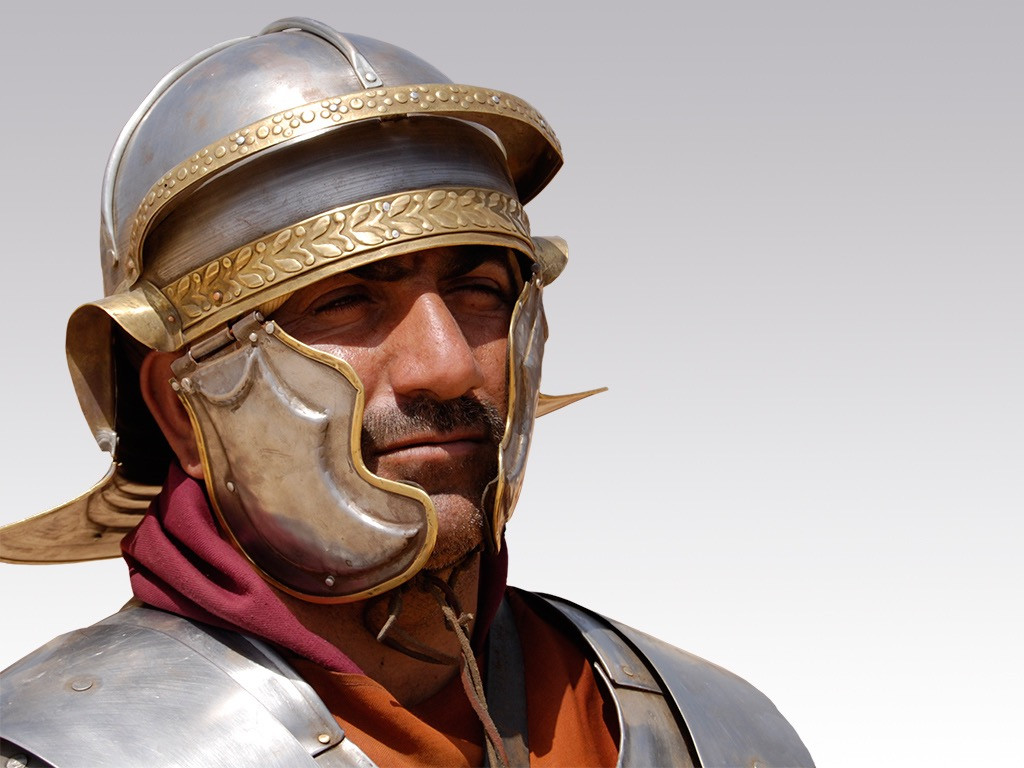
Obviously the Romans soldier’s helmet or cassis protected his head. See Image above. It was constructed of bronze or iron and included cheek pieces, a protrusion above the rim that protected the forehead, and a guard on the rear that protected the back of the neck. The inside was lined with leather and the helmet was fastened under the chin by a leather strap.
Paul describes the helmet as the “helmet of salvation” and begins by commanding the Christian soldier to “receive” it. This is a change from the commands for the first four pieces of armor. For those, the soldier’s actions were governed by the general command at the beginning of verse 14 where Paul says, “take your stand“. Four participles further explain how this is done: the soldier takes his stand by “having fastened” truth, “wearing” the breastplate of righteousness, “having shod” his feet with Good News readiness, and “having taken up” the shield of faith. These highlighted verbal forms (called participles) probably imply that these actions involve a certain degree of human effort and have been completed. Truth, righteousness, readiness, and faith are qualities the soldier is responsible to develop and exhibit in order to be ready to hold his ground. However, for the last two pieces of armor, the Helmet of Salvation and the Sword of the Spirit, Paul says the soldier is to “receive” them. This implies that they are gifts from God. They are not things done by the Christian soldier, except to receive them as a gift from God.
Paul compares the helmet to salvation. By this he may have all three aspects of salvation in mind that are taught in the New Testament:
- Salvation from the penalty of sin, which is death. This aspect of salvation, called justification, is a past completed action for the person who has accepted Christ as Savior (Ephesians 2:8-10). Justification is the action whereby God declares a person righteous when he or she receives Christ, because Christ paid the penalty for sin. Through His death believers are declared righteous, i.e., justified (Romans 3:23-24; Romans 5:8-9; 2 Corinthians 5:21). Justification results in peace with God.
- Salvation from the power of sin. This aspect of salvation, called sanctification, is a present lifelong process by which the believer’s character and conduct are changed. The goal is to become more like Christ. Success depends on yielding to God (Romans 12:1; Romans 6:13) and separating from sin (Galatians 5:16-24; Romans 6:13). The believer must put off sinful habits and put on holy living (Ephesians 4:22,24). The result is a renewed mind (Ephesians 4:23).
- Salvation from the presence of sin. This aspect of salvation, called glorification or ultimate sanctification, is a future assurance of full and final deliverance from sin that will occur when Christ returns. Paul expresses this idea in 1 Thessalonians 5:8 by using another armor illustration but refers to the helmet as the “hope of salvation“. “Hope” does not imply uncertainty, because glorification is grounded in God’s promises which He always fulfills. At the present it is hope and not sight, because what is promised is not yet realized. The believer can confidently anticipate a future deliverance from the very presence of sin and the completion of salvation.
Just as the helmet protected the Roman soldier’s head, the spiritual helmet protects the Christian soldier’s head, or by implication, his or her mind.
- Justification assures believers of peace with God (Romans 5:1) and peace with God means peace of mind because salvation is assured and nothing can separate the believer from God (Romans 8:38-39).
- Sanctification delivers the believer from bondage to a sinful lifestyle to a life of holiness and renews the mind (Ephesians 4:23). A renewed mind helps the believer better understand and apply God’s Word, and recognize and stand firm against the enemy’s lies.
- Glorification is a future assurance that is the object of hope in the present. The hopeful mind stays clear headed and alert, and knows that the battle is temporary and a glorious victory is in the future.
The shield of faith gives the Christian soldier confidence to hold his ground in the spiritual battle because of peace of mind, a renewed mind, and a hopeful mind.
In the next post I will comment on the Sword of the Spirit.
Here are links to all the posts for the Armor of God:
The Full Armor of God
Spiritual Opponents
Belt of Truth
Breastplate of Righteousness
Good News Boots
Shield of Faith
Helmet of Salvation
Sword of the Spirit
Pray and Stay Alert
Word Focus Lexicon
Lexical Form: ἡ περικεφαλαία περικεφαλαίας <Hear It>
Gloss: helmet
Part of Speech: First Declension Feminine Noun
New Testament Frequency: 2
Strong’s Number: G4030 (Link to Blue Letter Bible Lexicon)
Lexical Form: σωτήριος σωτήριον <Hear It>
Gloss: bringing salvation, saving
Part of Speech: Two Termination Adjective
New Testament Frequency: 5
Strong’s Number: G4992 (Link to Blue Letter Bible Lexicon)
Bibliography
Barkley, William. The Daily Study Bible, Letters to the Galatians and Ephesians. The Westminster Press. 1954, 1956, 1958.
Best, Ernest. The First and Second Epistles to the Thessalonians, (Harper’s New Testament Commentaries). Hendrickson Publishers, Inc. 1972, 1977, 1979, 1986.
Bromiley, Geoffrey W. (Editor). Theological Dictionary of the New Testament, Abridged. Wm. B. Eerdmans Publishing Company. 1985.
Bruce, F.F. The Epistles to the Colossians, to Philemon, and to the Ephesians (The New International Commentary on the New Testament). William B. Eerdmans Publishing Company. 1984.
Chafer, Lewis Sperry, revised by Walvoord, John F. Major Bible Themes. Zondervan Publishing House. 1926, 1953. Revised Edition 1974.
Danker, Frederick William (Editor). A Greek-English Lexicon of the New Testament and other Early Christian Literature, Third Edition (BDAG). The University of Chicago Press. 2000.
Earle, Ralph. Word Meanings in the New Testament. Hendrickson Publishers. 1998.
Foulkes, Francis. The Epistle of Paul to the Ephesians (Tyndale New Testament Commentaries). Inter-Varsity Press. 1956.
Gilbrant, Thoralf (Editor). The New Testament Greek-English Dictionary. The Complete Biblical Library. 1990.
Kent Jr., Homer A. Ephesians, The Glory of the Church. Moody Press. 1971.
Lincoln, Andrew T. Word Biblical Commentary, Ephesians. Word Incorporated. 1990.
Little, Paul E. Know What You Believe. SP Publications. 1970, 1985, 1987.
Morris, Leon. The First and Second Epistles to the Thessalonians, (The New International Commentary on the New Testament). William B. Eerdmans Publishing Company. 1991.
Robertson, Archibald Thomas. Word Pictures in the New Testament, Volume IV. Broadman Press. 1931.
Ryrie, Charles C. Basic Theology. SP Publications. 1986.
Salmond, S.D.F. The Expositors Greek Testament, Volume III. William B. Eerdmans Publishing Company. 1990.
Stott, John R.W. The Message of Ephesians (The Bible Speaks Today). Inter-Varsity Press. 1979.
Thiessen, Henry Clarence. Introductory Lectures in Systematic Theology. William B. Eerdmans Publishing Company. 1949.
Thomas, Robert L. 1 Thessalonians, (The Expositor’s Bible Commentary, Volume 11). The Zondervan Corporation. 1978.
Wanamaker, Charles A. The Epistles to the Thessalonians, (The New International Greek Testament Commentary). William B. Eerdmans Publishing Company. 1990.
Wood, A. Skevington. Ephesians, (The Expositor’s Bible Commentary, Volume 11). The Zondervan Corporation. 1978.
Unless otherwise noted, English translations of Bible verses are by the author from the Greek text and are not quotations from any copyrighted Bible version or translation.


Leave a Reply