
David Padfield/FreeBibleImages.org
10 Finally, be made strong in the Lord and in the power of His might. 11 Wear the full armor of God so that you can stand against the schemes of the Devil. 12 For our struggle is not against flesh and blood, but against the rulers, against the authorities, against the world powers of this dark domain, against the spiritual powers of evil in the heavenly realms. 13 For this reason, take up the full armor of God so that you can hold your ground in the evil day, and stand firm because you have made everything ready.
14 This being the case, take your stand having fastened truth around your waist, wearing the breastplate of righteousness, 15 and having shod your feet with the readiness that comes from the Good News whose message is peace. 16 In addition to all these*, having taken up the shield of faith with which you will be able to extinguish all the flaming arrows of the Evil One. 17 Also receive the helmet of salvation and the sword of the Spirit, which is the Word of God.
18 Take your stand praying in every situation in the Spirit by means of every kind of prayer and petition, and to this end, staying alert with all perseverance and petition for all the saints. (Ephesians 6:10-18)
*Or perhaps, “In all circumstances…” instead of “In addition to all these…“
Word Focus
the breastplate of righteousness
ὁ θώραξ τῆς δικαιοσύνης
ho thōrax tēs dikaiosunēs
<Hear It>
In this post I continue with comments on Ephesians 6:10 to 18 – the Armor of God. Paul uses the picture of a Roman soldier preparing for battle to teach about the spiritual conflict in which the Christian is engaged. There are evil forces at work attempting to defeat and destroy the believer and Paul explains the resources that will assure victory over these forces.
In verses 14 to 17, Paul lists six pieces of the spiritual armor that God provides and relates them to an ethical quality or virtue. They are set out and described in the order in which a soldier would dress himself for battle. The second piece of the armor described by Paul is the Breastplate of Righteousness in verse 14:
This being the case, take your stand… wearing the breastplate of righteousness.
The breastplate of the Roman soldier was a major piece of armor that protected the vital organs from a disabling or fatal wound. The picture above shows a type of breastplate called the lorica segmentata, which is what we typically imagine to be what the Roman soldier wore. However, this was probably popular only during the first and second centuries AD and it is unknown how extensive its use was throughout the empire. It was constructed of overlapping strips of iron held together with leather straps. It protected the front and back of the soldier. However, for many common soldiers, the breastplate was simply a brass plate about 9″ square called a pectorale that covered the heart, while more affluent offices wore a coat of bronze or iron chain mail called a lorica hamata (see picture below).
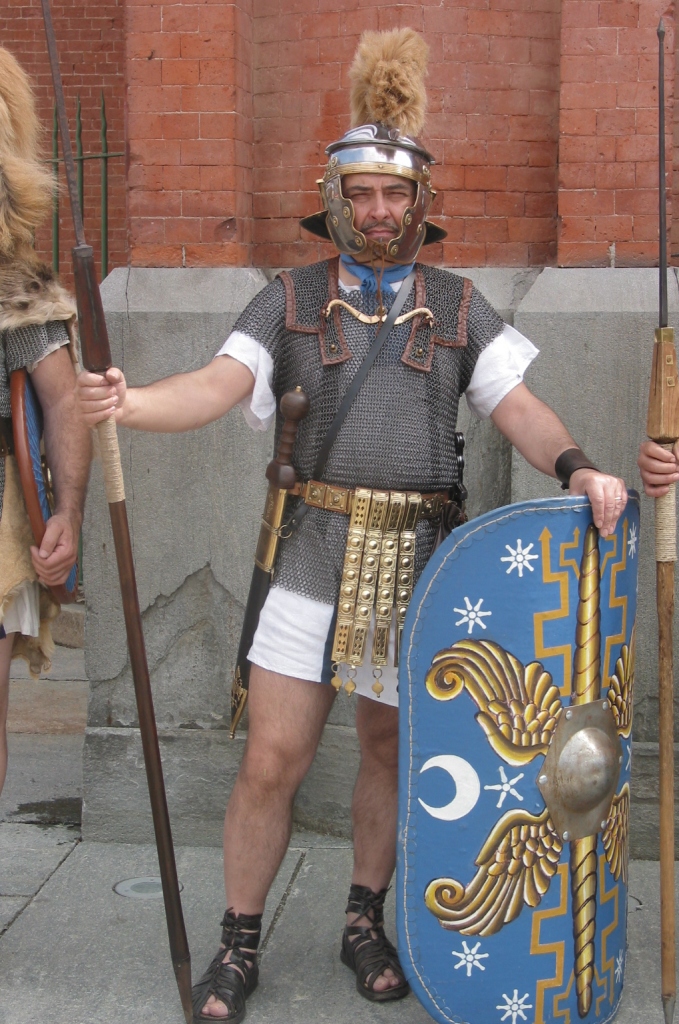
By Greatbeagle – Own work, CC BY 3.0. Greatbeagle
Paul compares the breastplate to righteousness. Some commentators understand this as the righteousness of justification – the action of God whereby he declares a person righteous when he or she receives Christ, who paid the penalty for sin. Through His death believers are made righteous (Romans 8:3-4; Romans 10:4; 2 Corinthians 5:21; However, in Paul’s armor illustration it probably refers to practical righteousness in everyday living – right conduct, righteousness expressed by our actions. Practical righteousness is made possible by the new life created in us by Jesus Christ.
Living righteously is a defense against accusations from the conscious or from human or spiritual opponents. It demonstrates that the accusations are a lie. Living in an unrighteous manner leaves a deadly hole in the armor. Just as the soldier’s breastplate protected his heart from fatal thrusts, so also does the believer’s breastplate of righteousness provide protection from spiritual opponents by guarding the heart through right living.
In the next post I will comment on the military boots.
Here are links to all the posts for the Armor of God:
The Full Armor of God
Spiritual Opponents
Belt of Truth
Breastplate of Righteousness
Good News Boots
Shield of Faith
Helmet of Salvation
Sword of the Spirit
Pray and Stay Alert
Word Focus Lexicon
Lexical Form: ὁ θώραξ θώρακος <Hear It>
Gloss: breastplate, chest
Part of Speech: Third Declension Masculine Noun
English Derivative: thorax
New Testament Frequency: 5
Strong’s Number: G2382 (Link to Blue Letter Bible Lexicon)
Lexical Form: ἡ δικαιοσύνη δικαιοσύνης <Hear It>
Gloss: righteousness, uprightness, justice
Part of Speech: First Declension Feminine Noun
New Testament Frequency: 92
Strong’s Number: G1343 (Link to Blue Letter Bible Lexicon)
Pronunciation Note: The letter Xi (ξ) as in the word θώραξ, is pronounced like the ks in elks. It is called a “double consonant” because it represents the combined sounds of the two Greek letters Kappa (κ) and Sigma (σ). The upper case form of the letter is Ξ but it does not occur anywhere in modern additions of the Greek New Testament.
Bibliography
Bromiley, Geoffrey W. (Editor). Theological Dictionary of the New Testament, Abridged. Wm. B. Eerdmans Publishing Company. 1985.
Bruce, F.F. The Epistles to the Colossians, to Philemon, and to the Ephesians (The New International Commentary on the New Testament). Wm. B. Eerdmans Publishing Company. 1984.
Danker, Frederick William (Editor). A Greek-English Lexicon of the New Testament and other Early Christian Literature, Third Edition (BDAG). The University of Chicago Press. 2000.
Foulkes, Francis. The Epistle of Paul to the Ephesians (Tyndale New Testament Commentaries). Inter-Varsity Press. 1956.
Gilbrant, Thoralf (Editor). The New Testament Greek-English Dictionary. The Complete Biblical Library. 1990.
Kent Jr., Homer A. Ephesians, The Glory of the Church. Moody Press. 1971.
Lincoln, Andrew T. Word Biblical Commentary, Ephesians. Word Incorporated. 1990.
Salmond, S.D.F. The Expositors Greek Testament, Volume III. Wm. B. Eerdmans Publishing Company. 1990.
Stott, John R.W. The Message of Ephesians (The Bible Speaks Today). Inter-Varsity Press. 1979.
Wood, A. Skevington. The Expositor’s Bible Commentary, Volume 11. The Zondervan Corporation. 1978.
Unless otherwise noted, English translations of Bible verses are by the author from the Greek text and are not quotations from any copyrighted Bible version or translation.
 Koine Foundations
Leave a comment