

David Padfield/FreeBibleImages.org
10 Finally, be made strong in the Lord and in the power of His might. 11 Wear the full armor of God so that you can stand against the schemes of the Devil. 12 For our struggle is not against flesh and blood, but against the rulers, against the authorities, against the world powers of this dark domain, against the spiritual powers of evil in the heavenly realms. 13 For this reason, take up the full armor of God so that you can hold your ground in the evil day, and stand firm because you have made everything ready.
14 This being the case, take your stand having fastened truth around your waist, wearing the breastplate of righteousness, 15 and having shod your feet with the readiness that comes from the Good News whose message is peace. 16 In addition to all these*, having taken up the shield of faith with which you will be able to extinguish all the flaming arrows of the Evil One. 17 Also receive the helmet of salvation and the sword of the Spirit, which is the Word of God.
18 Take your stand praying in every situation in the Spirit by means of every kind of prayer and petition, and to this end, staying alert with all perseverance and petition for all the saints. (Ephesians 6:10-18)
*Or perhaps, “In all circumstances…” instead of “In addition to all these…“
Word Focus
I put on footwear
ὑποδέω / hupodeō
<Hear It>
In this post I continue with comments on Ephesians 6:10 to 18 – the Armor of God. Paul uses the picture of a Roman soldier preparing for battle to teach about the spiritual conflict in which the Christian is engaged. There are evil forces at work attempting to defeat and destroy the believer and Paul explains the resources that will assure victory over these forces.
In verses 14 to 17, Paul lists six pieces of spiritual armor that God provides and relates them to an ethical quality or virtue. They are set out and described in the order in which a soldier would dress himself for battle. The third piece of the armor described by Paul is the Good News Boots in verse 15:
And having shod your feet with the readiness that comes from the Good News whose message is peace.
During the first century AD, when Paul wrote the letter to the Ephesians, Roman soldiers wore heavy-soled, sandal-like boots called caligae (singular caliga) as shown in the images below. They were designed for both marching and fighting. Socks were usually not worn with the boots, except in colder climates.

The soles of the boots were studded with iron hobnails to provide grip (see image below). They also inflicted further injury on a downed enemy combatant.
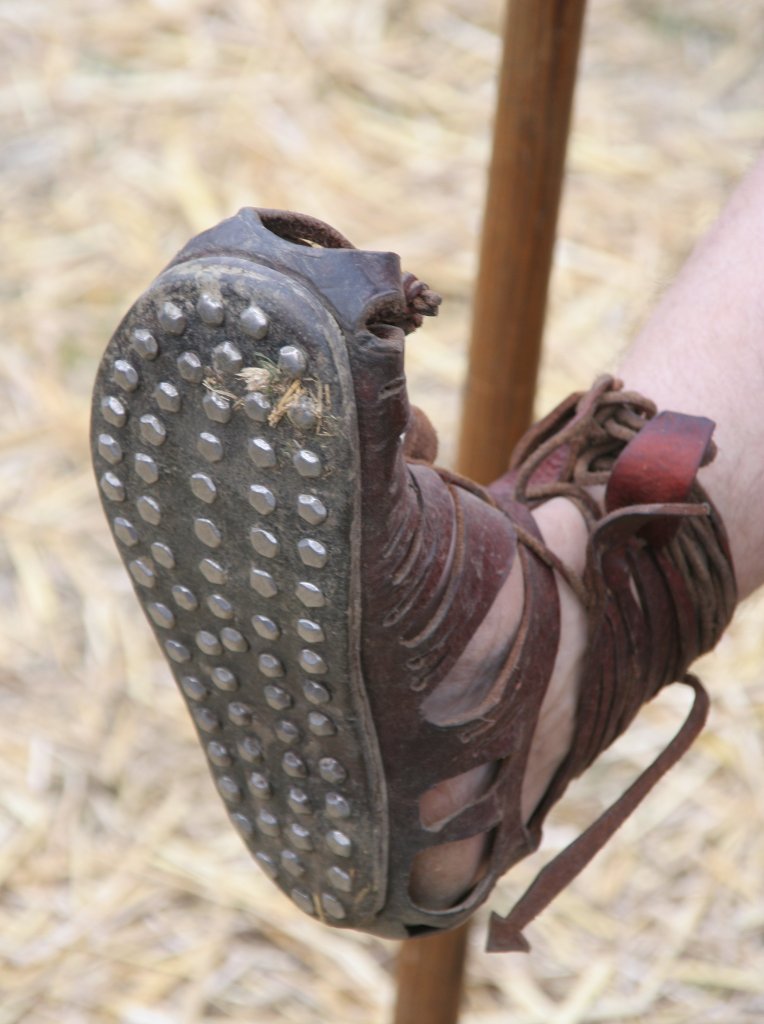
These boots provided excellent mobility to undertake long marches at incredible speed and sure footing in close quarter fighting.
In describing the Christian’s armor, Paul does not actually use the word “shoe” or “boot” in verse 15. Instead, he uses the verb that describes the action of putting on footwear (ὑποδέω / hupodeō), which I have translated as “having shod your feet“. Obviously Paul is referring to putting on military boots since his illustration is a Roman soldier.
Paul compares wearing the boots with “having a readiness that comes from the Good News“. Some commentators understand this to mean being prepared to share the Good News, which certainly is an effective way to battle the spiritual forces led by Satan. However, it is probably better to understand this to mean the readiness for battle which the Good News gives to those who believe it. (See Translation Note below.)
Why does the Good News give readiness for the battle? As Paul explains at the end of verse 15, because it is the Good News “whose message is peace“.
A principal teaching of the New Testament is the peace that is a state of reconciliation with God. Because of sin, hostility exists between God and mankind. God took the initiative to bring about peace by sending His Son, Jesus Christ, to die for sin. His death brought reconciliation and peace with God (Romans 5:1). The message about this is called the Good News or Gospel. It is sometimes also called the Good News of Peace or the Gospel of Peace (see Acts 10:36; Ephesians 2:17; Ephesians 6:15). For those who believe the Good News, the result is peace with God and also peace of mind (Romans 15:13). Based on this principal, perhaps an amplified or interpretative translation of verse 15 would be:
And having shod your feet with the readiness of mind that comes from the Good News whose message is peace.
There is a paradox in this peace:
- The believer acquires peace to be ready for war. Knowing we have peace with God gives us peace of mind and courage to stand firm in the battle.
- There is inner peace in the midst of external warfare (John 16:33; Philippians 4:7). We also have peace of mind because we know that God has everything under control.
Putting on the Good News Boots gives the believer the secure footing to hold his ground and stand firm (verse 13) in the spiritual battle.
The New English Bible’s modern translation gives a good paraphrase that captures the meaning of the verse:
Let the shoes on your feet be the gospel of peace, to give you firm footing.*
In the next post I will comment on the Shield of Faith.
*Scripture quotation taken from the New English Bible, copyright © Cambridge University Press and Oxford University Press 1961, 1970. All rights reserved.
Translation Note
I translated verse 15 as: “and having shod your feet with the readiness that comes from the Good News whose message is peace.” A word-for-word translation from Greek to English is “and having shod the feet with readiness of the Good News of peace.” You can see that I have added some additional words in my English translation to clarify the meaning of the Greek. This is typical in translation because there is often no one-to-one correspondence in ideas between languages.
The challenge in translating this verse are the phrases “readiness of the Good News” (τοῦ εὐαγγελίου) and “Good News of peace” (τῆς εἰρήνης). The words in bold are in the Greek Genitive Case and describe the words they modify. What does that mean?
Well, Greek is an inflected language that uses cases to show the grammatical function of words in a sentence. Inflections are simply spelling changes. English is not an inflected language, but it does use a few inflections such as to show singular and plural forms: cat / cats. The “s” spelling change is an inflection to show that “cats” is plural. Greek inflects virtually every word in a sentence to show its grammatical function! The basic function of the Genitive Case in Greek is to describe another word.
First year Greek students are typically taught to translate Genitive phrases with the word “of” – such as “of the Good News” and “of peace“. As they advance in Greek they learn to clarify the description. For example: “a wing of an angel” is “a wing that belongs to an angel” or “an army of angels” is “an army composed of angels“. (The English word “of” is a amazingly flexible word in meaning.)
So, in verse 15 how does “of the Good News” describe “readiness“? I see it as describing origin. It is the readiness “that comes from” the Good News. Note that the NIV, NET and ESV bibles translate this phrase as describing origin. However, some commentators see this as an objective genitive – it describes the object of the “readiness”. So they world translate it to say that the believer’s boots are his “readiness for the Good News” or his “readiness to announce the Good News“.
And how does “of peace” describe “Good News“? I see it as describing content. It is the Good News “whose message is” peace.
Here are links to all the posts for the Armor of God:
The Full Armor of God
Spiritual Opponents
Belt of Truth
Breastplate of Righteousness
Good News Boots
Shield of Faith
Helmet of Salvation
Sword of the Spirit
Pray and Stay Alert
Word Focus Lexicon
Lexical Form: ὑποδέω <Hear It>
Gloss: I bind beneath, I shod, I put on footwear
Part of Speech: Omega Contract Verb (Epsilon Stem)
New Testament Frequency: 3 (Mark 6:9; Acts 12:8; Ephesians 6:15)
Strong’s Number: G5265 (Link to Blue Letter Bible Lexicon)
Bibliography
Bromiley, Geoffrey W. (Editor). Theological Dictionary of the New Testament, Abridged. Wm. B. Eerdmans Publishing Company. 1985.
Bruce, F.F. The Epistles to the Colossians, to Philemon, and to the Ephesians (The New International Commentary on the New Testament). Wm. B. Eerdmans Publishing Company. 1984.
Danker, Frederick William (Editor). A Greek-English Lexicon of the New Testament and other Early Christian Literature, Third Edition (BDAG). The University of Chicago Press. 2000.
Earle, Ralph. Word Meanings in the New Testament. Hendrickson Publishers. 1998.
Foulkes, Francis. The Epistle of Paul to the Ephesians (Tyndale New Testament Commentaries). Inter-Varsity Press. 1956.
Gilbrant, Thoralf (Editor). The New Testament Greek-English Dictionary. The Complete Biblical Library. 1990.
Kent Jr., Homer A. Ephesians, The Glory of the Church. Moody Press. 1971.
Lincoln, Andrew T. Word Biblical Commentary, Ephesians. Word Incorporated. 1990.
Robertson, Archibald Thomas. Word Pictures in the New Testament, Volume IV. Broadman Press. 1931.
Salmond, S.D.F. The Expositors Greek Testament, Volume III. Wm. B. Eerdmans Publishing Company. 1990.
Stott, John R.W. The Message of Ephesians (The Bible Speaks Today). Inter-Varsity Press. 1979.
Wood, A. Skevington. The Expositor’s Bible Commentary, Volume 11. The Zondervan Corporation. 1978.
Unless otherwise noted, English translations of Bible verses are by the author from the Greek text and are not quotations from any copyrighted Bible version or translation.
 Koine Foundations
Leave a comment