
David Padfield/FreeBibleImages.org
10 Finally, be made strong in the Lord and in the power of His might. 11 Wear the full armor of God so that you can stand against the schemes of the Devil. 12 For our struggle is not against flesh and blood, but against the rulers, against the authorities, against the world powers of this dark domain, against the spiritual powers of evil in the heavenly realms. 13 For this reason, take up the full armor of God so that you can hold your ground in the evil day, and stand firm because you have made everything ready.
14 This being the case, take your stand having fastened truth around your waist, wearing the breastplate of righteousness, 15 and having shod your feet with the readiness that comes from the Good News whose message is peace. 16 In addition to all these*, having taken up the shield of faith with which you will be able to extinguish all the flaming arrows of the Evil One. 17 Also receive the helmet of salvation and the sword of the Spirit, which is the Word of God.
18 Take your stand praying in every situation in the Spirit by means of every kind of prayer and petition, and to this end, staying alert with all perseverance and petition for all the saints. (Ephesians 6:10-18)
*Or perhaps, “In all circumstances…” instead of “In addition to all these…“
Word Focus
the shield of faith
ὁ θυρεὸς τῆς πίστεως
ho thureos tēs pisteōs
<Hear It>
In this post I continue with comments on Ephesians 6:10 to 18 – the Armor of God. Paul uses the picture of a Roman soldier preparing for battle to teach about the spiritual conflict in which the Christian is engaged. There are forces at work attempting to defeat and destroy the believer and Paul explains the resources that will assure victory over these forces.
In verses 14 to 17, Paul lists six pieces of spiritual armor that God provides and relates them to an ethical quality or virtue. They are set out and described in the order in which a soldier would dress himself for battle. The fourth piece of the armor described by Paul is the Shield of Faith in verse 16:
In addition to all these, having taken up the shield of faith with which you will be able to extinguish all the flaming arrows of the Evil One.
The shield was an essential part of the the Roman soldier’s armor. The Greek historian Polybius (c. 200 BC to c. 118 BC) describes it in his work called The Histories. He writes that the complete armor consisted of…
“first, a large shield, the surface of which is curved outwards, its breadth two and a half feet, its length four feet… It consists of two layers of wood fastened together with bull’s-hide glue; the outer surface of which is first covered with canvas, then with calf’s skin. On the upper and lower edges it is bound with iron to resist the downward strokes of the sword, and the wear of resting upon the ground. Upon it also is fixed an iron boss, to resist the more formidable blows of stones and pikes, and of heavy missiles generally.” (Polybius, The Histories, 6.23 – read more of his account at this link.)
Weighing around 20 pounds, the shield was light enough to be held in one hand. The iron boss in the center of the shield could deflect the blows of a sword but also be used as a punching weapon against an enemy combatant.
The shield covered the soldier from the shoulder to the knee and provided protection in close quarter combat and from projectiles such as arrows and pila (javelins).
Arrows always posed a dangerous threat to the soldier. A dramatic example is found in the historical account of the Battle of Dyrrhachium in 48 BC between Julius Caesar and Pompey for control of the Roman Republic. From the account we learn that centurion Cassius Scaevus was hit in the eye by an arrow, among other injuries. He pulled the arrow from his eye socket and continued to fight to victory. After the battle he counted over 200 arrows in his shield! In this particular engagement of the battle involving just 400 Roman soldiers under his command against 6000 enemy troops, the account estimates that about 30,000 arrows were shot at his soldiers. This illustrates Paul’s urging for believers to take up the full armor in order to “hold your ground” and “stand firm” in the spiritual battle (verse 13), even against overwhelming forces.
[Click here to see a 7 minute YouTube video about the life of Cassius Scavus that focuses on the Battle of Dyrrhachium.]
Paul’s mention of “flaming arrows” refers to the military tactic of firing flaming projectiles into enemy defensive positions and ships. This was an effective way to set fire to the enemy fortifications and equipment. The use of flaming projectiles is recorded in historical accounts. For example, the Greek historian Thucydides (c. 460 BC – c. 400 BC) mentions burning missiles in his account of the Peloponnesian War. And the Roman historian Livy (59 BC – AD 17) notes the use of flaming javelins. (Thucydides, The Peloponnesian War 2.75.5 – see verse 5; Livy, The History of the Romans, 21:8 – see verses 9 to 12. Read more of their accounts at these links.)
The shield prevented the flaming projectiles from hitting the soldier, and the leather covering would not easily burn. The arrows would either be knocked down to the ground or burn themselves out on the shield.
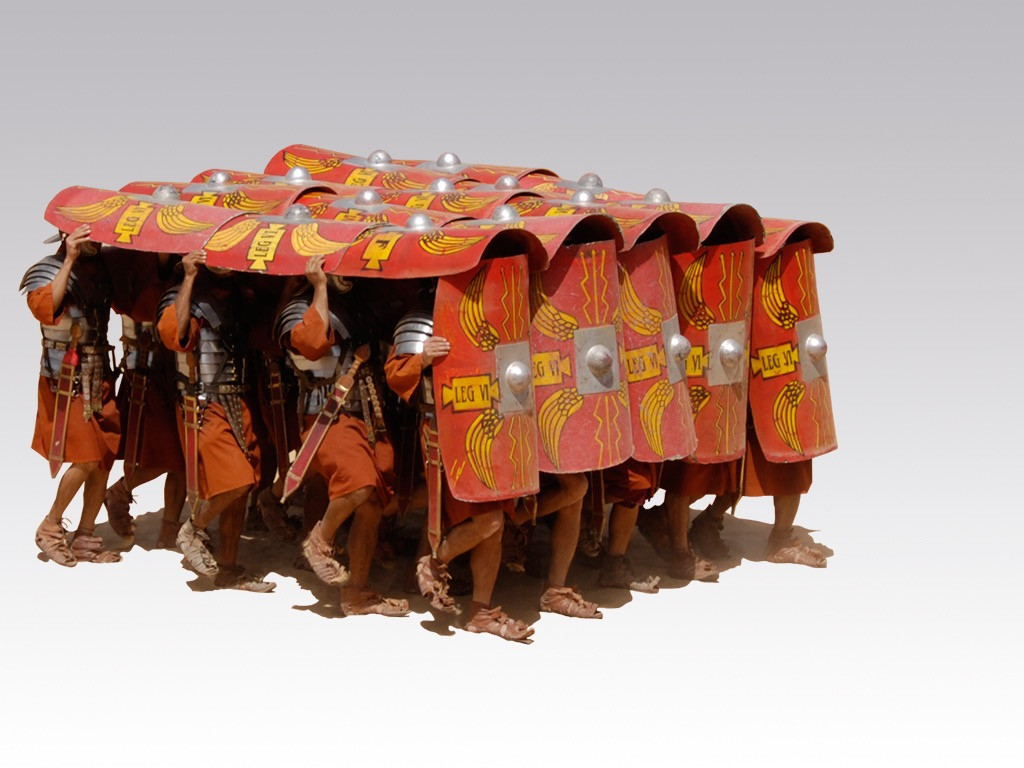
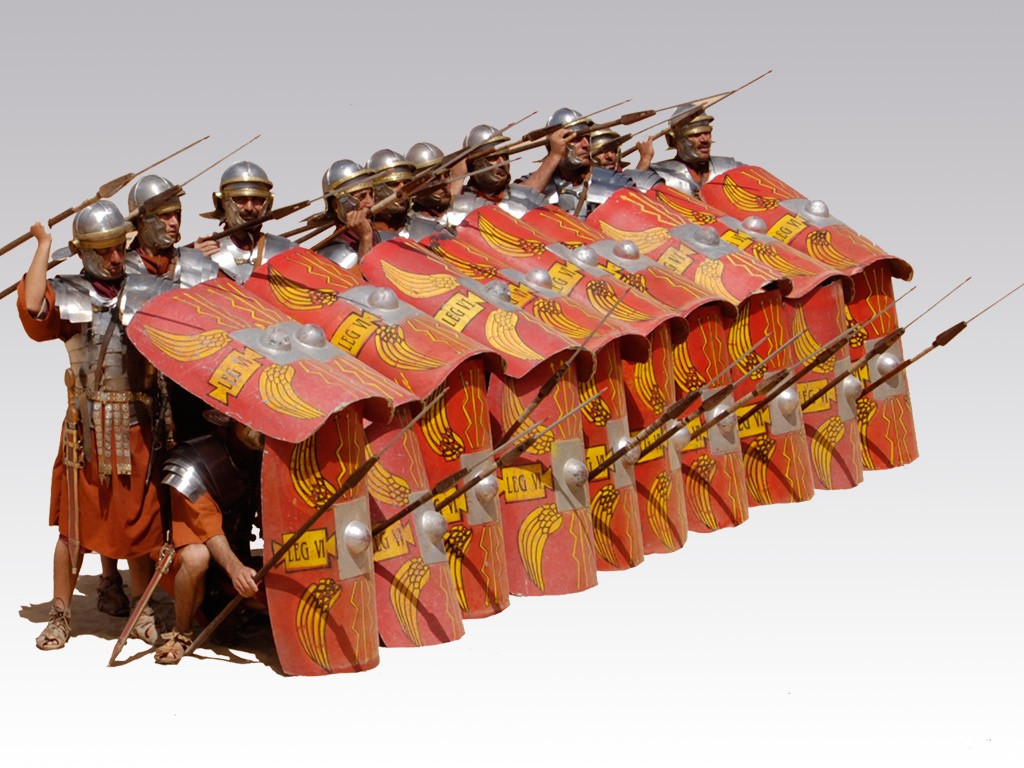
Shields could also be combined to form a shield wall known as a testudo or tortoise formation as shown in the images below. It was effective at protecting soldiers from infantry and projectiles.
David Padfield/FreeBibleImages.org
David Padfield/FreeBibleImages.org
Paul begins his discussion of the shield (θυρεός / thureos) by saying “in addition to all these“, referring to the items of armor he had just listed. This is a translation of the Greek prepositional phrase ἐν πᾶσιν / en pasin. It is also possible to translate the Greek as “in all circumstances“. Of the modern English translations, the NASB, NIV and LSB use the former, and the ESV and CSB use the latter. I choose the former translation because it fits with the sense of verse 16 – because of the nature of the spiritual warfare more armor is needed for complete protection. The shield is needed “in addition to” all the other pieces of armor to protect them and the soldier from flaming arrows. The body armor is useless without the shield to protect it. E.F. Scott suggests in his commentary that the sense of the phrase is “to cover all the rest“.* You can see in the images above how the large shield covers the soldier.
Paul describes the shield as the “shield of faith” (ὁ θυρεὸς τῆς πίστεως / ho thureos tēs pisteōs). So, it is faith that acts as the shield to cover all the rest. Faith is placing one’s confidence in a trustworthy person, thing, or body of truth (it is not a blind faith). God and His Word are trustworthy, and so the Christian soldier uses the shield of faith by laying hold of the power of God and the promises of God. The power of God is available by maintaining a close personal relationship with God. The promises of God are claimed by studying and living by God’s Word, the Bible.
The shield is the only piece of armor for which Paul gives a specific reason for its use: “with which you will be able to extinguish all the flaming arrows of the Evil One“.
Metaphorically, “flaming arrows” are one of the “schemes of the Devil” (verse 11) which probably represent things that assault the believer’s faith, such as: doubt, fear, disappointment, despair, false guilt, criticism by others, temptations to sin, hatred, envy, disunity, and false teaching. Through these and many other “flaming arrows” the Evil One and his forces attempt to destroy believers or at least make them ineffective in their Christian lives. However, faith lays hold of the power and promises of God “to extinguish all the flaming arrows” – to render them harmless.
The shield of faith provides protection so that the Christian warrior can hold his ground and stand firm (verse 13) with confidence knowing that deadly arrows will be stopped and extinguished.
In the next post I will comment on the Helmet of Salvation.
*Scott, E.F. The Epistles of Paul to the Colossians, to Philemon and to the Ephesians. Hodder and Stoughton. 1930. Page 253.
Here are links to all the posts for the Armor of God:
The Full Armor of God
Spiritual Opponents
Belt of Truth
Breastplate of Righteousness
Good News Boots
Shield of Faith
Helmet of Salvation
Sword of the Spirit
Pray and Stay Alert
Word Focus Lexicon
Lexical Form: ὁ θυρεός θυρεοῦ <Hear It>
Gloss: shield
Part of Speech: Second Declension Masculine Noun
New Testament Frequency: 1
Strong’s Number: G2375 (Link to Blue Letter Bible Lexicon)
Lexical Form: ἡ πίστις πίστεως <Hear It>
Gloss: faith, trust, faithfulness, reliability, fidelity, belief
Part of Speech: Third Declension Feminine Noun
New Testament Frequency: 243
Strong’s Number: G4102 (Link to Blue Letter Bible Lexicon)
Bibliography
Bromiley, Geoffrey W. (Editor). Theological Dictionary of the New Testament, Abridged. Wm. B. Eerdmans Publishing Company. 1985.
Bruce, F.F. The Epistles to the Colossians, to Philemon, and to the Ephesians (The New International Commentary on the New Testament). Wm. B. Eerdmans Publishing Company. 1984.
Danker, Frederick William (Editor). A Greek-English Lexicon of the New Testament and other Early Christian Literature, Third Edition (BDAG). The University of Chicago Press. 2000.
Earle, Ralph. Word Meanings in the New Testament. Hendrickson Publishers. 1998.
Foulkes, Francis. The Epistle of Paul to the Ephesians (Tyndale New Testament Commentaries). Inter-Varsity Press. 1956.
Gilbrant, Thoralf (Editor). The New Testament Greek-English Dictionary. The Complete Biblical Library. 1990.
Kent Jr., Homer A. Ephesians, The Glory of the Church. Moody Press. 1971.
Lincoln, Andrew T. Word Biblical Commentary, Ephesians. Word Incorporated. 1990.
Robertson, Archibald Thomas. Word Pictures in the New Testament, Volume IV. Broadman Press. 1931.
Salmond, S.D.F. The Expositors Greek Testament, Volume III. Wm. B. Eerdmans Publishing Company. 1990.
Scott, E.F. The Epistles of Paul to the Colossians, to Philemon and to the Ephesians. Hodder and Stoughton. 1930.
Stott, John R.W. The Message of Ephesians (The Bible Speaks Today). Inter-Varsity Press. 1979.
Wood, A. Skevington. The Expositor’s Bible Commentary, Volume 11. The Zondervan Corporation. 1978.
Unless otherwise noted, English translations of Bible verses are by the author from the Greek text and are not quotations from any copyrighted Bible version or translation.
 Koine Foundations
Leave a comment