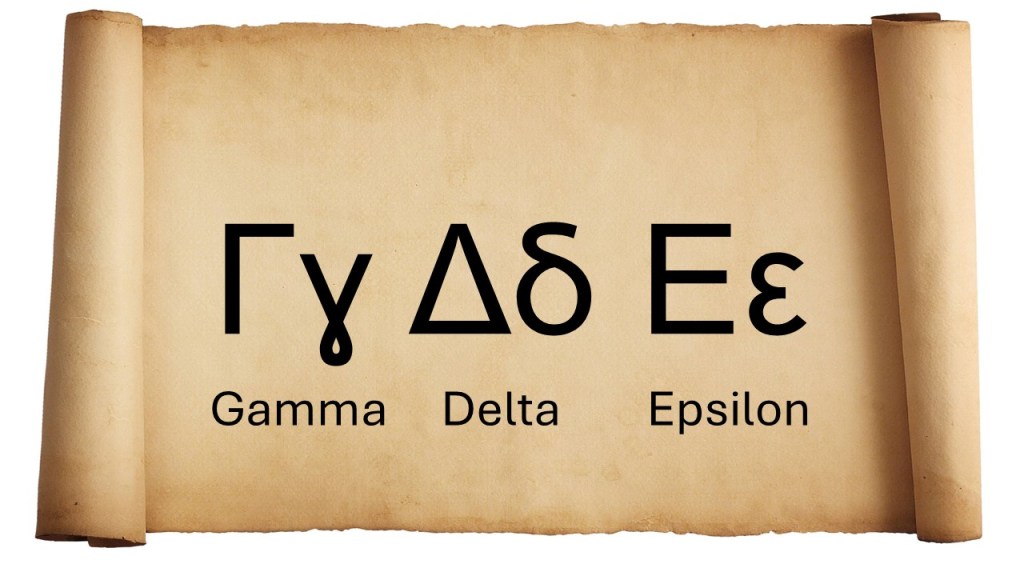
Lesson 4: This post is the fourth in a series that explains how to pronounce the Koine Greek alphabet and Greek words. Each post explains three Greek letters and provides example words that contain only the letters covered to that point. This post explains the letters gamma, delta, and epsilon, and accent marks.*
ɣάμμα / gamma
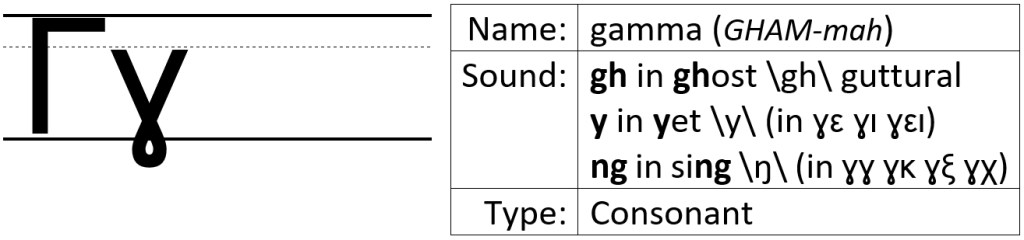
Gamma is the most complex letter in regard to sound because it represents three different sounds: gh, y and ng. All three of these sounds are common in words. You will easily learn them as you learn vocabulary words. In this post you will learn the primary sound and you will learn the other two sounds in Lesson 7 and Lesson 11.
The primary sound of gamma is like the gh in the English word ghost, but with a guttural sound formed at the back of the throat.
In modern printed texts, the lower-case Gamma often looks similar to the English lower-case y: γ. But in my examples I will use the more traditional form ɣ.
δέλτα / delta

Delta is somewhat similar in appearance to the upper-case and lower-case D/d in the English alphabet.
However, delta sounds like the th in the English word then. It does not have a hard “d” sound as in English.
The deposits of soil and sand at the mouth of a river are called a delta because of their triangular shape that resembles the upper-case letter Delta.
ἒ ψιλόν / epsilon

Epsilon is similar in appearance and sound to the upper-case and lower-case E/e in the English alphabet. As shown above, the lower-case form can be written two different ways. The ε form is used in many modern printed texts. The ϵ form was sometimes used by scribes in ancient texts.
Epsilon is a vowel and always sounds like the e in the English word end.
The name “epsilon” was coined in the Middle Ages and means “simple e”.
Accent Marks
In English, many words have a syllable that is accented or stressed. We learn where English words are accented as we hear them spoken by other native speakers, such as our parents.
Greek words also have accents. In ancient Greek, accents were probably tonal rather than stress. Scholars believe that the accent was a musical rising and falling of the voice.
As the Greek language spread because of the conquests of Alexander the Great and bumped up against other languages, the tonal accent gradually changed. By the time of Jesus in the first century, the Koine Greek accent was probably a simple stress accent just like in English.
Because the rules of accenting Greek words were complex, sometime around 200 BC, accent marks were developed to help non-native speakers know where to accent words. However, accent marks were not consistently written in manuscripts until 800 years later.
Modern printed editions of ancient Greek texts, such as the works of the philosopher Aristotle or the New Testament, have accent marks. So, you will know where words are accented as you read the text.
Here are some basic points about accent marks. Because accents marks are provided for you in printed texts, this information is FYI only.
- There are three types of accent marks: acute (ά), circumflex (ᾶ), and grave (ὰ) (“grave” rhymes with “mauve”).
- Almost every word has an accent mark.
- Occasionally a word will have two accent marks.
- Accent marks are always placed over vowels.
- Accent marks can only occur on the last three syllables of a word.
- In a word beginning with a vowel, there may be a breathing mark and an accent mark over the same vowel (example: ἄɣω).
Here is how to handle the accent marks as you pronounce a word:
- Acute Accent (ά): Stress the accented syllable and return to normal voice on the next syllable.
- Circumflex Accent (ᾶ): Stress the accented syllable and return to normal voice on the same syllable.
- Grave Accent (ὰ): No stress on accented syllable if speaking at normal speed. Slight stress if speaking slowly.
Example Words
Practice saying the example words to learn the sounds represented by the alphabet letters in this lesson.
ἄɣω
I lead, bring, go
[verb]
Notice the smooth breathing mark and acute accent over the beginning alpha. The smooth breathing mark does not affect how the word is pronounced. The acute accent shows that the stress is on the first syllable.
English Derivatives: Pedagogue – a person who teaches or leads a child. Agent – a person who acts (goes) on behalf of another person.
Example Verse: Then Pilate went outside again and said to them, “Look! I am bringing Jesus out to you, so that you will know that I find nothing worthy of punishment in Him.” (John 19:4)
ὧδε
here
[adverb]
Notice the rough breathing mark and circumflex accent over the beginning omega. The rough breathing mark does not affect how the word is pronounced. The circumflex accent shows that the stress is on the first syllable.
Example Verse: The disciples said to Jesus, “We have nothing here except five loaves of bread and two fish.” And He said, “Bring them here to me.” (Matthew 14:17-18)
ἐɣώ
I
[personal pronoun]
This is the first person, singular, personal pronoun that is used as the subject of a verb. Notice the smooth breathing mark over the beginning epsilon. The smooth breathing mark does not affect how the word is pronounced. The acute accent shows that the stress is on the final syllable.
English Derivative: Ego, egocentric.
Example Verse: Jesus said to him, “I (ἐɣώ) am the way and the truth and the life. No one comes to the Father, except through me.” (John 14:6)
Jesus makes a bold and profound claim in this verse. He does not simply show us the way to a relationship with God, He claims that He is the way. He is the only way to God.
Practice & Review
ἀββά
father
ἄɣω
I lead, bring, go
ὧδε
here
ἐɣώ
I
The table below shows the Greek alphabet in order from alpha to omega. Verbs are highlighted in yellow. Lower-case sigma, highlighted in blue, has two forms.

Here are two options to hear the the entire Greek alphabet recited:
- Click here to listen to a 30 second audio file of the alphabet.
- Click here to view a 1 minute video of the alphabet.
*Symbols enclosed in left slashes such as \ä\ are Merriam-Webster Pronunciation Symbols. These are the standard pronunciation symbols used in the Merriam-Webster dictionary. They are provided as another way to know the sound of each Greek letter. Click here for a downloadable PDF document that explains the symbols and includes a one-page chart on the last page. They are also explained in any hardcopy edition of the Merriam-Webster dictionary.
Bibliography
Danker, Frederick William (Editor). A Greek-English Lexicon of the New Testament and other Early Christian Literature, Third Edition (BDAG). The University of Chicago Press. 2000.
Unless otherwise noted, English translations of Bible verses are by the author from the Greek text and are not quotations from any copyrighted Bible version or translation.
© Copyright 2022 by Matthew Jones
koinefoundations@gmail.com
 Koine Foundations
Leave a comment